
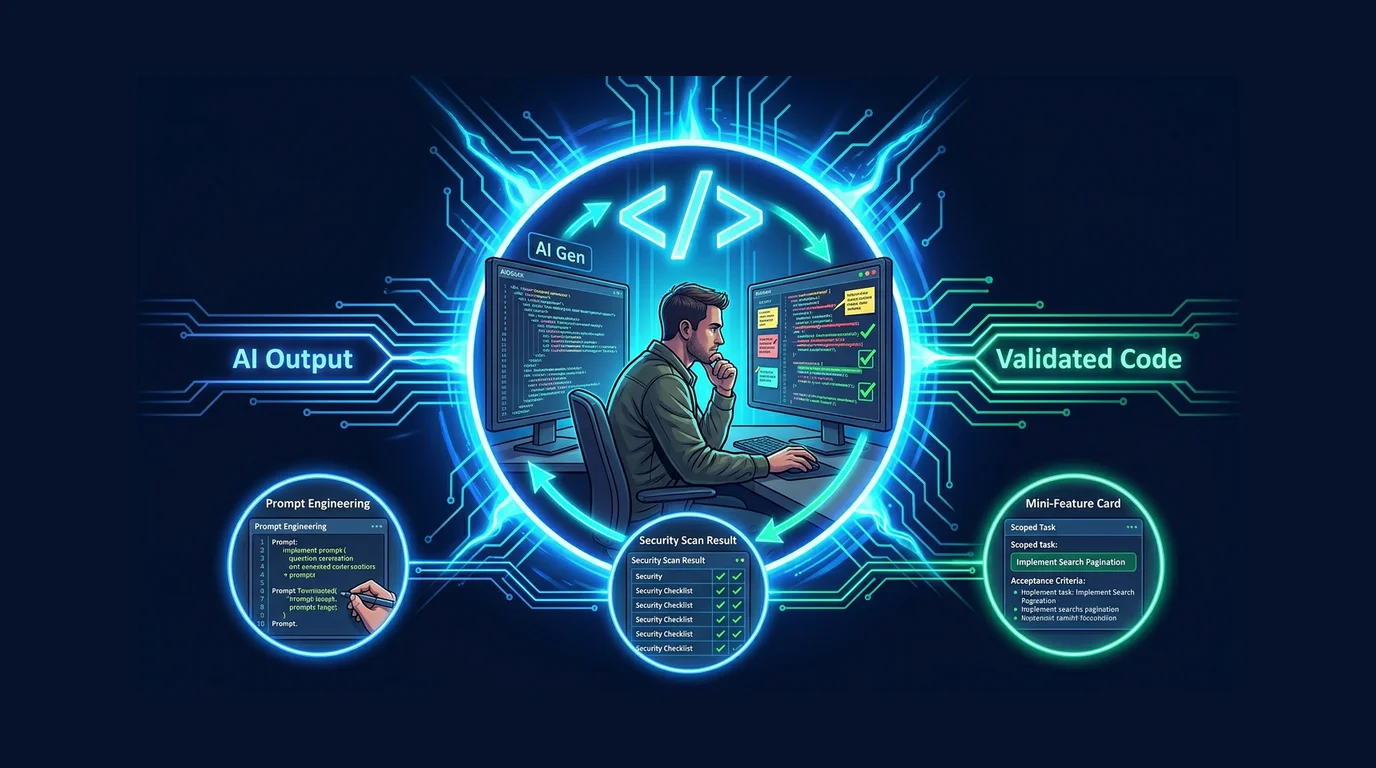
The team’s AI coding tools are live. First week: output is genuinely impressive, PR count is up, everyone’s excited.
At the sprint review, the board looks the same.
Half the PRs are still waiting on review. Several came back with QA flags. A few were blocked by a requirements question nobody had answered. The code was faster. The sprint wasn’t.
This is where most vibe coding rollouts stall. Not because the tools don’t work - they do. But because the developer changed how they work and everything around the developer didn’t. This post is about what actually has to shift at the developer level - and what traps to watch for along the way.
This is Post 1 in the Vibe Thinking series. If you haven’t read the intro yet, start there - it explains why developer-only transformation doesn’t move the sprint.
What Actually Changes in a Developer’s Day
The most visible change is the obvious one: you write less raw code. You describe intent, steer output, review and validate. You direct the AI rather than type every line yourself.
But that framing undersells what actually shifts.
The developer’s role moves from author to architect-and-reviewer. That’s a meaningful change in what the job demands - and a more cognitively complex one than it sounds.
Authoring is generative: you build something from scratch, making decisions sequentially.
Reviewing and directing is evaluative: you hold the whole picture in your head while assessing whether the output matches it, catching what’s wrong, knowing why it’s wrong, and steering toward what’s right.
That’s a harder mental model to sustain. Not harder in the “this takes more effort” sense - harder in the “this requires genuine expertise to do well” sense.
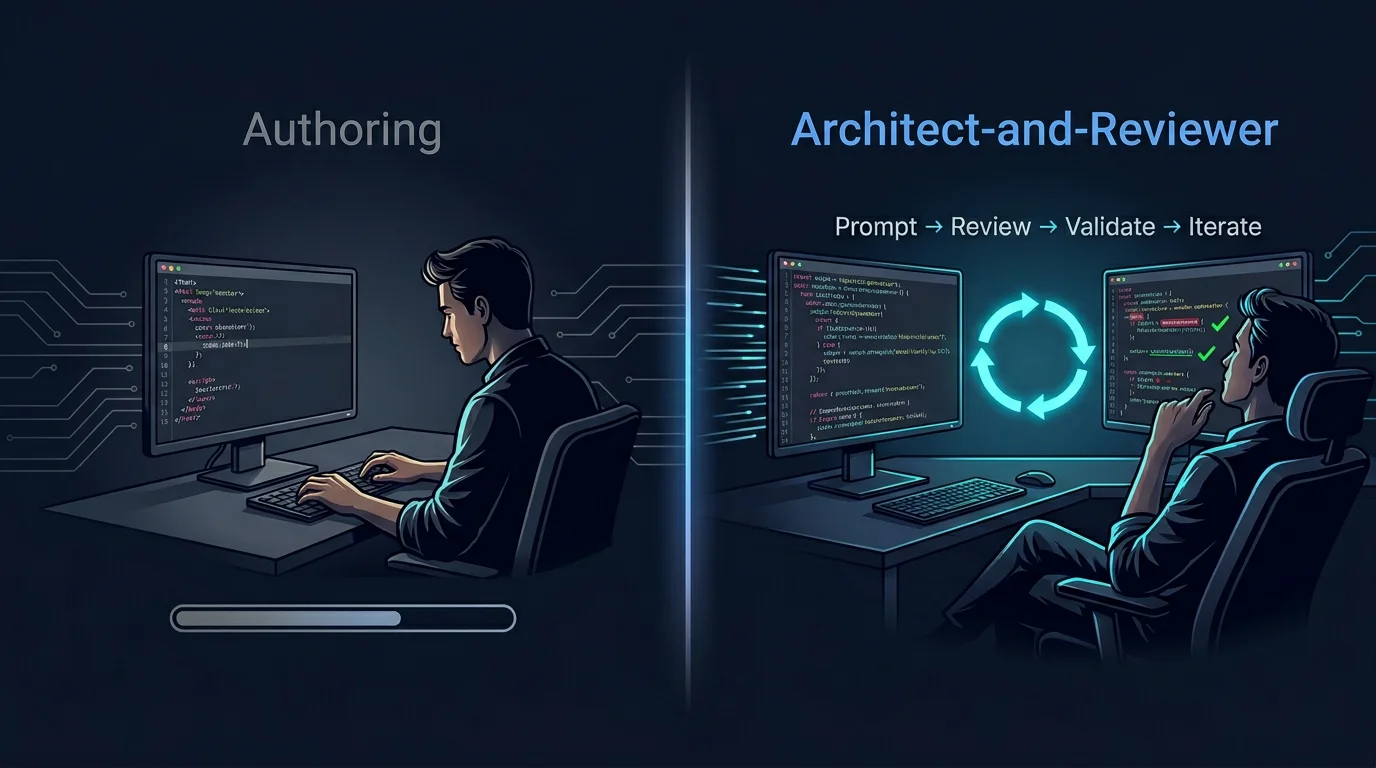 The workday rhythm shifts from long linear writing sessions to tight iterative feedback loops - each cycle shorter, each requiring fresh evaluative judgment from the developer.
| Authoring (before) | Architect-and-Reviewer (now) |
|---|---|
|
|
What also changes: the shape of a workday. Instead of long stretches of focused writing, you’re working in tighter feedback loops - prompt, review, validate, iterate, prompt again. The rhythm is different - more fragmented, less linear.
What Doesn’t Change
Working hours don’t change. Neither does accountability for output quality, or the real cost of bad code in production.
You own every line of code that gets merged, regardless of who - or what - wrote it. If AI-generated code causes a production incident, the developer who reviewed and approved it is accountable. That’s how professional engineering works.
The cost of technical debt doesn’t change either. Vibe coding can accumulate debt faster than traditional development if the review layer is weak - because the output volume is higher and the patterns are harder to spot. More code arriving faster with the same or weaker validation is worse, not better.
And the requirement to deeply understand what you ship doesn’t change. If you can’t explain why a piece of code works, you can’t debug it when it breaks, extend it confidently, or defend it in a code review. Never merge what you can’t reason through. That rule gets more important, not less, when AI is generating the code.
The Review Burden Reality
Here’s something that surprises a lot of developers when they first move to vibe coding at pace: the review workload goes up, not down.
More code is being produced. Every line of it needs to be understood, validated, and owned before it merges. If you’re generating 3x the code output, you need 3x the review rigour - or you’re accumulating risk at 3x the previous rate.
The review step is where most of the value is created or destroyed in a vibe coding workflow. A developer who generates fast and reviews carelessly is a liability generator. I’ve seen orgs celebrate PR velocity for a full sprint before anyone noticed quality had stopped being verified.
Review is the craft now. Prompt engineering gets the code to a draft. Review is where the developer’s expertise actually shows up.
What to Let Go Of
Some developer habits made complete sense before AI coding tools existed. They don’t anymore.
The hero coder identity. The developer who writes every line from scratch, who holds the entire codebase in their head, who is the single source of truth for how everything works. That identity served a purpose - it was how craft was recognised and rewarded. In a vibe coding world, it drives under-use of tools (protecting the identity) or over-reliance without critical review (abandoning the expertise that makes the identity worth having). The new identity is architect-and-reviewer. The craft is in the judgment, not the typing.
Typing speed as the measure of output. It was always a proxy for the wrong thing, and that hasn’t improved. Output quality and delivery velocity are what matter.
Waiting for complete requirements before starting. The instinct to wait for a fully specified brief made sense when starting meant committing significant time and rework was expensive. Vibe coding changes the economics of starting - but it doesn’t mean starting on vague work. The right model is to decompose first.
Big-batch sprint work. Large features developed over a full sprint and released in one push are higher risk and slower to validate in a world where you can build faster. Continuous small increments replace the big-batch approach - not because of any planning philosophy, but because the economics of how code gets built have changed.
Gold-plating before shipping. Merge the working atomic feature, validate, and iterate. The instinct to perfect before releasing is understandable - but in a vibe coding workflow it creates inventory, not quality.
| Let Go Of | Replace With |
|---|---|
|
|
The Atomic Feature Model
The right unit of work in a vibe coding workflow is an atomic feature - a chunk of work that’s independently specifiable, buildable, testable, and ready to hand off for review and testing within a single session.
Here’s what makes something a good atomic feature:
- You can write the outcome in one sentence
- The acceptance signal is unambiguous - either it works or it doesn't
- You can build and validate it without waiting for other work to complete
- If requirements change later, only this chunk is affected - not everything downstream
This decomposition step should happen before the first prompt is written. A PM or BA who understands vibe coding writes work items already decomposed into atomic features. A well-structured LLM with enough system context can also assist with decomposition. The developer still owns validating the decomposition before building. Whether the atomic features came from the PM or were AI-suggested, the developer needs to confirm the slicing makes sense architecturally - that each chunk is truly independent, that dependencies are understood, that integration points don’t create hidden coupling. That review requires genuine knowledge of the system. That’s the expertise vibe coding doesn’t replace.
Take a real example. “User login with Google OAuth” is not an atomic feature - it’s a feature. Built as one prompt, it becomes a tangled output that’s hard to review and harder to debug. Decomposed properly, it becomes three independently buildable chunks:
| Atomic Feature | Outcome | Independent? |
|---|---|---|
| OAuth Callback Handler | Server receives the callback, exchanges code for token, retrieves user profile | ✓ Yes - testable with a mock profile |
| Session Creation & Storage | On successful auth, creates a server-side session, sets a secure cookie, returns user to intended page | ✓ Yes - testable with a hard-coded mock user before OAuth is wired in |
| Login Error States | Handles cancelled auth, expired tokens, account-not-found - displays appropriate messages | ✓ Yes - all paths simulatable without a live OAuth flow |
Each chunk can be built in a single session, validated against a clear acceptance signal, and reviewed as a unit. If something fails during review or testing, the issue is contained to one chunk - not the entire login flow.
That containment is the architectural value of decomposition - and it’s a judgment call the developer makes, not the AI.
The New Craft
Three skills define what it means to be a great developer in a vibe coding workflow.
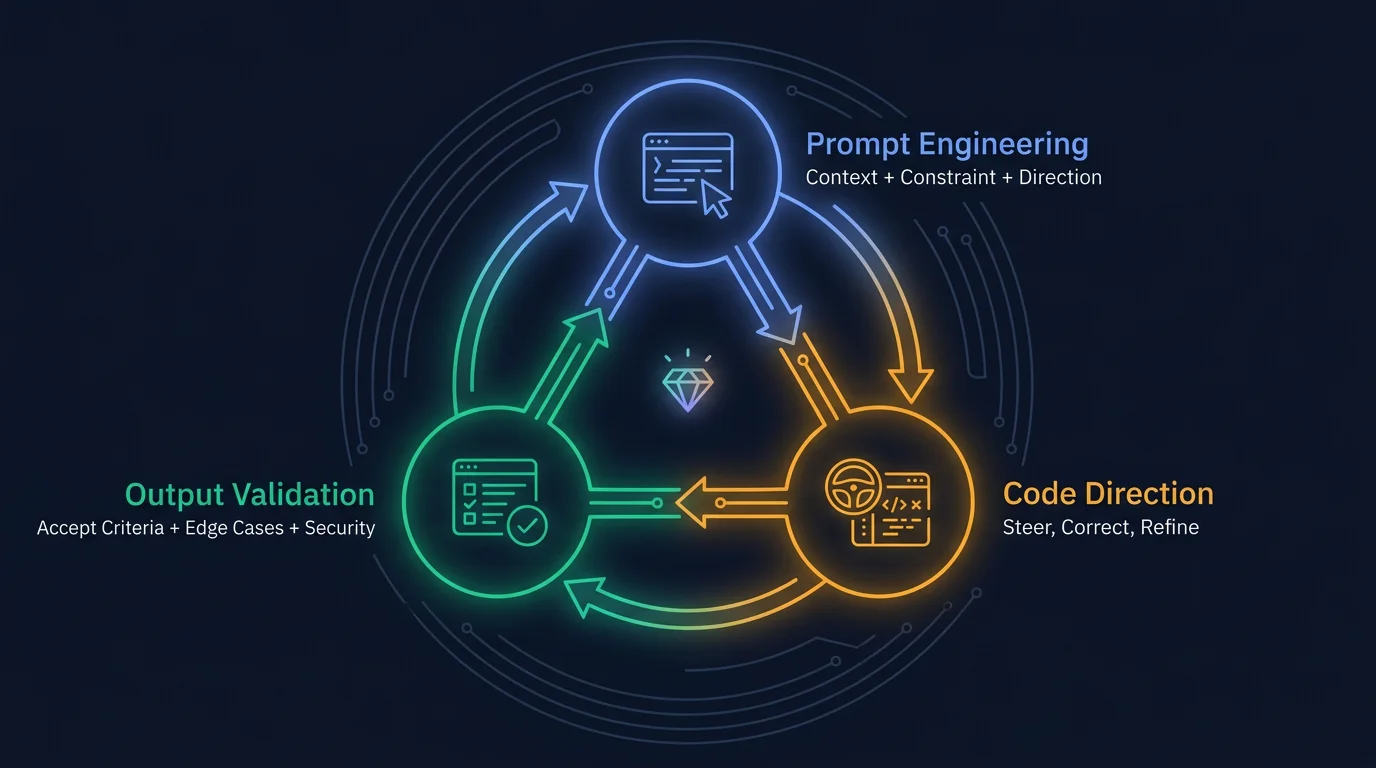 Three skills, one continuous loop. Prompt to get close, direct to refine, validate before it merges. The cycle repeats until the output is exactly what was intended - and the developer can explain every line.
Prompt Engineering
Giving the AI enough context, constraint, and direction to produce output that’s close to right on the first pass. This is not a trivial skill - it takes practice, domain knowledge, and understanding of how models behave. A vague prompt produces vague output. The difference is concrete:
| Vague Prompt | Precise Prompt |
|---|---|
|
"Add a rate limiter to the API." What you get:
Each gap becomes a review finding or a production bug. |
"Add rate limiting to
The effort is in the prompt - not in fixing the output. |
Code Direction
The ability to steer iteratively. When the output is 80% right, knowing exactly what to change and how to instruct the model to correct it - without losing what’s already right. This requires genuine understanding of the code, which is why “never merge what you can’t explain” is foundational. If you don’t understand the output well enough to direct corrections precisely, you’re just hoping the model corrects itself.
Output Validation
The structured practice of verifying that AI-generated code does what it’s supposed to do, doesn’t do what it shouldn’t, is secure, and is maintainable. Not a skim-read. Not a quick run. A deliberate pass against the acceptance criteria, the edge cases, and the security posture.
These three skills together are the new craft. They’re hard to develop, impossible to fake at the review stage, and more transferable across domains than raw typing speed ever was.
The Psychological Shift
The skills shift is visible and documentable. The psychological one is harder to pin down.
The antidote isn't pretending the identity shift doesn't hurt. The architect-and-reviewer is not a lesser version of the author. The judgment required to direct AI well, review its output rigorously, and own the outcome under pressure is a more sophisticated form of the same craft - applied at a different level.
The way to close this gap is rigorous review practice, not avoidance. Understand every line before it merges, not after it breaks.
Ownership must be named, not inferred. The developer who prompted and reviewed it, stated at the end of every session, logged - non-negotiable.
The Stack Overflow 2025 Developer Survey found that 46% of developers actively distrust the accuracy of AI output - and only 3% highly trust it. That distrust is rational. It's the comprehension gap showing up as a slow erosion of confidence in your own ability to validate what's in front of you.
Vibe Coding Without Discipline Burns People Out
Vibe coding is cognitively exhausting in a way that’s different from traditional development - and that difference matters for how teams need to be structured and how individuals need to manage their time.
The Discipline Layer
Teams that sustain vibe coding handle these pressure points differently from teams that burn out within two sprints.
| Protect deep-work blocks | 2-3 hours of uninterrupted coding. Standups at the start or end of the day - not in the middle. Async-first communication during coding hours. The interruption cost in a vibe coding workflow is at least as high as traditional development - probably higher, because the feedback loop is tighter and context is more ephemeral. |
| Atomic feature sessions, not marathon builds | Each atomic feature is a complete cognitive unit with a defined finish line. When it's validated and merged, the session is done. This gives the workday shape - a sequence of completions rather than one continuous open-ended effort. Completions are restorative in a way that ongoing work is not. |
| Review discipline, not review volume | First-pass triage - syntax issues, security vulnerabilities, style violations - should not be a human job. That's the job of automated tooling. Human reviewers should focus on architecture, outcome judgment, and correctness reasoning. Protecting that boundary protects reviewer capacity and prevents rubber-stamping. |
| Deliberate skill maintenance | One session per week - or fortnight at minimum - solving a non-trivial problem without AI assistance. Think of it as drilling fundamentals: an athlete doesn't abandon the basics just because their equipment improved. The core reasoning skills that make vibe coding effective are exactly the skills that atrophy if they go unused. |
| Named ownership, every session | At the end of every session, state who owns the code - the developer who prompted and reviewed it, not the team and not the AI. Write it down. This practice prevents the accountability vacuum and the production-incident chaos that follows it. |
| Recovery between sessions | After a deep vibe coding session, the next task should be a different kind of work - reviewing documentation, a planning conversation, a design discussion. Recovery is what makes the next session high quality. |
The Security Dimension - AI Code Fails Security Tests at Scale
The numbers in this section are uncomfortable, but they belong in any honest account of vibe coding.
Why does this happen? AI models are trained on code that exists in the world. A lot of that code is insecure. The model learns to reproduce the patterns - including the insecure ones - because it’s optimising for functional correctness, not security posture. It doesn’t know the difference between a pattern that works and a pattern that works but exposes a SQL injection vector.
This is a developer-level problem before it’s a QA or governance problem. The first line of defence is the developer reviewing the output. Which means the developer needs to know what to look for - and needs the tooling to surface what they miss.
Never merge code you can’t explain. That rule matters twice as much here. If you can’t articulate why a piece of code does what it does, you can’t assess whether it does something unsafe. The comprehension gap is a quality risk and a security risk in equal measure.
Shadow IT is part of this picture too. Vibe coding has lowered the barrier to building software so significantly that non-technical users - in marketing, operations, finance - are now shipping applications. Often without any security review, without engineering oversight, and outside the governance structures that exist for a reason. Developers and engineering leads need to know this is happening and flag it.
At vibe coding pace, manual security review can’t keep up - automated tooling is structural, not optional. When developers are generating code in tight feedback loops, human reviewers can’t catch every security issue on first pass. The answer is to ensure automated security tooling intercepts every PR before a human reviewer sees it. Static analysis tools that flag OWASP-class vulnerabilities automatically, dependency scanners that catch insecure packages, and code review agents that surface issues with ready-to-apply fixes form the first-pass layer that no human reviewer can sustain at volume. This is exactly what “Review discipline, not review volume” means in practice: protect the human reviewer for judgment calls - use automation for detection.
What the Developer Needs From Everyone Else
A developer operating well in a vibe coding workflow needs three things from the rest of the org:
Well-decomposed work items. Atomic features, not vague briefs. The PM’s job is to write with precision. The developer shouldn’t spend the first hour of every session reverse-engineering what was actually wanted. (That’s the Post 2 problem - and it’s next.)
Fast review cycles. If PRs sit in a queue for two days, the developer’s output is blocked regardless of how fast they built it. Review turnaround needs to match development pace - which means automated first-pass tooling and clear human reviewer focus.
Uninterrupted coding time. Deep-work blocks need to be protected at the team level, not just the individual level. A culture that values meeting presence over coding focus will neutralise every developer-level vibe coding gain within a sprint.
When these three things are missing, the developer can vibe code as well as possible and the sprint still won’t move.
Working With Flytebit
At FLYTEBIT TECHNOLOGIES, Vibe Coding Transformation is a structured engagement - not a workshop and a tool licence.
Two of our products directly address the developer-layer constraints that vibe coding makes visible.
DOCKR is an AI-powered documentation automation platform built for codebases that move fast. Connect your repository once - DOCKR analyses your code and auto-generates living documentation: architecture diagrams, component maps, and dependency graphs, refreshing automatically on every push via webhook. No developer effort after setup; documentation stays current and accurate across 11 programming languages without anyone having to write it. Know more ↗
PASSR intercepts every PR and commit automatically - reviewing across eight dimensions (Performance, Availability, Security, Scalability, Architecture, Error Handling, Code Quality, Testing) and delivering each finding with a description, impact, and ready-to-apply fix before any human sees the diff. Merge protection blocks critical PRs; the portal tracks quality trends across all repos. Know more ↗
Not sure where your organisation stands today? The Vibe Coding Transformation Readiness Quick Check takes five minutes and gives you a per-function view of where your pipeline is most exposed.
If your team has already rolled out AI coding tools and the developer layer feels faster but the sprint hasn’t moved, let’s talk.
What’s in This Series
POST 0 Everyone
What’s Next
The developer layer is only one piece. Our AI software engineering services cover architecture, delivery, and governance across the full pipeline.
Related Reading
The series intro:
👉 Vibe Thinking - The Full Org Transformation
Why developer-only vibe coding doesn’t change the sprint - and what has to shift across every function.
On documentation at speed:
👉 The Developer’s Dilemma: Why Your Documentation Is Always Outdated
Why documentation rots the moment you finish writing it - and why that problem gets worse as development speed increases.
On AI rollout failure patterns:
👉 The 5 Biggest AI Implementation Mistakes - and How to Avoid Them
The patterns that cause AI rollouts to underdeliver - including the developer-layer mistakes that are easiest to make.
Key Takeaways
- ✅ The developer's role shifts from author to architect-and-reviewer: That's a more cognitively demanding identity - not a lesser one. The craft is in the judgment, not the typing.
- ✅ Review is the craft now: Prompt engineering gets code to a draft. Review is where expertise shows up. Never merge what you can't reason through.
- ✅ More code output means more review responsibility, not less: The review workload increases with AI tools - and so does the accountability for what gets merged.
- ✅ The atomic feature model is the right unit of work: Independently specifiable, buildable, testable, and ready for review within one session. Decompose before you prompt. Validate the decomposition before you build.
- ✅ Precise prompts produce reviewable output; vague prompts produce vague output: Prompt engineering, code direction, and output validation are the three skills that define developer excellence in a vibe coding workflow.
- ✅ The psychological shift is real and needs naming: Hero identity threat, illusion of control, fragmented ownership, skill atrophy - these aren't soft concerns. They're the failure modes that undermine the technical ones.
- ✅ Vibe coding without a discipline layer burns people out: Deep-work blocks, atomic feature finish lines, deliberate skill maintenance, and named ownership aren't optional hygiene - they're what makes the pace sustainable.
- ✅ 45% of AI-generated code fails OWASP security tests (Veracode 2025): Security review is part of output validation for every developer in a vibe coding workflow - not a downstream QA step.
- ✅ The developer alone can't solve the sprint problem: Well-decomposed work items, fast review cycles, and protected deep-work time are org-level commitments - not individual responsibilities.
Frequently Asked Questions
How does generative AI improve developer productivity in software development teams?
Generative AI improves developer productivity by shifting the developer's role from writing code line by line to directing, reviewing, and validating AI-generated output. The developer describes intent in natural language, the AI generates code, and the developer reviews, edits, and ships. This compresses the time spent on boilerplate, repetitive implementation, and syntax. The productivity gain is real but narrow. Code generation gets 3-5x faster, while the surrounding pipeline (review, testing, requirements, deployment) stays at human pace. Without aligning the rest of the engineering org, the bottleneck simply moves from code generation to code review or testing. Teams that see sustained productivity gains are the ones that adapt their PM process, QA process, and governance to match the new pace of code delivery.

Ready to Transform Your Business with AI?
Let's discuss how Agentic AI and intelligent automation can help you achieve your goals.