
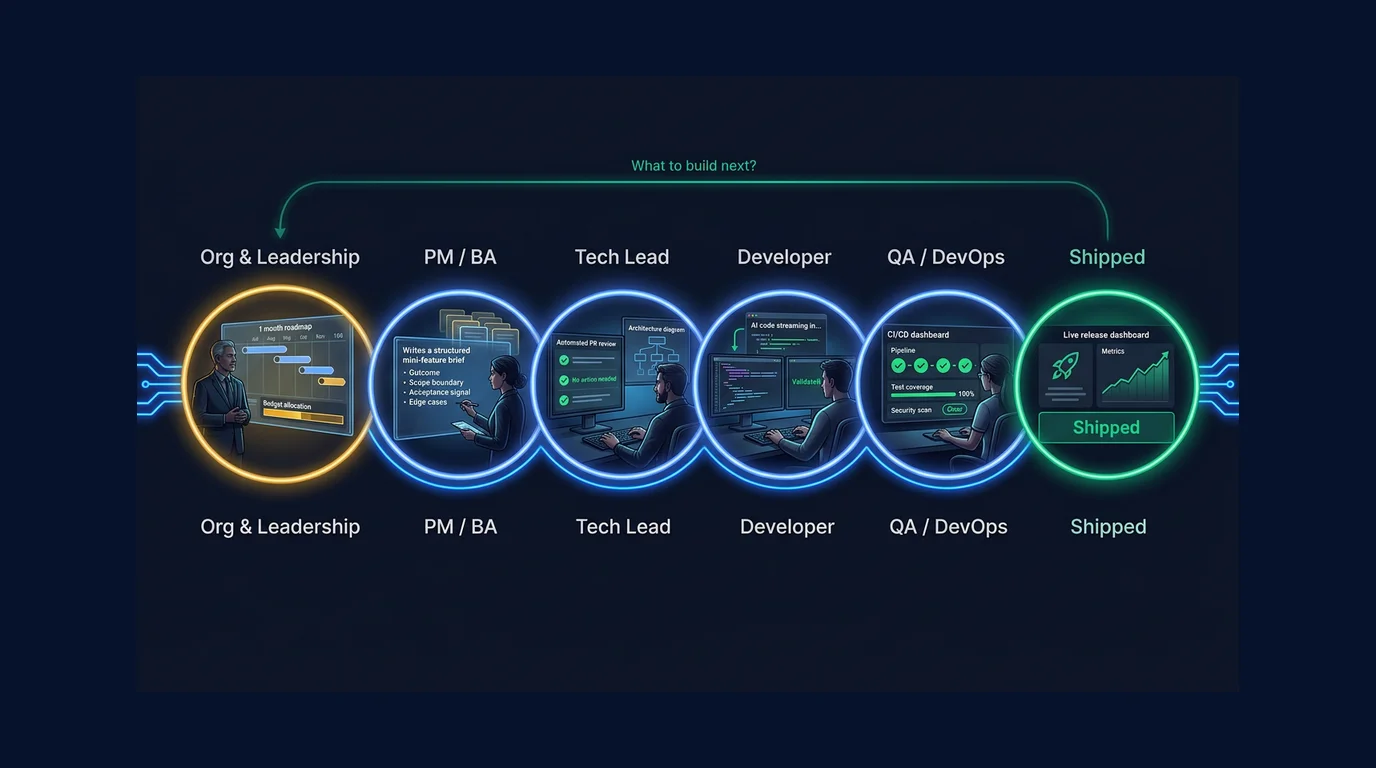
Six months in. The team is shipping more than they ever have.
The backlog that used to feel infinite now has a realistic twelve-month horizon with a plan behind it. The org is executing on work it couldn’t have committed to before. The question leadership is asking isn’t “how do we reduce headcount” - it’s “what do we build next, and how fast can we get there?”
That outcome required every function to change. Not just the developers. The PMs, QA, the tech lead, the governance model - all of it. A developer workshop and a tool licence rollout don’t produce that result. An org that rewired how it operates does.
This is the post about the org. Not the developer, not the PM, not any single function - the whole thing, how it fits together, and what goes wrong when it doesn’t.
Still Waiting to See If AI Is “Worth It”?
I keep running into the same leadership team. They’ve been watching AI adoption for a year or two. Read the reports. Attended the conferences. And they’re still waiting - for more evidence, for the right moment, for the market to settle.
Some of those stumbles were real. Gartner’s 2024 research found that orgs which rushed in without a plan hit predictable walls - and the ones on the sideline saw that and used it as a reason to wait longer. But watching others stumble isn’t the same as avoiding the problem. Forrester’s April 2026 report found that three years in, most enterprises are still not getting real value from AI - not because the technology doesn’t work, but because they haven’t built the internal capability to use it well. The orgs that did start, even slowly and imperfectly, are now ahead. That gap is widening.
The organisations doing it well started small, picked a specific problem, and built evidence from within.
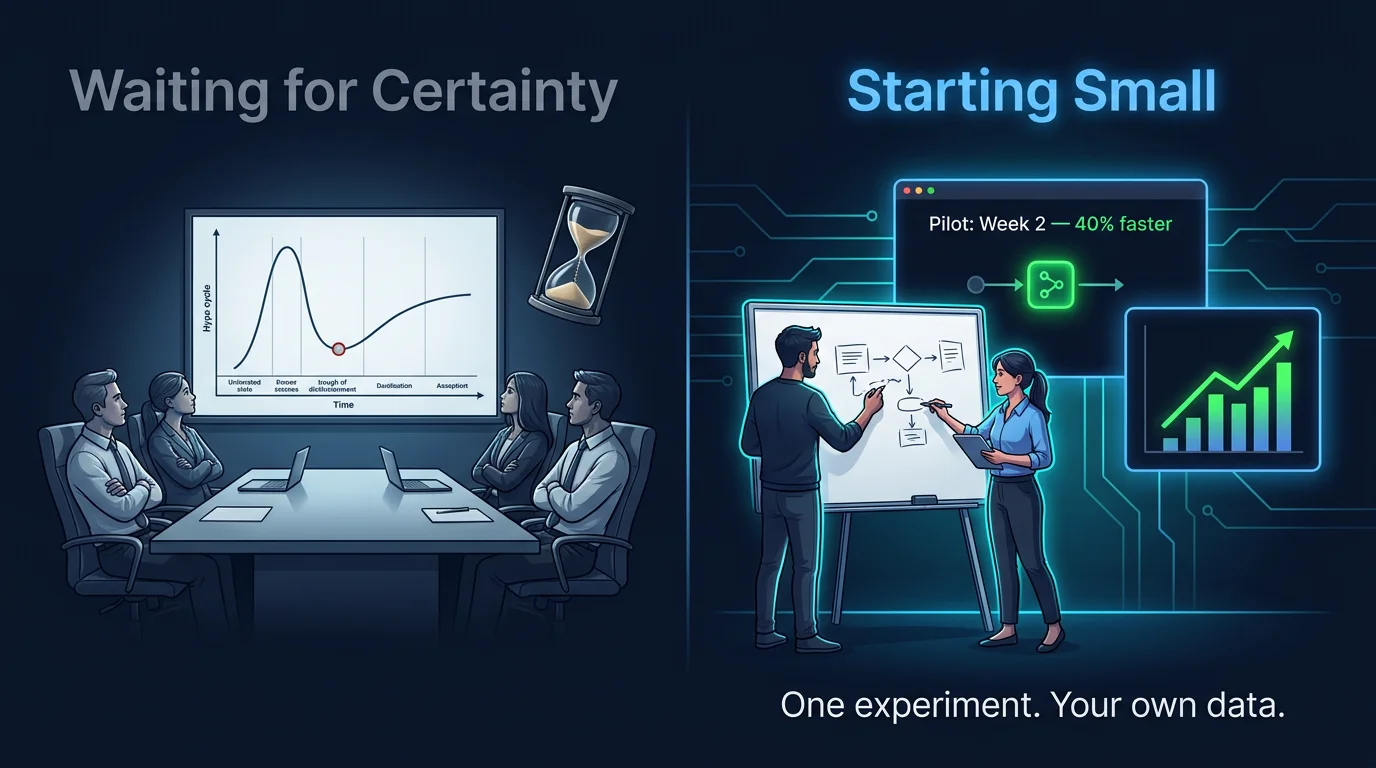 Waiting isn’t neutral. The gap between AI-active and AI-passive organisations widens every quarter.
In 2026, “should we do AI?” is not the question anymore. The question is: where can we use it right now, at small scale, and what does it show us? One team, one workflow, a clear before-and-after. No Gartner report will ever know your backlog, your team, or your codebase as well as you do. Your own data is the only evidence that counts.
Gartner predicts that by 2028, organisations that adopt and sustain an AI-first strategy will achieve 25% better business outcomes than competitors. That gap is being built right now, in orgs that are running experiments while others are scheduling strategy reviews.
What the Full Picture Looks Like
Vibe coding requires every function to change - not just the developer. Five layers, each one dependent on the others. When any layer stays the same, the transformation stalls at that point. And without the first layer - the org itself - none of the others start moving.
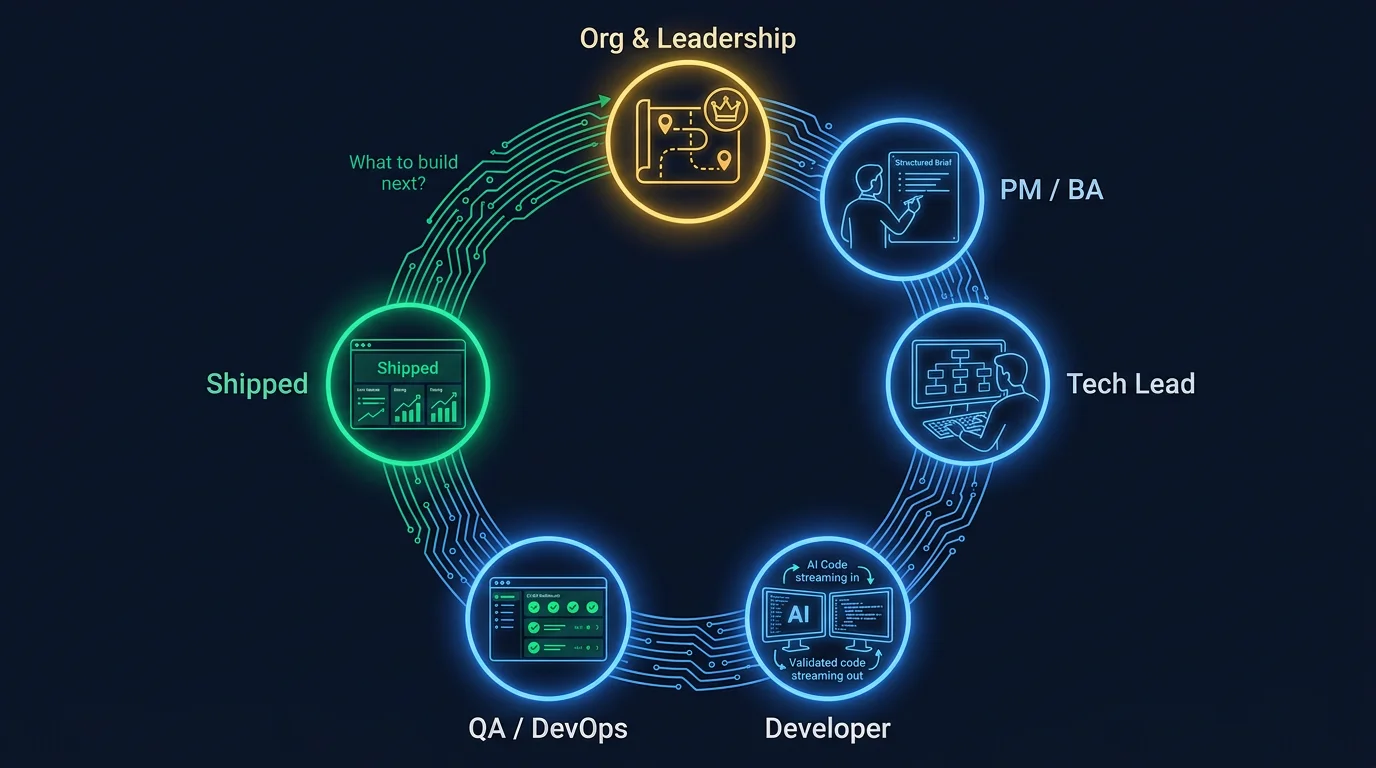 Five layers. Each one dependent on the others. The org is not a bystander - it’s the foundation.
The Org and Leadership is the layer that makes everything else possible. Without a committed twelve-month roadmap, a phased budget, a governance model, and a deliberate decision to transform all functions rather than just one, none of the layers below can sustain what they unlock. The org decides what gets built, funds the transition, sets the ownership policy, and defines how success is measured. Everything downstream - the briefs, the code, the reviews, the tests - is only as good as the strategic foundation above it. When leadership treats this as a developer tool rollout, the transformation stalls at the developer’s desk. When leadership treats it as an org redesign, the whole pipeline moves.
PMs and BAs shifted from backlog managers to pipeline owners. They write precision mini-feature briefs - outcome, scope boundary, acceptance signal, explicit edge cases - that AI can execute without interpretation. They operate ahead of the dev team, not alongside it, so the pipeline never runs dry. Ambiguity in a brief becomes improvisation in the code - and improvisation is often insecure.
Tech leads shifted from coordinators to individual contributors at higher altitude. They build the hard things. They direct architecture in living documentation instead of holding it in their heads. They use automated PR review to reclaim the time coordination consumed, and spend it on architectural and outcome judgment that only their experience can provide. They define the technical standards that govern what AI-generated code gets approved and to what quality bar.
Developers shifted from authors to architect-reviewers. They work in mini-features, validate AI output rigorously, own every merged line regardless of what generated it, and maintain craft discipline on prompt engineering, code direction, and output validation. The psychological dimensions - identity threat, cognitive overload, fragmented ownership - are named and managed, not ignored.
QA and DevOps shifted from downstream gatekeeper to embedded quality layer. Test thinking enters at the brief stage. Unit tests are generated automatically on every commit. Security scanning runs on every PR, not quarterly. Pipelines are designed for continuous delivery, not weekly releases. QA’s human judgment is focused on integration flows, E2E behaviour, and exploratory testing - not re-running what automation already covers.
When all five layers shift, the bottleneck disappears. Code moves through a pipeline built for it. The org that closes the loop is the org in the scenario at the top of this post - shipping more than it ever has, asking what to build next rather than when it will finally ship.
Budget, Savings, and the Transition That Takes Time
One of the most common failure modes I’ve seen has nothing to do with tools or skills. It’s about expectations. Leadership hears “AI transformation” and forms a mental model where this is a one-time investment that pays for itself in six months through headcount reduction.
That expectation is where most AI projects die - not because the technology failed, but because the plan was wrong before anything started. Gartner’s research found that less than 1% of announced layoffs in the first half of 2025 were attributable to AI productivity gains - and forecasts a net increase in jobs from AI beginning in 2028. AI is coming for inefficiency, not headcount. The orgs planning around the latter are building on a false premise.
Harvard Business Review found in 2023 that 80% of AI projects fail to move from pilot to full deployment - and the most common reasons weren’t technical. They were organisational: insufficient budget planning, unrealistic timelines, and a mismatch between what the transformation requires and what leadership committed to fund.
You need a phased budget, not a project budget. The first phase is the feasibility study and audit: understanding where you are before designing the change. The second phase is the transformation engagement itself: reskilling, tooling, process redesign, governance. The third phase, which most plans skip entirely, is the ongoing layer: maintaining the tooling, monitoring quality, iterating the process as the team matures and output increases.
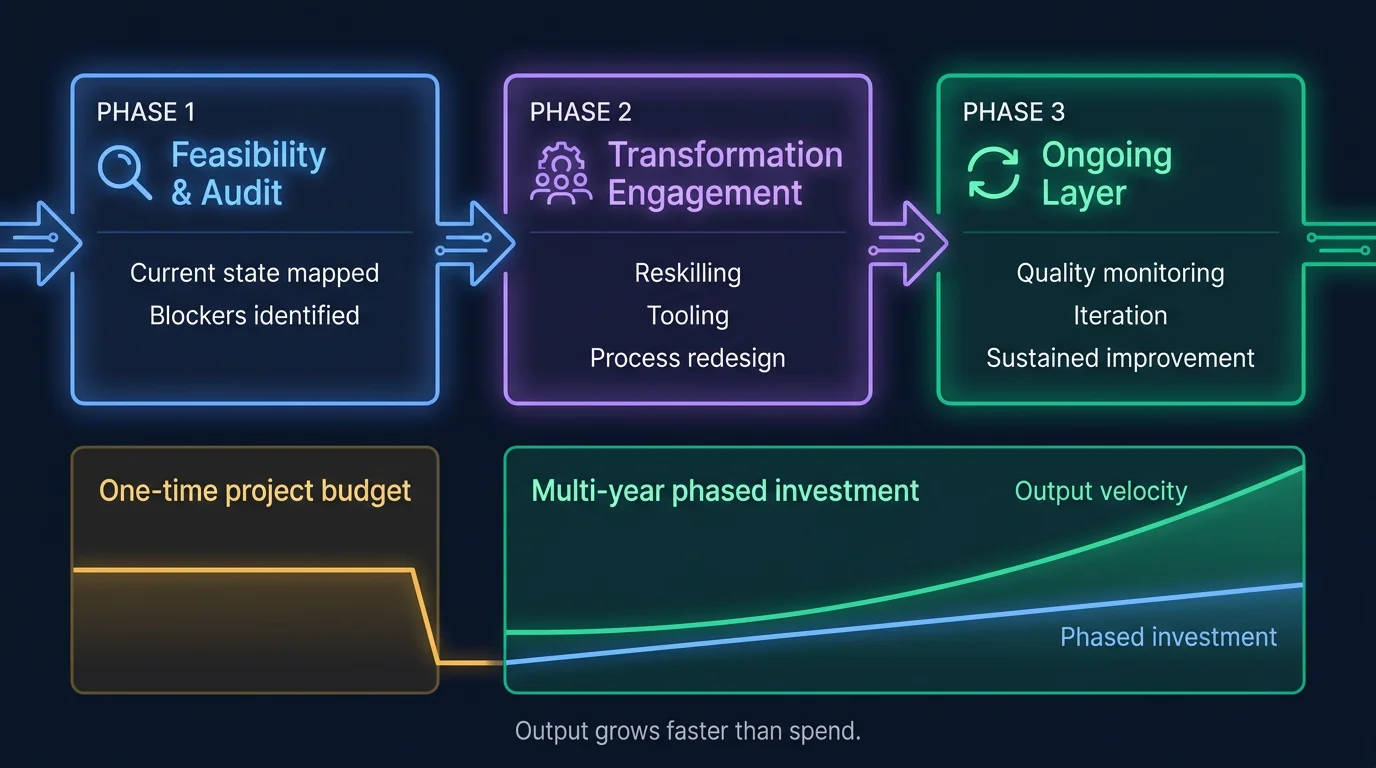 A project budget kills the transformation. A phased investment sustains it.
Replacing everything a team does with AI in one go isn’t achievable. It’s a transition. Sprints one through four look different from sprints twelve through twenty-four. Expecting sprint-three results in sprint one is where the business case collapses and the project gets cancelled - not because AI failed, but because the plan was wrong from the start.
The orgs getting results are the ones that treated this like a platform investment, not a cost-reduction exercise. They carved out a multi-year budget, defined what success looked like at each phase, and evaluated the surrounding systems - the process, the team structure, the tooling dependencies - before moving anything. One team converting to vibe coding while the rest of the org stays unchanged doesn’t deliver org-level results. The vision has to be the whole organisation, transformed in phases, with each phase funded and evaluated before the next begins.
| What usually happens | What actually works |
|---|---|
|
|
The savings are real. They compound on the back end, not the front end, and they take longer than one sprint cycle to show up. The orgs getting results are the ones that designed for business value from the start - not the ones that handed out licences and waited.
Trust Your Internal Teams. Seriously.
This one cuts against how most AI transformations are sold. An external agency comes in, presents a framework, runs workshops, hands over a playbook, and leaves. Six months later, the transformation has quietly stalled.
Deloitte’s 2023 Digital Transformation Survey found that transformations led primarily by external vendors had a significantly lower long-term success rate than those where internal teams owned the change from early on. Organisations that invested in upskilling internal talent and giving them real accountability were more than twice as likely to report sustained improvement after two years.
External agencies know transformation frameworks. Your internal SMEs know your codebase, your clients, your edge cases, and the unofficial decision-making structure that determines whether anything actually changes. That second category is what gets a developer in the payments team or a QA lead in insurance to genuinely change how they work day to day.
A consulting partner can start the transformation and should. They bring structure, outside perspective, and experience with the common failure points. That’s genuine value in the early phases. But the internal teams carry it from phase two onward. They’re the ones who either make this part of daily practice or quietly revert when the external team is gone.
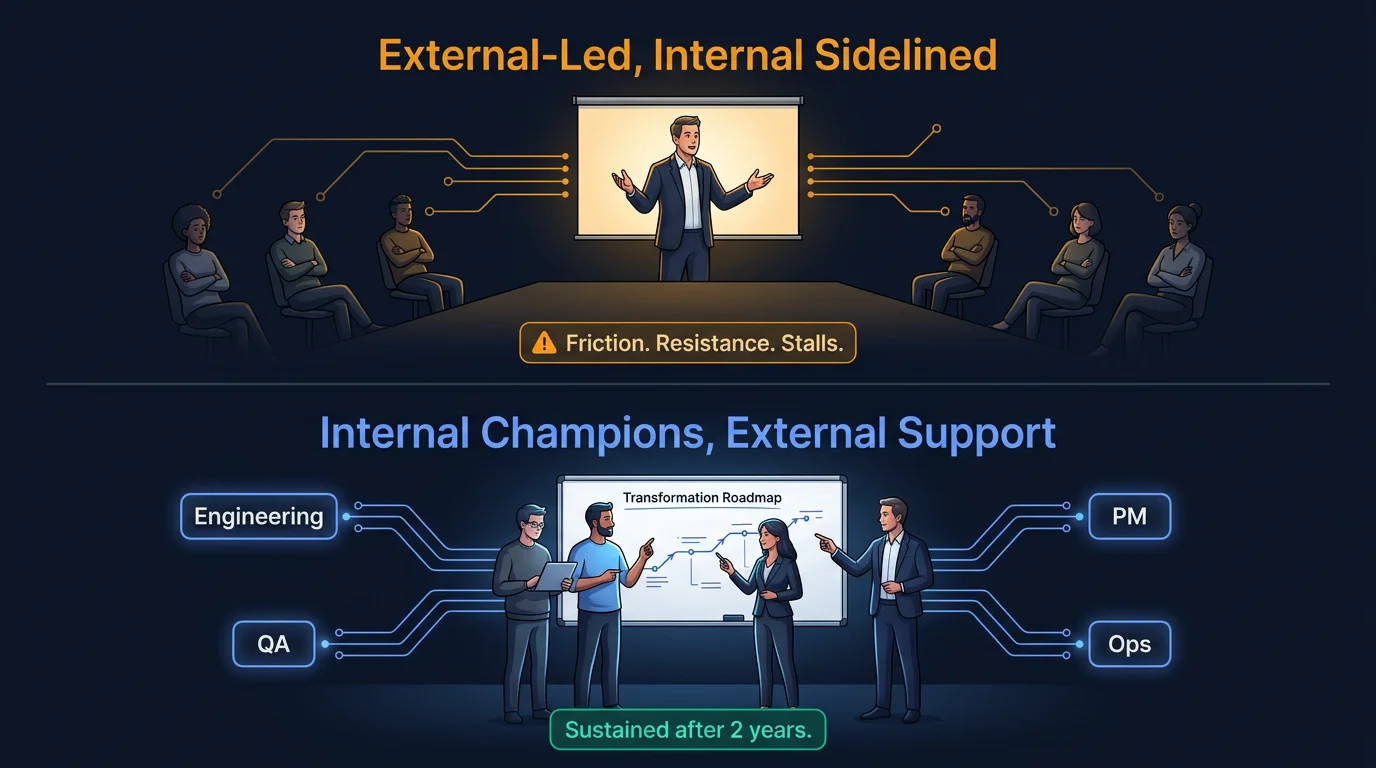 External partners start it. Internal champions carry it. Sidelining your SMEs is where the transformation stops progressing.
The mistake I see repeatedly: internal talent gets sidelined. The agency runs the show. SMEs get consulted occasionally but don’t own anything. They feel bypassed, disengage, and that disengagement turns into friction - slow adoption, passive resistance, quiet workarounds. The transformation doesn’t fail in a meeting. It just stops moving.
Gartner’s May 2026 research found that 73% of highly productive AI users are managers or executives - individual contributors, the people responsible for the majority of automatable tasks, are consistently underserved with support and guidance. Employees with a positive outlook toward AI are 3.4 times more likely to be highly productive. That outlook doesn’t come from a policy document. It comes from being included, trained, and given real ownership of the change.
The right structure: bring in a partner to design the transformation and run the first phase. At the same time, from day one, identify your internal champions - the developers, QA leads, and PMs who are curious, credible with their peers, and willing to own this. Give them the time and budget to go deep. Let the external partner work alongside them, not in front of them. When the engagement ends, the internal champions should be driving it forward, not reading a playbook written by people who’ve already left.
The urgency here is higher than most leadership teams realise. Gartner predicts that by 2027, 50% of enterprises without a people-centric AI strategy will lose their top AI talent to competitors who built theirs around the people doing the work. And the same research found that 88% of employees with enterprise AI access are already using personal AI tools for business tasks - often to work around tools or processes that don’t meet their needs. If you don’t build a framework that includes your internal talent, they’ll build their own. That’s both a governance problem and a retention problem.
What to Let Go Of at the Org Level
Most of the letting-go happens at the function level, and the earlier posts in this series covered each one. At the org level, what remains are the structural assumptions that only leadership can change.
Headcount as the proxy for capacity. A vibe-thinking team delivers more per person than a traditionally-structured team. Measuring team capacity in bodies-on-seats is the wrong instrument. The right instrument is output velocity - feature lead time, deployment frequency, backlog throughput.
Velocity points as the measure of productivity. Story points measure estimation accuracy, not output value. In a vibe coding org where a developer can ship a well-defined mini-feature in a morning, story points become meaningless noise. The question is not “how many points did we deliver?” but “how many valuable features reached users, how fast, and at what quality?”
Stage-gate approvals and big-batch releases. Release processes designed to gate large batches of change introduce artificial latency into a pipeline built for continuous delivery. When the team can ship daily, a fortnightly release gate is a two-week hold on every feature that was ready yesterday.
The assumption that transformation is a developer training programme. This is the one that fails the most organisations. They run a two-day vibe coding workshop for their development team, hand out tool licences, and wait for the sprint to change. When it doesn’t - because QA, PM, and leadership haven’t changed - they conclude that the tools don’t work. The tools worked. The transformation wasn’t a transformation.
Short-horizon planning. If the org is planning only to the end of the current sprint, it’s operating without a trajectory. In a vibe coding org where output velocity has increased, the backlog can be exhausted faster than before. Leadership needs a twelve-month committed roadmap - funded, sequenced, and defined at the mini-feature level - so that the team’s capacity is directed at the right work from the moment the transformation takes hold.
| Let Go Of | Replace With |
|---|---|
| Headcount = capacity | Output velocity per developer |
| Velocity points | Feature lead time + quality trends |
| Stage-gate releases | Continuous delivery |
| Transformation = dev training | Full-org process and mindset redesign |
| Short-horizon roadmap | Twelve-month focused commitment with funded backlog |
| AI code ownership left undefined | Named human accountability policy for every merged line |
The Partial Transformation Failure Modes
Most organisations that invest in vibe coding don’t fail because the tools don’t work. They fail because they only transform some of the layers. A partial transformation doesn’t produce a slower version of the full result - it produces a measurably worse outcome than the starting state. More code volume moving through a process that was already slow, with nobody quite sure why things feel worse than before.
Layer by layer:
Developer-only transformation.
The developers are building faster. PRs are arriving at double or triple the previous rate. But QA hasn’t changed, the PM workflow hasn’t changed, the tech lead is still manually reviewing everything. The pipeline was built for the old output rate.
Faster code piles up at every unchanged gate. Review queues grow. QA becomes the bottleneck. Security risk increases because more AI-generated code flows through a review process that wasn’t designed for this volume. The org spends money on tools and training, the sprint doesn’t change, and leadership concludes that vibe coding doesn’t work. The tools worked. The transformation wasn’t a transformation.
Developer + PM transformation, QA and DevOps unchanged.
Better requirements mean cleaner code, faster. The developer is getting well-formed mini-feature briefs and building them in hours.
The bottleneck migrates. QA is now the constraint, receiving more volume through a process that hasn’t changed. Security scanning is still quarterly. Manual regression is still the safety net.
Developer + PM + QA transformation, tech lead unchanged.
Code ships fast. Tests run automatically. The pipeline is built for continuous delivery.
The architectural coherence problem surfaces slowly. The tech lead stays in coordination mode, still the single point of context for the whole system. As code volume increases and the lead stays in triage, nobody evaluates how individual features fit together at scale. Technical debt accumulates in the architecture, not in individual files. Six months later, the team is fast and fragile.
All layers transformed, no governance model.
Everything is working. Code ships fast, tests run automatically, PRs are reviewed well.
Nobody owns what shipped. When an OWASP-class vulnerability surfaces in production - and with 45% of AI-generated code failing OWASP Top 10 tests, it will - there’s no clear answer to “who approved this?” Security debt has been building silently in a codebase that was moving too fast for anyone to track it.
| What Transformed | What Was Left Unchanged | Outcome |
|---|---|---|
| Developers only | PM, QA, Tech Lead, Governance | Faster code, same slow pipeline. Code quality risk goes up. |
| Developers + PM | QA, Tech Lead, Governance | Bottleneck migrates to QA. More volume through an unchanged testing model. |
| Developers + PM + QA | Tech Lead, Governance | Pipeline moves fast. Architecture slowly loses coherence. |
| All layers | Governance | Ships fast. Owns nothing clearly. Security debt accumulates silently. |
| All layers + Governance | - | Transformation complete. Every layer aligned. Bottleneck disappears. |
An ad-hoc rollout - tools here, training there, a workshop next quarter - almost always lands in one of those partial rows. A structured engagement that maps the full transformation before starting is what keeps you out of them.
The Backlog-First Mindset
Transformation unlocks capacity. What the org does with that capacity is the question nobody prepares for.
Most transformation programmes leave the org stranded here. The developers are faster, the pipeline is healthier, the lead is back to building - and the backlog is two weeks deep. The capacity gain sits idle or gets absorbed by low-value maintenance, and the business case for the transformation quietly weakens.
The backlog is the fuel. An org that transforms its engineering output without preparing the backlog first has a high-performance engine with nowhere to go.
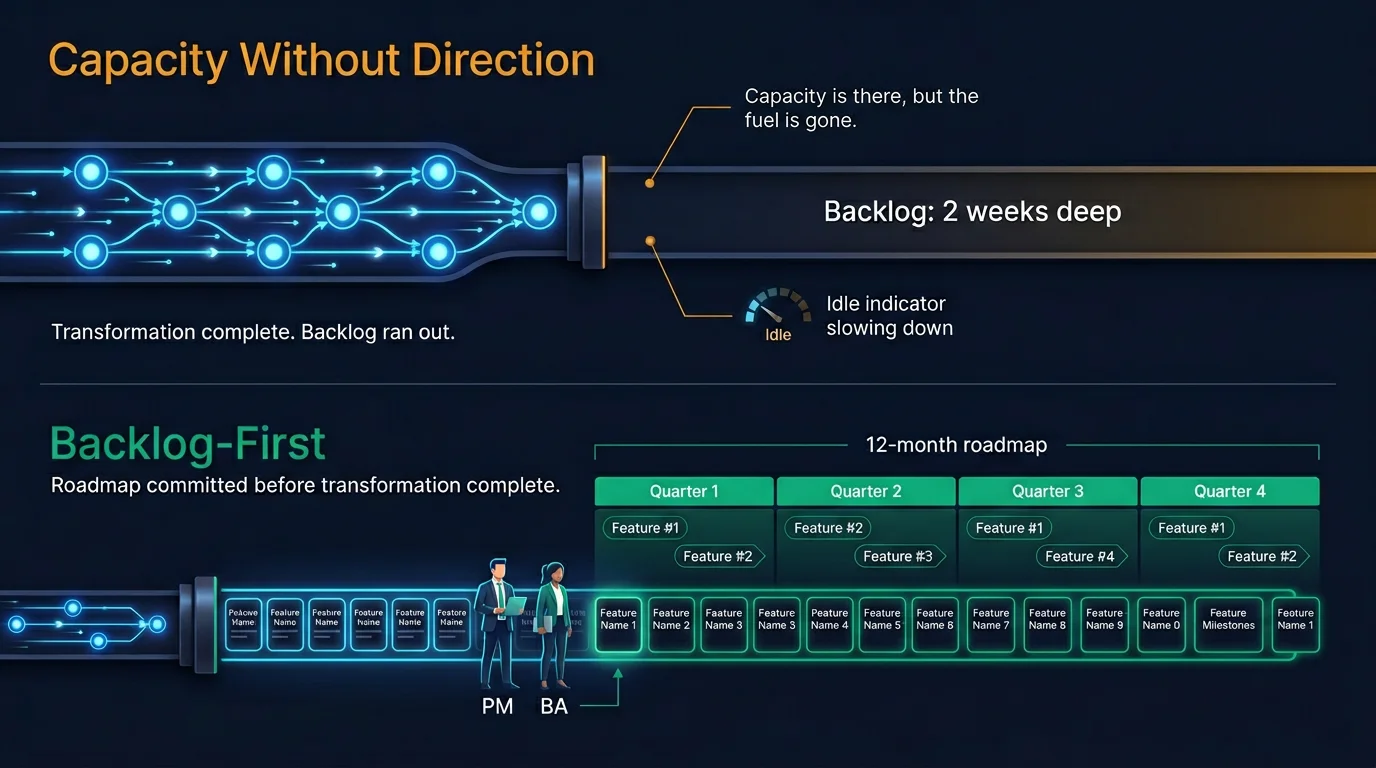 An unlocked pipeline with an empty backlog gains nothing. The fuel has to be ready before the engine is.
Every function has to plan ahead at the same time:
Leadership defines an ambitious, focused twelve-month roadmap before the transformation completes - not after. Funded, prioritised, committed at the product level.
Tech leads sequence the roadmap into architectural work - understanding what the codebase needs to look like in six months to support the features planned for months seven through twelve, and making those architectural decisions now.
PMs and BAs run continuously ahead of the dev team. The pipeline of well-defined mini-feature briefs should never run dry, regardless of current dev velocity.
Resource decisions come last. Make headcount decisions after the org has committed to a backlog that actually uses the new velocity, and after the team has executed against it for a quarter. Cutting headcount as the first move - before the transformation has shown what the team can do - is how orgs undercut the investment they just made.
The Governance Model
When vibe coding spreads across an organisation, ownership and security governance stop being developer conventions. They become leadership decisions.
Google’s CEO noted in April 2026 that 75% of all new code is now AI-generated, approved by engineers. That approval model is already the governance model at scale. The question is who owns what gets approved, and what standard they’re approving it to.
Leadership needs to define three things explicitly:
Ownership policy. Every merged line has a named human accountable for it - a specific developer who reviewed and approved it, not “the team.” Left to individual convention, accountability diffuses. Diffuse accountability is how production incidents happen with no clear owner.
Security review standard. What does “approved” mean in the context of AI-generated code? At minimum: the approving developer understands the code, can explain every line, and has validated it against the acceptance signal from the brief. In security-sensitive contexts: PASSR has reviewed it, findings have been resolved, and the developer can account for the security posture of the merged code.
Shadow IT governance. Vibe coding lowers the technical barrier to building. Non-engineering functions - operations, marketing, analytics, finance - will start building their own tools and automations, often without visibility into the security model of the systems those tools connect to. This is already happening: Gartner found that 88% of employees with enterprise AI access also use personal AI tools for business tasks, often to save time where the official tooling falls short. A self-built internal automation that touches a production database is an attack surface. HBR’s research on AI governance found that the standard responsible AI approach - policy documents and ethics principles - is too slow and too vague for the generative AI era. The CISO and the governance model need to be part of the transformation from day one, not a separate conversation after the fact.
The Metrics That Actually Changed
The clearest signal that a transformation has landed isn’t output volume. It’s which metrics the team stops reporting and which ones they start.
Retired:
- Story points and sprint velocity - replaced by feature lead time
- Tickets closed per sprint - replaced by features shipped to production
- Lines of code committed - retired entirely
- Time to first PR - replaced by time from brief to production
Adopted:
- Feature lead time: From mini-feature brief to production. In a well-functioning vibe coding org, this compresses significantly - days, not weeks. This is the DORA metric that shows the transformation is working end-to-end.
- Deployment frequency: How often is the team shipping to production? Weekly or daily is a different org than monthly.
- Change failure rate: What proportion of releases cause an incident or require a rollback? A fast team with a high failure rate is not a transformed team.
- Quality trend: Is the codebase getting healthier or less healthy over time? PASSR’s portal shows this across all repos as a continuous signal rather than a point-in-time audit.
- Backlog depth: Does the team always have a ready queue of well-defined mini-features ahead of it? If the backlog regularly runs dry, the PM pipeline is the constraint.
These metrics answer one question: is the org healthy and moving? The retired metrics answered a different question: was everyone busy? Those two questions point at completely different things.
What Flytebit Does - The Full Product Suite
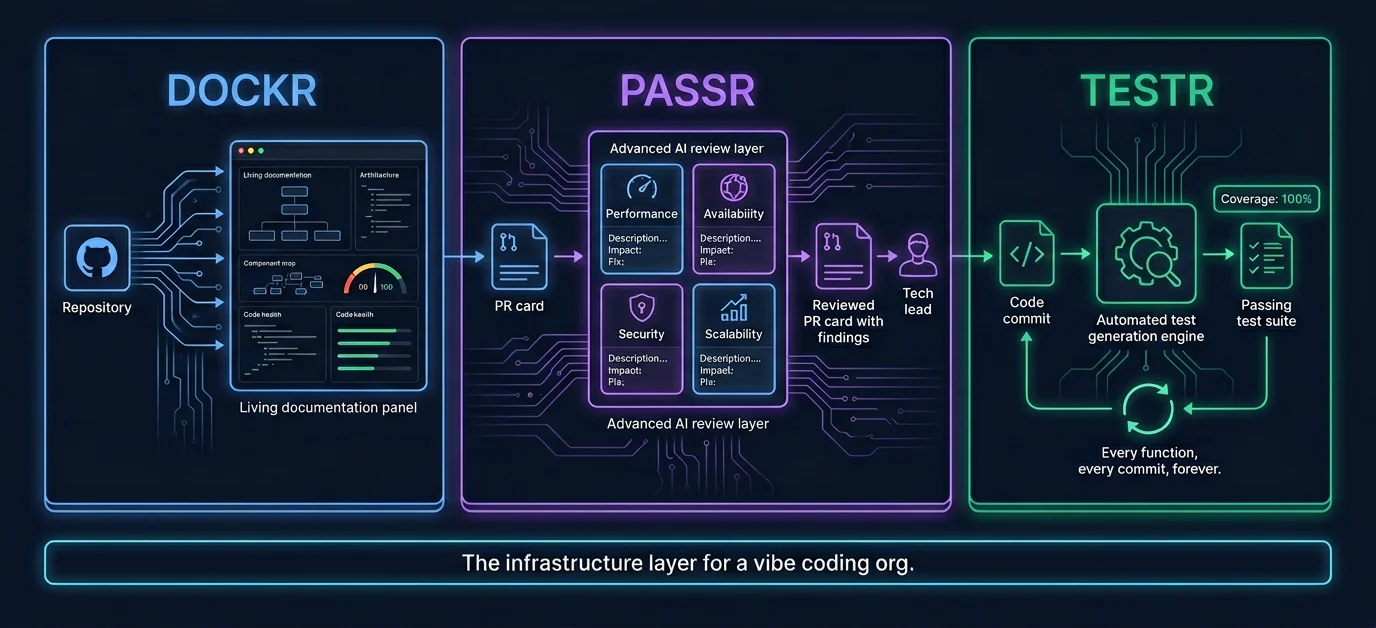 Three products. One infrastructure layer. Documentation, security review, and test coverage - running continuously as output scales.
Three Flytebit products form the infrastructure layer that makes a vibe coding org measurable, secure, and sustainable. Fast without these is just fast-and-fragile.
DOCKR solves the documentation problem that vibe coding accelerates. When code output doubles, the gap between what the codebase does and what anyone can explain about it widens fast. DOCKR connects to your repositories and automatically generates living documentation - visual architecture diagrams, component maps, code health scores - updated via webhooks on every push. The architecture stops living in the tech lead’s head and starts living in a shareable, always-current form that every developer on the team can use independently. DOCKR supports eleven languages and requires no manual documentation effort - it reads the code and produces the documentation automatically.
PASSR - Performance, Availability, Security, and Scalability - operates as two connected layers. The PR Agent is the silent worker: it intercepts every pull request and commit the moment it lands, runs automated reviews across all four dimensions, and produces findings with a description, impact statement, and a ready-to-apply fix before any human reviewer sees the diff. It runs via webhooks and CI/CD hooks continuously - not as a one-time scan, but as an always-on quality signal. The PASSR portal is the visibility layer: every finding PR Agent surfaces aggregates into a team dashboard where leads and managers track issue status, fix rates, PR timelines, and quality trends across all repositories over time.
TESTR solves the test coverage problem that vibe coding creates. When a developer is generating code in hours instead of days, manually writing unit tests is the first thing that gets deferred - and the deferral compounds. TESTR connects to your repository, reads your code, and automatically generates, runs, and debugs unit tests for every function on every commit, forever. No test-writing sprint. No coverage gaps. Unit coverage stays current with output volume automatically.
Together, they cover the three things that most commonly break when vibe coding scales: documentation, security and quality review, and test coverage. None of them replace human judgment in those areas. They remove the mechanical work that makes human judgment impossible once output volume increases.
Working With Flytebit
At FLYTEBIT TECHNOLOGIES, Vibe Coding Transformation is a structured engagement, not a workshop and a tool licence.
An org that rolls out AI tools on top of an unmapped process baseline is building on assumptions. When those assumptions are wrong - and they usually are somewhere - the transformation underperforms and the business case weakens before it had a chance to prove itself.
We run a two-stage engagement designed to avoid that failure mode:
Stage 1 - Feasibility Study and Audit. Before any training or tooling rollout, we map the actual development landscape: team structure, how developers are actually spending their time, process health, codebase health, and what would limit or accelerate a transformation at each layer. The output is a findings report - what’s there, what it means, and what needs to be resolved before Stage 2.
Stage 2 - Transformation Engagement. With the current state understood and critical blockers resolved, the transformation begins with a clear baseline. We work alongside the team - on-site and online - through each layer: developers, PMs and BAs, QA and DevOps, and tech leads. We work through the practice change with the people doing the work, and we identify and build up the internal champions who will carry this forward after the engagement closes.
Not sure where your organisation stands today? The Vibe Coding Transformation Readiness Quick Check takes five minutes and gives you a per-function view of where your pipeline is most exposed.
Stay tuned for our upcoming product launch.
What’s in This Series
What’s Next
If this series describes your org, our AI software development services cover every layer - from feasibility study to deployed agents and team training.
Related Reading
If you’re at the start of this journey:
👉 Vibe Thinking - The Full Org Transformation
Where the series began: why developer-only vibe coding doesn’t change the sprint - and what a real transformation requires at the org level.
To go deeper on each function:
👉 Vibe Thinking - The Developer Who Codes at the Speed of Thought
What changes and what doesn’t at the developer level - identity, craft, and the new feedback loop.
👉 Vibe Thinking - The PM Who Writes Requirements That an AI Can Actually Use
Precision requirements as fuel for a fast pipeline - and what happens when they’re missing.
👉 Vibe Thinking - When QA Becomes the New Bottleneck
How testing and pipelines have to evolve to match developer output - or become the constraint.
👉 Vibe Thinking - The Team Lead Who Stopped Managing and Started Building Again
The leadership shift that determines whether the transformation holds - or slowly unravels.
Key Takeaways
- ✅ Start small, don't wait: The orgs ahead didn't wait for certainty - they ran experiments. Pick one workflow, measure what changes, and let your own data answer the strategic question.
- ✅ Budget for a transition, not a project: AI transformation is a multi-phase, multi-year investment. Expecting sprint-three results from a one-time budget is how most AI projects fail before they start.
- ✅ Build internal champions from day one: External partners start the transformation. Internal SMEs carry it across every function, every day, indefinitely. Sidelining them is where friction and failure come from.
- ✅ Partial transformation makes things worse: Developer-only produces a queue at QA. Developer + PM produces a queue at testing. All layers without governance produces fast shipping with no clear ownership when something goes wrong.
- ✅ Prepare the backlog before the capacity arrives: A funded twelve-month roadmap should be ready before the transformation completes - not drafted after. An unlocked pipeline with an empty backlog gains nothing.
- ✅ Governance is a leadership decision: Named ownership policy for every merged line, a defined security review standard for AI-generated code, and a shadow IT governance model before non-engineering teams start shipping their own tools.
- ✅ Measure outcomes, not activity: Feature lead time, deployment frequency, change failure rate, quality trend, and backlog depth - not story points, velocity, or tickets closed.

Ready to Transform Your Business with AI?
Let's discuss how Agentic AI and intelligent automation can help you achieve your goals.