
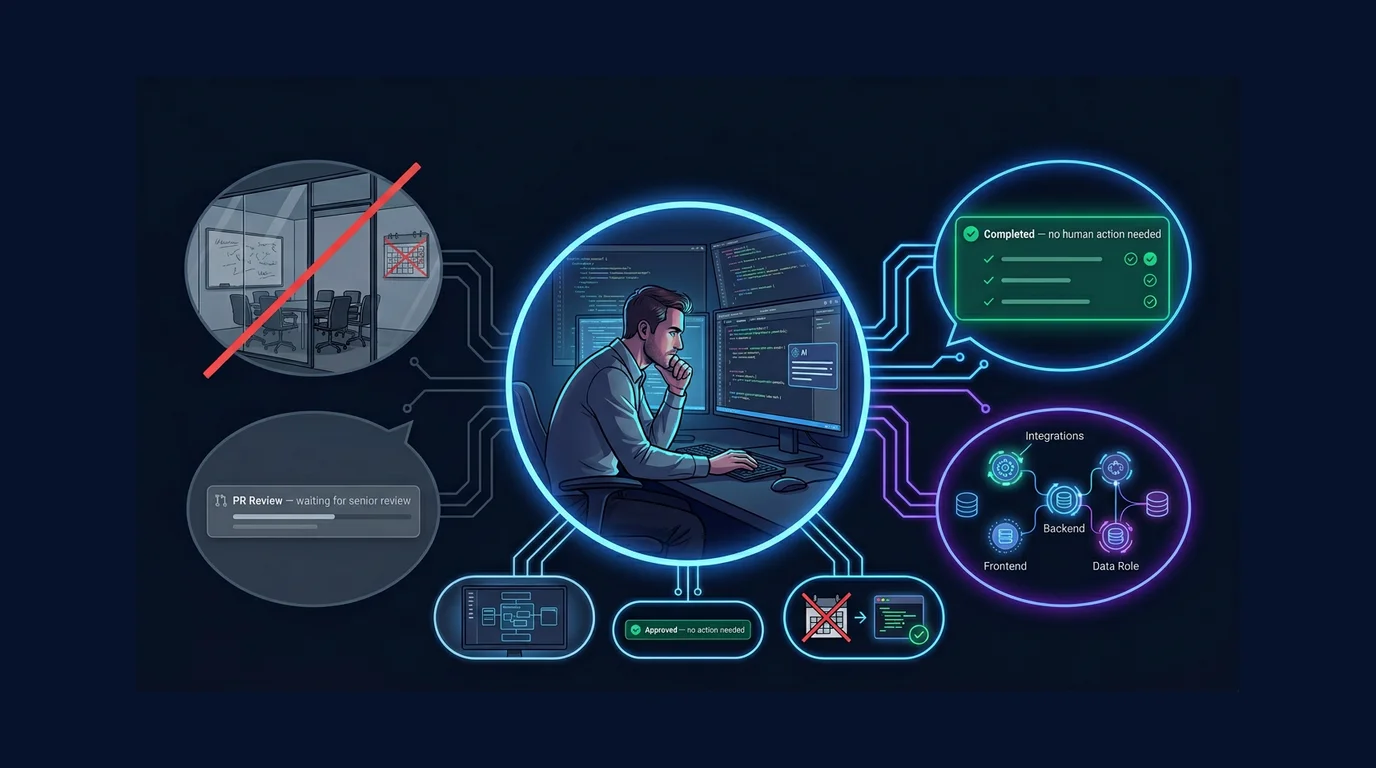
The team has AI coding tools. The developers are moving faster.
But the tech lead is spending their day in exactly the same place as before: standups, PR queues, clarification threads, chasing delivery across the team. Their hands-on coding time is near zero.
The bottleneck is no longer the developers. It’s the person directing them.
Not because the tech lead isn’t capable (they’re usually the most capable person on the team), but because the model they’re operating in was designed for a world where developers were the constraint. In that world, the lead’s job was to coordinate: assign work, unblock dependencies, review every PR, keep the team moving. That made sense when code moved slowly.
When code moves fast, that model inverts. The lead becomes the chokepoint.
This is Post 4 in the Vibe Thinking series. The posts covered so far are:
- Post 0 - Vibe Thinking - The Full Org Transformation
Why developer-only vibe coding doesn’t change the sprint, and what full transformation actually requires. - Post 1 - Vibe Thinking - The Developer Who Codes at the Speed of Thought
The developer layer, and the discipline required to make fast output safe. - Post 2 - Vibe Thinking - The PM Who Writes Requirements That an AI Can Actually Use
The PM layer, and how ambiguous requirements become faster garbage in a vibe coding workflow. - Post 3 - Vibe Thinking - When QA Becomes the New Bottleneck
How the testing and pipeline layer has to evolve before the tech lead’s role can fully shift.
This post is about what happens when the queue reaches the lead.
Fair warning: This is probably the most uncomfortable post in the series. The earlier posts asked developers, PMs, and QA engineers to change how they work. This one asks tech leads to question something deeper - whether the role they’ve built their identity around is the right one for the environment they’re now operating in. That’s not a process change. It’s a harder conversation. Some of what follows will feel like criticism of people who are working hard and doing exactly what they were hired to do. It isn’t meant that way. The system that made coordination the job is the problem, not the people doing it well.
The Coordination Trap
Most senior engineers don’t choose to stop building. It happens gradually, and it usually starts with a promotion.
The team grows. A contractor joins, then another. The lead becomes the person who knows the most about the system, so they become the person who answers every question. Every architectural decision routes through them. Every blocked PR lands in their inbox. Every stakeholder who needs a technical opinion gets thirty minutes on their calendar.
Before long, the lead is spending 70% of their day on coordination. The remaining 30% is fractured by interruptions. Deep work, the kind that produces actual code, actual architecture, actual craft, has disappeared.
This is the coordination trap. It’s not a failure of the individual. It’s the natural outcome of a structure that relies on a single person to hold all the context, answer all the questions, and unblock all the dependencies. In that structure, the most experienced person on the team is also the most constrained one.
The trap is sustainable when the team moves slowly. When developers are the bottleneck, the lead’s coordination work keeps pace. The queue of decisions never overwhelms the queue of code being written.
Vibe coding breaks that equilibrium.
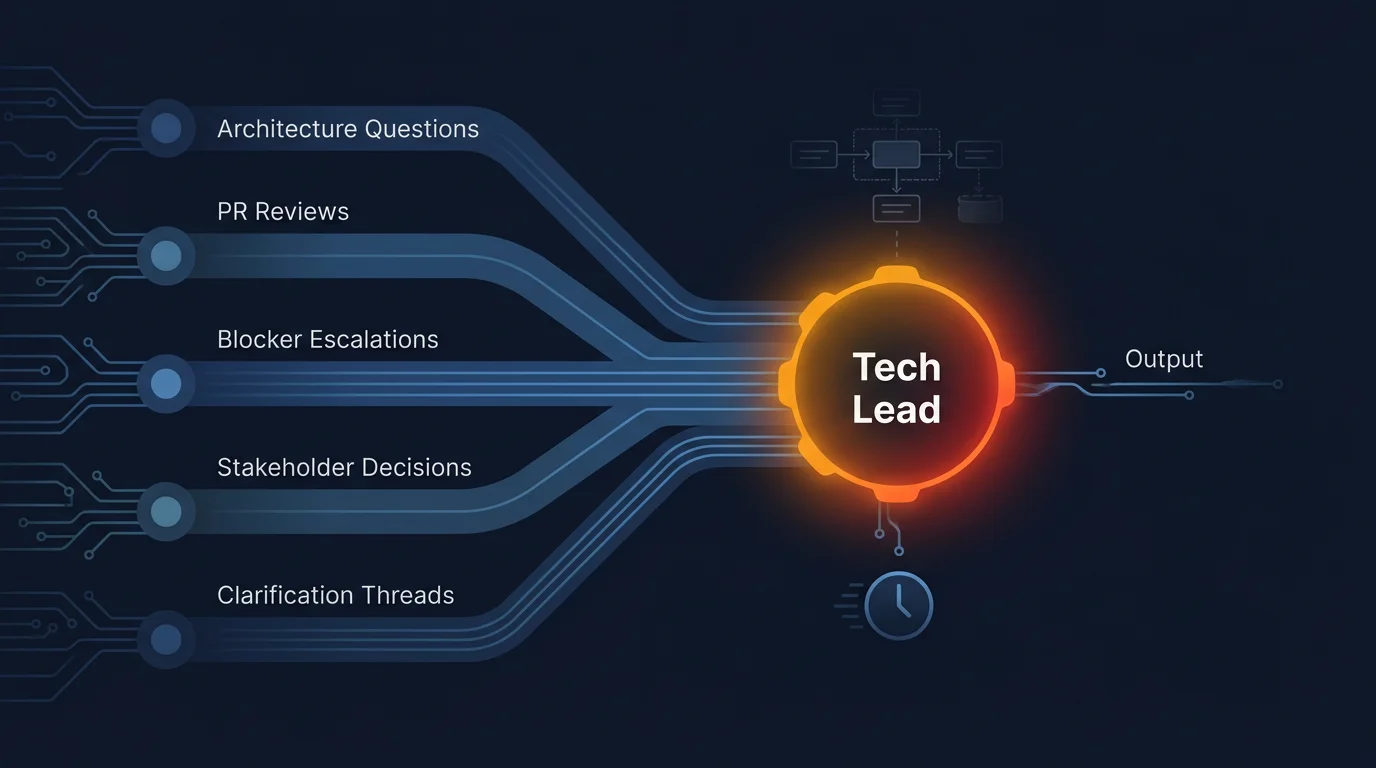 The coordination trap is structural, not personal. One node. All the context. Every decision waiting.
Why This Model Collapses Under Vibe Coding
When developers start using AI coding tools effectively, their output rate changes. PRs that used to take three days arrive in a morning. The queue of work flowing toward the lead increases: more code to review, more decisions arriving faster, more architectural questions needing answers before the next commit.
The lead is now the slowest link.
A tech lead manually reviewing every PR in a vibe coding org is not a quality gate. It’s a queue. If a developer can open six PRs in a day and the lead can meaningfully review two, the other four are waiting. The developer who just built six things is sitting idle or context-switching into new work while the old work sits unreviewed.
The second collapse point is less visible but more damaging: the architecture.
When vibe coding increases code volume and the lead is fully occupied with coordination, nobody thinks about the architecture at scale. Individual PRs get reviewed for correctness, not for how they fit together over time. Technical debt accumulates faster than before, not because the code is worse, but because more of it arrives and less of it gets evaluated in the context of where the system is going.
A tech lead who isn’t building also can’t effectively direct AI-generated code. Vibe coding requires craft judgment: knowing when an AI-generated approach is the right one, when it’s technically correct but architecturally wrong, when the prompt needs to be reframed. That judgment doesn’t survive six months of coordination work. It atrophies. And a lead whose craft has atrophied makes architectural decisions without a current mental model of what the code actually looks like.
The Identity Shift
The hardest part of this transition is the identity dimension, and most engineering cultures don’t have language for it.
“Senior” in most engineering cultures has come to mean removed from the keyboard. The implicit career ladder points away from hands-on work: you graduate from individual contribution to team coordination to programme management to strategic oversight. Getting back to building can feel like going backward.
That framing is wrong, and in a vibe coding world, it causes real harm.
A senior engineer directing AI coding agents is not doing what a junior engineer does with those tools. The level of abstraction is different. The quality bar is different. The architectural thinking that goes into a well-structured prompt, a rigorous output review, and a defensible merge decision requires years of experience. The craft didn’t disappear. It moved up a level.
The vibe-thinking tech lead is an individual contributor again, operating at a higher altitude. They build complex features using AI as a multiplier. They set the quality bar by example, not by policy. They do hands-on reviews of AI-generated code, not as a gatekeeper, but as the person with the deepest system knowledge on the team.
The shift is from “the person who coordinates everyone else’s work” to “the person who builds the hardest things and sets the standard for how everything else gets built.”
The role was always supposed to work this way.
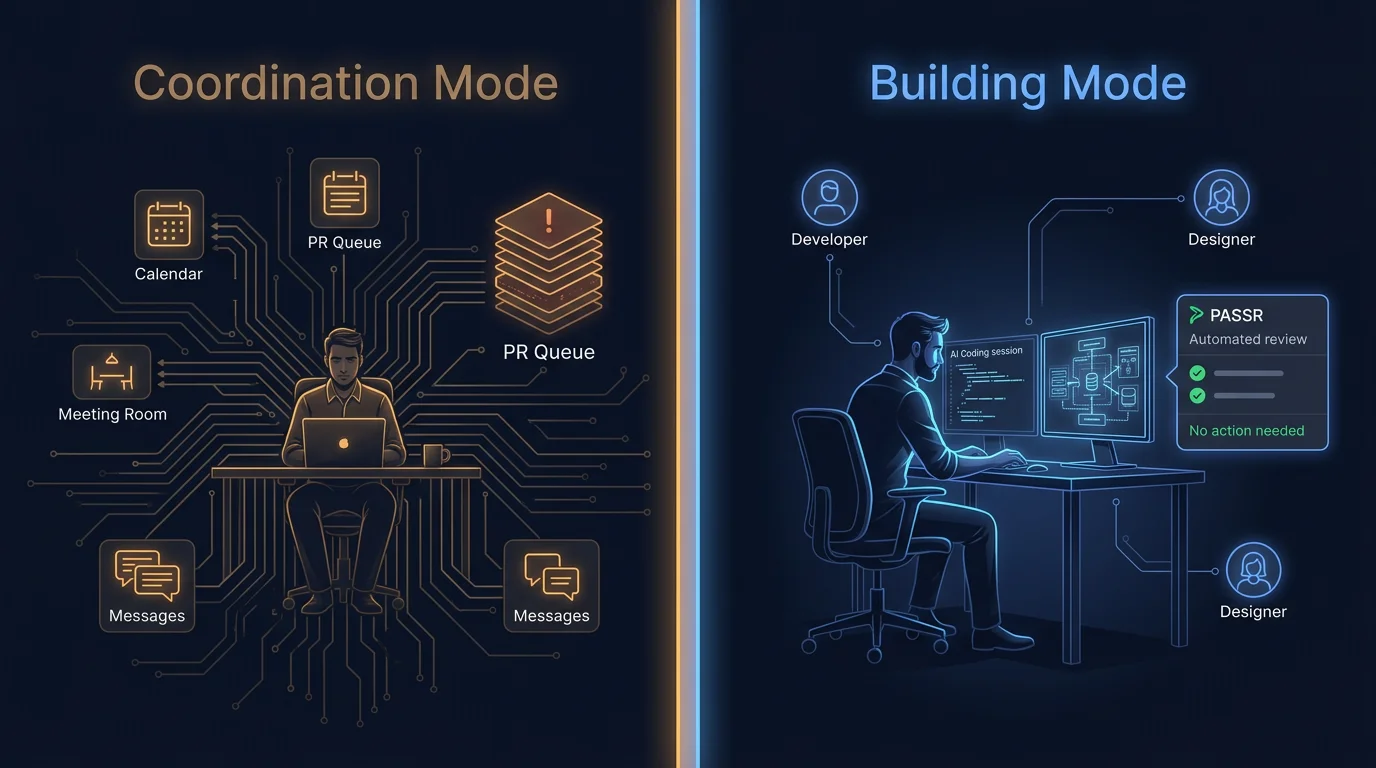 Coordination mode holds one person responsible for everything. Building mode lets that person do the thing only they can do.
What to Let Go Of
| Let Go Of | Replace With |
|---|---|
|
|
|
|
|
|
|
|
|
|
|
|
|
|
|
|
Some need more context, because they’re where most tech leads get stuck.
The coordinator role. Coordination (assigning work, chasing blockers, managing dependencies) is operationally necessary but strategically limiting. In a well-structured vibe thinking org, most of this work distributes: PMs own the pipeline, PASSR handles first-pass review triage, developers own their outputs. The lead’s coordination surface shrinks by design.
PR gatekeeping. Every PR the tech lead manually reviews is a serial process in a world that needs a parallel one. First-pass triage, catching style issues, obvious logic errors, and OWASP-class security patterns, is exactly what automated review handles well. The lead’s review time belongs on architectural decisions, integration risks, and the judgment calls that require full system context. Everything else is a queue tax.
Architecture held in your head. If the system architecture exists only in the tech lead’s memory, the team can’t move independently. When the lead is the only person who knows why a particular service boundary exists or what a specific pattern was designed to prevent, every decision that touches that area routes back through them. DOCKR eliminates that dependency: living documentation reflecting the actual architecture, updated automatically on every push, accessible to every developer without a meeting.
Activity metrics. Tickets closed, PRs merged, lines committed. These proxies made sense when developer output was the constraint. In a vibe coding org, they incentivise the wrong behaviour: closing tickets fast rather than building the right things well. The metrics that matter are outcomes: features shipped that users actually use, quality trends, deployment frequency, lead time from brief to production.
Being hands-off as “senior.” The belief that seniority means delegation is the most persistent misconception in engineering leadership. In a vibe coding org, the most experienced engineer has the highest leverage building with AI tools, because their craft judgment is exactly what AI can’t replicate. Stepping back from the keyboard is waste, not seniority.
What a Vibe-Thinking Tech Lead Actually Does
The role doesn’t disappear. It reshapes.
Builds the hard things. Takes on the features that require the deepest system knowledge: the ones where AI output needs the most sophisticated direction and validation. Sets the bar for what a well-built feature looks like by building well, not by writing policies.
Directs architecture, not people. Makes the structural decisions that shape how everything else gets built (service boundaries, data models, integration patterns, performance constraints). Documents those decisions in living form with DOCKR so developers can work within them independently, without routing every choice through the lead.
Reviews at the right altitude. Uses PASSR to handle first-pass triage. Focuses human review energy on the architectural questions: does this fit the system direction? Does this introduce coupling that becomes a problem in six months? Is the pattern here consistent with how similar things are built?
Owns quality trends, not individual fixes. When output volume doubles, a lead who spends their time fixing individual PR issues is playing whack-a-mole. The more useful question is: why do those issues keep appearing? Is it a specific developer who needs support? A part of the codebase with structural debt? A recurring pattern PASSR is flagging across multiple repos? That’s a portfolio question, and it needs a lead who has time to look at it.
Thinks twelve months out. Plans the team’s shape, the backlog’s structure, and the architectural direction for the next four quarters. Knows what the team needs to be capable of building in six months and is actively growing toward it.
The Developer Health Responsibility
Post 1 covered the psychological and health dimensions of vibe coding from the developer’s perspective. At the tech lead level, those dimensions become a leadership responsibility.
The PR fatigue, high-intensity burnout, and debugging spirals that vibe coding can produce aren’t personal failures. They’re structural outcomes. When a developer reviews 3x the code volume they used to produce, the cognitive load is real. When the review cycle is long and context-switching is constant, the compounding effect is real. When identity is anchored to authorship and authorship is being displaced, the psychological friction is real.
A lead who doesn’t acknowledge this creates an environment where developers perform confidence they don’t have. Fragile code gets merged because the developer doesn’t want to surface uncertainty. Security issues slip through because nobody wants to ask a “dumb question” about AI output. The lead’s willingness to say “this output doesn’t look right to me, and here’s why” sets the permission structure for the whole team.
Named ownership policy. Every AI-generated component that gets merged has a named developer accountable for it individually, not spread across the team. Diffuse ownership is how security debt accumulates without anyone noticing. The lead sets this as a team norm.
Review load as a design constraint. If the team’s output has doubled and review capacity hasn’t changed, the lead redesigns the review process rather than just working harder. PASSR handles part of this. Rotating review responsibilities handles more. Bounding WIP handles the rest.
Craft practice, not just craft expectation. A lead who builds regularly creates the conditions for developers to talk honestly about what they’re building and how. A lead who only reviews creates a one-way dynamic where judgment flows down and reality flows nowhere.
PASSR: What Changes in the Lead’s Week
The most direct change PASSR makes to a tech lead’s day is reclaiming review time.
In a vibe coding org where PR volume has increased, a lead manually triaging every PR spends a significant portion of their week on first-pass work: catching the issues that could be caught automatically, before they even get to the architectural judgment that only a human can provide.
PASSR’s PR Agent runs on every pull request the moment it lands, before the tech lead sees it. It reviews across Performance, Availability, Security, and Scalability dimensions, flags issues with a description, impact rating, and a ready-to-apply fix, and does this via webhooks before any human reviewer is involved.
Here’s what a Monday looks like, with and without PASSR:
- Tech lead reviews 22 PRs on Monday
- Eight have minor issues: style inconsistencies, missing null checks, one endpoint without input validation
- Lead comments on each; developers fix; lead re-reviews
- Four require a second round
- Wednesday morning: still re-reviewing PRs from Monday
- Architectural work this week: zero
- 22 PRs land; PASSR runs automatically on each
- Eight issues flagged, including the missing input validation (flagged as a potential injection risk with a ready-to-apply fix)
- Developers resolve before the lead sees the queue
- Lead's PR review list: 14 remaining, all already passing quality gates
- Lead reviews for architectural fit and integration correctness
- Done by Tuesday lunchtime; Tuesday afternoon: architectural work
The PASSR portal gives the lead the portfolio view that manual review never provides. Across all repositories, all teams: current open issue count, how quickly fixes are being applied, what patterns are trending, which repos are accumulating risk. This is the data that lets a lead make team-level quality decisions rather than PR-level ones.
The lead’s review role shifts from triage to judgment. That’s where the value of senior engineering experience actually lives.
The Engineering Manager Layer
Everything so far applies to the tech lead as a practitioner. The engineering manager layer, whether that’s a separate role or the same person at a different altitude, has its own shift to make.
The core one is measurement.
Engineering teams have been measured by activity for so long that activity feels like productivity. Tickets closed. PRs merged. Sprint velocity. Story points completed. These metrics were designed for a world where the constraint was developer output, where more tickets closed meant more work got done.
In a vibe coding org, those metrics can be actively misleading. A team running 40 tickets a sprint might be shipping features nobody uses, generating technical debt faster than it can be addressed, and building toward a direction nobody agreed on. The number looks good. The outcome isn’t.
The metrics that matter in a vibe coding org are outcome metrics:
- Feature lead time: from mini-feature brief to production, how long does it actually take?
- Deployment frequency: how often is value reaching users?
- Change failure rate: what proportion of releases cause an incident?
- Quality trend: is the codebase getting healthier over time, as measured by PASSR?
- Backlog depth: does the team always have well-defined, ready-to-build work ahead of it?
Here’s what this looks like in a real planning conversation:
"We closed 38 tickets last sprint. Velocity was 82 points, up from 74. Three stories carried over."
"Four features shipped to production last sprint. Lead time averaged 3.1 days from brief to deploy, down from 5.2. Change failure rate: one rollback out of 12 deploys. PASSR quality trend: open issue count down 18% over the last four weeks. Backlog: 11 ready-to-build mini-features queued ahead of the team."
The second version tells you whether the team is healthy and moving in the right direction. The first tells you whether they were busy.
Working With Flytebit
At FLYTEBIT TECHNOLOGIES, Vibe Coding Transformation is a structured engagement, not a workshop and a tool licence.
We work specifically with tech leads and engineering managers as part of every transformation engagement, because this is where vibe coding investments most commonly stall. The developer tools are in place. The team is building faster. But the lead is still in coordination mode, still reviewing every PR manually, still the single point of failure for architectural decisions. The productivity gain at the developer level hits the coordination ceiling and stops there.
The questions we work through with leads: how do you redesign the review process so your time goes to judgment, not triage? How do you get the architecture out of your head and into living documentation? How do you measure your team’s health in a world where story points don’t mean what they used to?
Not sure where your organisation stands today? The Vibe Coding Transformation Readiness Quick Check takes five minutes and gives you a per-function view of where your pipeline is most exposed.
Ready to get started?
- Visit us at: flytebit.com
- Follow FLYTEBIT TECHNOLOGIES on LinkedIn for insights and updates
- to discuss your specific use cases
What’s in This Series
What’s Next
When the lead gets back to building, the pipeline needs AI workflow automation that runs continuously - documentation, review, testing, and governance in one system.
Related Reading
If coordination is the trap, architecture trapped in one head is the fuel:
On documentation rot and the hidden cost of knowledge that lives only in the lead’s head, and what DOCKR does about it.
The testing layer has to change before the lead’s role can fully shift:
👉 When QA Becomes the New Bottleneck
How the testing and pipeline layer has to evolve before the tech lead’s role can fully shift, and what TESTR and PASSR make possible.
The developer-level shift that changes the lead’s situation:
👉 The Developer Who Codes at the Speed of Thought
What changes in a developer’s day when vibe coding works. The post explains why the lead’s model collapses under the volume it creates.
Key Takeaways
- ✅ The coordination trap is structural, not personal: Tech leads don't choose to stop building. A structure that routes all context, decisions, and blockers through one person does it for them. Vibe coding makes that structure untenable.
- ✅ Manual PR review at every commit is a queue, not a gate: When developers produce six PRs per day and the lead can meaningfully review two, the other four wait. First-pass triage belongs in automation; the lead's time belongs at the architectural level.
- ✅ Treating hands-off as seniority wastes the most experienced engineer on the team: The belief that seniority means stepping back from the keyboard is the most damaging misconception in engineering leadership. Senior engineers have the highest leverage building with AI tools because their craft judgment is exactly what AI can't replicate.
- ✅ Architecture trapped in the lead's head is a single point of failure: DOCKR (living documentation updated on every push) distributes that context to the whole team and eliminates the dependency on the lead being available to answer every question.
- ✅ Named ownership is a leadership norm, not a developer preference: Every AI-generated component that gets merged needs an individual developer accountable for it. Diffuse accountability is how security debt accumulates without visibility.
- ✅ Developer health is structural, not personal: PR fatigue, identity threat from authorship displacement, and cognitive overload under high review volume are outcomes of the system the lead designs. A lead who doesn't acknowledge this creates an environment where developers perform confidence they don't have.
- ✅ Activity metrics mislead in a vibe coding org: Tickets closed, story points completed, PRs merged: these tell you if the team was busy, not if they're healthy. Feature lead time, deployment frequency, quality trend, and backlog depth tell you if the work is actually moving in the right direction.
- ✅ PASSR shifts the lead from triage to judgment: With automated first-pass review handling style, security patterns, and obvious issues before the lead sees a PR, the lead's review energy goes where it belongs: architecture, integration correctness, and the calls that require full system context.

Ready to Transform Your Business with AI?
Let's discuss how Agentic AI and intelligent automation can help you achieve your goals.