

You’ve probably heard the term “Agentic AI” thrown around in tech circles, boardrooms, and LinkedIn feeds. But what does it actually mean? And more importantly, why should you care?
In this comprehensive guide, we’ll break down everything you need to know about Agentic AI-from the basics to real-world applications-in clear, jargon-free language.
Non-Agentic AI vs. Agentic AI
Non-Agentic AI
Non-Agentic AI is reactive and task-focused. You give it a command, it executes that specific task, then stops and waits for your next instruction. It’s like a highly skilled assistant who only does exactly what you ask-nothing more, nothing less.
Characteristics of Non-Agentic AI:
- Reactive: Waits for input before acting
- Single-task: Handles one thing at a time
- Stateless: No memory between interactions
- Human-dependent: Needs constant direction
Example:
- You: “Summarize this document”
- AI: Provides summary
- AI: Waits for next command
 Linear, reactive workflow requiring constant human input
Agentic AI
Agentic AI is proactive and goal-oriented. You give it a high-level objective, and it autonomously plans, executes, and adapts to achieve that goal. It’s like a trusted teammate who understands your vision and takes initiative to make it happen.
Characteristics of Agentic AI:
- Proactive: Takes initiative based on goals
- Multi-task: Handles complex workflows
- Stateful: Remembers context and history
- Goal-oriented: Works toward outcomes autonomously
Example:
- You: “Keep our blog active with weekly AI trend posts”
- AI: Researches trends, drafts posts, generates images, optimizes SEO, schedules publication, creates social snippets, tracks engagement-all automatically
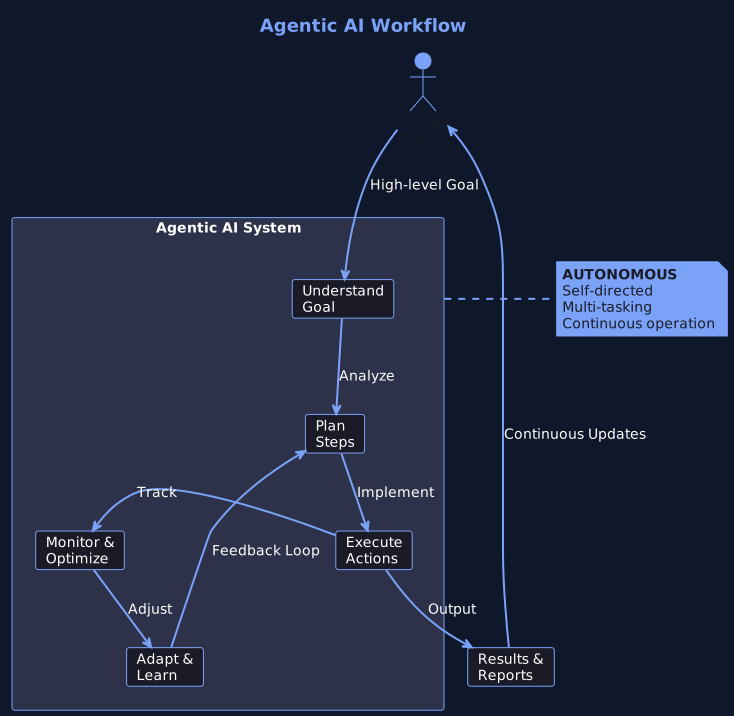 Autonomous, multi-step workflow with self-directed decision-making and feedback loops
See the difference? Non-Agentic AI is a tool you operate. Agentic AI is a teammate that collaborates.
Agentic AI vs. Rule-Based Systems
Rule-based systems have powered business automation for decades. If-then rules, decision trees, scripted integrations, RPA bots. They work when the world fits the rules.
The world rarely fits the rules.
A returns workflow coded for “item received within 30 days” has no answer for a partial shipment that arrives in two boxes on different days. A pricing rule that checks competitor prices weekly is already late when competitors change prices daily. Scripted integrations cover the happy path. Edge conditions in the other 20-25% of cases break them.
Agentic AI handles the cases rules cannot. Instead of following a fixed script, an agent perceives the situation, reasons about what to do, chooses a path, and adapts when something unexpected happens. It does not need every edge case pre-coded. It handles them the way a person would: by looking at the context and making a judgment call within defined boundaries.
| Dimension | Rule-Based Systems | Agentic AI |
|---|---|---|
| How it decides | Fixed if-then rules, decision trees | Reasons about context, evaluates options, chooses a path |
| Handles edge cases | No. Unhandled cases error out or fall through. | Yes. Adapts to situations not pre-coded. |
| Handles ambiguity | No. Requires binary logic. | Yes. Weighs trade-offs and picks the best available option. |
| When it breaks | Breaks when reality deviates from the rule. | Adjusts plan when an action fails or conditions change. |
| Maintenance | Every new edge case needs a new rule. Rules accumulate until the system is unmaintainable. | Learns from outcomes. New situations handled without code changes. |
| Scope | One workflow, one decision path. | Multi-step workflows across multiple systems with dependencies. |
| Failure mode | Silent failure or hard stop. The workflow stalls. | Detects failure, retries, escalates to a human, or tries an alternative. |
| Best for | High-volume, predictable, deterministic tasks (data validation, compliance checks, format conversions). | Workflows with edge cases, judgment, multi-step decisions, and changing conditions. |
| Cost to build | Low for simple rules. High and growing as rules accumulate. | Higher upfront. Lower marginal cost as the system handles more cases without re-coding. |
A rule-based returns system processes the 75% of returns that fit the rules and escalates the rest to humans. An agentic returns system processes the 75% the same way, then handles half of the remaining 25% by reasoning through the edge case within governance boundaries. That 12.5% of volume is what currently consumes human time and breaks SLAs.
Rule-based systems are the right tool for deterministic, high-volume tasks where the rules are stable and the edge case rate is near zero. But agentic AI is the right tool when the workflow involves judgment and the inputs vary. At some point the cost of coding every edge case exceeds the cost of building an agent that can handle them.
Most production systems use both. Rules handle the predictable cases. Agentic AI handles the edge cases that rules miss, and a human reviews whatever neither can resolve.
What Makes AI “Agentic”?
Five key capabilities distinguish Agentic AI from non-agentic AI:
Understands Goals (Not Just Commands)
Non-Agentic AI: “Find me 5 hotels in Boston with conference rooms”
Agentic AI: “Plan a 2-day team offsite in Boston for 10 people”
The difference? You tell it what you want to achieve, not how to do it. The AI figures out the steps.
Plans Actions Autonomously
Agentic AI breaks down complex goals into actionable steps:
- What needs to happen first?
- What depends on what?
- What’s the optimal sequence?
- What resources are needed?
It creates its own execution plan rather than following pre-programmed instructions.
Takes Initiative
Once it has a plan, Agentic AI executes with minimal hand-holding:
- Calls APIs
- Updates databases
- Sends notifications
- Makes decisions within defined boundaries
- Handles routine exceptions
You don’t need to micromanage every step.
Adapts on the Fly
When something doesn’t work as expected, Agentic AI adjusts its approach:
-
API call fails? Try an alternative method
Example: Hotel booking API times out → Switches to backup booking service or direct hotel websites -
Data unavailable? Find another source
Example: Venue pricing not listed online → Calls venue directly or checks competitor pricing databases -
Constraint changes? Revise the plan
Example: Budget reduced from $4K to $3K → Adjusts venue selection and catering options automatically
It doesn’t just error out-it problem-solves.
Learns from Context
Agentic AI understands:
- Your business processes
- Your data patterns
- Your preferences
- Historical outcomes
Over time, it gets better at achieving your goals because it learns what works in your specific context.
Real-World Examples
Let’s look at concrete examples that illustrate the difference:
Example 1: Planning a Team Offsite
| Non-Agentic AI | Agentic AI |
|---|---|
| Your Input: "Find me 5 hotels in Boston with conference rooms" | Your Input: "Plan a 2-day team offsite in Boston for 10 people, budget $5000, dates March 15-16" |
| What Happens: | What Happens: |
| - AI returns list of hotels | - AI searches venues |
| - You manually check availability | - AI checks availability |
| - You compare prices | - AI compares prices |
| - You book rooms | - AI books rooms |
| - You arrange catering separately | - AI arranges catering |
| - You send calendar invites | - AI sends calendar invites |
| - You follow up on confirmations | - AI follows up on confirmations |
| - AI provides complete itinerary | - AI provides complete itinerary |
| Time Investment: 4-6 hours | Time Investment: 10 minutes |
Example 2: Publishing a Blog Post
| Non-Agentic AI | Agentic AI |
|---|---|
| Your Input: "Write a blog post about AI trends" | Your Input: "Publish a weekly blog post about AI trends every Monday at 9 AM" |
| What Happens: | What Happens: |
| - AI generates 1000-word article | - AI researches current trends |
| - You create cover image | - AI generates cover images |
| - You optimize for SEO | - AI checks for accuracy |
| - You schedule in CMS | - AI optimizes for SEO |
| - You create social media posts | - AI creates social media snippets |
| - You track engagement manually | - AI schedules publication |
| - AI tracks engagement | - AI tracks engagement |
| - AI reports on performance | - AI reports on performance |
| Time Investment: 3-4 hours per post | Time Investment: 15 minutes per week |
Example 3: Customer Support
| Non-Agentic AI | Agentic AI |
|---|---|
| Scenario: Customer asks about order issue | Scenario: Customer asks about order issue |
| What Happens: | What Happens: |
| - AI provides answer from knowledge base | - AI understands intent and context |
| - If complex, escalates to human | - AI checks order history & account status |
| - Human handles everything else | - AI reviews previous interactions |
| - AI resolves issue (refund/replacement) | - AI resolves issue (refund/replacement) |
| - AI updates CRM | - AI updates CRM |
| - AI follows up to ensure satisfaction | - AI follows up to ensure satisfaction |
| - Only escalates complex edge cases | - Only escalates complex edge cases |
| Time Investment: 10-15 minutes per ticket | Time Investment: 2-3 minutes per ticket |
Why Agentic AI Matters Now
We’re at an inflection point. Three things have converged to make Agentic AI not just possible, but essential:
AI Models Are Finally Good Enough
Modern large language models (LLMs) can:
- Understand context and nuance
- Reason through complex problems
- Generate coherent multi-step plans
- Adapt to changing circumstances
Previous generations of AI models couldn’t do this reliably.
Integration Is Easier Than Ever
APIs and modern architectures make it possible for AI to:
- Connect to your existing systems
- Access your data securely
- Take actions across multiple platforms
- Integrate with your workflows
The technical barriers have fallen.
The Cost of NOT Automating Is Too High
Competition is fierce. Teams that can:
- Move faster
- Make better decisions
- Operate more efficiently
- Scale without proportional headcount growth
…have an unfair advantage.
The gap between companies that embrace Agentic AI and those that don’t is widening fast.
Key Benefits of Agentic AI for Large Enterprises
Large enterprises face a different set of challenges than startups. Scale brings complexity: thousands of workflows, hundreds of integrations, strict compliance requirements, and teams that span time zones. Agentic AI and intelligent automation address these challenges in ways that traditional automation cannot.
24/7 Operations Without Proportional Staffing
Autonomous agents handle monitoring, review, and routine decisions without waiting for human commands. A code review agent like PASSR reviews every PR the moment code lands - at 2 AM on a Saturday or during a peak deployment window. Response times drop from hours to minutes, and coverage is complete rather than dependent on reviewer availability.
Scale Without Proportional Headcount Growth
When workflow volume spikes - more PRs, more support tickets, more compliance checks - agents handle the additional load without hiring, onboarding, and training new staff. An enterprise that processes 1,000 transactions per day can scale to 10,000 without tripling its operations team. The agent system absorbs the volume; the human team focuses on exceptions and strategic work.
Compliance Automation with Full Audit Trails
Every action an autonomous agent takes is logged: what it did, why it did it, what data it accessed, and what the outcome was. This creates a compliance-ready audit trail that manual processes cannot match. For regulated industries - finance, healthcare, insurance - this means policies are applied consistently across every transaction, with evidence available on demand for regulators.
30-70% Operational Cost Reduction
Enterprises implementing agentic AI and intelligent automation typically see 30-70% operational efficiency improvements. The cost savings come from three sources: reduced manual effort on repetitive tasks, faster cycle times that reduce work-in-progress costs, and fewer errors that would otherwise require rework. The savings are measurable and trackable - not vague productivity gains but specific reductions in cost-per-transaction, cost-per-review, or cost-per-ticket.
Faster Cycle Times Across Multi-Step Workflows
Agents eliminate handoff delays between teams. Instead of a workflow that moves from queue to queue (developer submits, QA reviews, security scans, ops deploys), an autonomous agent system can execute the entire pipeline with human approval only at defined checkpoints. Cycle times compress from days to hours.
Human Talent Reallocation
The most underestimated benefit: employees shift from repetitive task execution to strategic, creative, and complex problem-solving work. When agents handle the routine 80% of workflows, human teams focus on the 20% that requires judgment, creativity, and domain expertise. This improves retention - people do more meaningful work - and improves output quality, because the hardest problems get the most experienced people.
The Key Principle: Autonomy with Governance
Here’s what most people get wrong about Agentic AI:
It’s not about replacing humans.
It’s about empowering humans to do what they do best: problem-solving, strategic thinking, creativity, and building relationships.
Autonomous Enough to Be Useful
Agentic AI should handle:
- Repetitive tasks
- Data-heavy processes
- Time-consuming workflows
- Routine decisions
Without requiring constant human intervention.
Governed Enough to Be Safe
Every Agentic AI system needs:
Clear Boundaries:
- What can it do?
- What can’t it do?
- What requires human approval?
Human Oversight:
- Who’s accountable?
- Who reviews decisions?
- What’s the escalation path?
Audit Trails:
- What did it do?
- Why did it do it?
- What was the outcome?
Kill Switches:
- How do we stop it if something goes wrong?
- What are the emergency protocols?
This isn’t optional. It’s essential for responsible AI deployment.
Getting Started with Agentic AI
If you’re considering Agentic AI for your organization, here’s how to approach it:
Step 1: Identify High-Impact Use Cases
Look for processes that are:
- Repetitive: Same steps every time
- Time-consuming: Taking hours of human effort
- Data-heavy: Requiring analysis of large datasets
- Rule-based: Following clear logic and decision trees
Step 2: Start Small
Don’t try to automate everything at once. Pick one specific use case and:
- Define clear success metrics
- Build a pilot system
- Gather feedback
- Iterate and improve
- Scale gradually
Step 3: Establish Governance
Before deployment, define:
- Decision boundaries
- Approval workflows
- Audit requirements
- Human oversight protocols
- Risk mitigation strategies
Step 4: Measure and Optimize
Track:
- Time saved
- Accuracy rates
- User satisfaction
- ROI
- Areas for improvement
Use these insights to refine and expand your Agentic AI capabilities.
The Future: From AI That Assists to AI That Acts
We’re moving from AI that assists to AI that acts. From tools you operate to teammates that collaborate.
This isn’t science fiction. It’s happening now.
Organizations that figure out how to work WITH Agentic AI-not just use it as another tool-will have an unfair advantage in the next 2-3 years.
What We’re Building at Flytebit
At FLYTEBIT TECHNOLOGIES, we’re building generative AI services that:
- Understand your business goals
- Take intelligent action to achieve them
- Maintain appropriate human oversight
- Improve over time through learning
We believe the future of work is humans and AI working together-each doing what they do best.
Want to Learn More?
Explore Agentic AI for your organization:
- Visit us at: flytebit.com
- Follow FLYTEBIT TECHNOLOGIES on LinkedIn for insights and updates
- to discuss your specific use cases
Read Next
Ready to take action? Understand the urgency:
👉 Why Agentic AI Matters Now - More Than Ever
Discover why the next 2-3 years will separate leaders from laggards, and why waiting is no longer an option.
FAQ
What are the key benefits of implementing agentic AI and intelligent automation in large enterprises?
The key benefits are: (1) 24/7 operations - autonomous agents handle monitoring, review, and routine decisions without waiting for human commands. (2) Scale without proportional headcount growth - agents handle volume spikes without hiring and training new staff. (3) Compliance automation - agents apply policies consistently with full audit trails for regulators. (4) Cost reduction - enterprises typically see 30-70% operational efficiency improvements. (5) Faster cycle times - agents eliminate handoff delays by executing multi-step workflows autonomously. (6) Human talent reallocation - employees shift from repetitive tasks to strategic, creative work. The organizations that see these benefits implement agentic AI with proper governance, monitoring, and human-in-the-loop controls from day one.
What makes agentic AI more powerful than rule-based systems?
Agentic AI is more powerful than rule-based systems because it handles the 20-25% of cases that rule-based systems cannot. Rule-based systems follow fixed if-then scripts that break the moment reality deviates from the rule. Every new edge case requires a new rule, and rules accumulate until the system becomes unmaintainable. Agentic AI perceives the situation and reasons about what to do. It adapts when something unexpected happens, without needing every edge case pre-coded. It handles ambiguity and trade-offs. When an action fails, it adjusts its plan. Rule-based systems are still the right tool for deterministic, high-volume tasks where the rules are stable. But agentic AI is the right tool when the workflow involves judgment and the inputs vary. Most production systems combine both: rules for the predictable cases, agentic AI for the edge cases. A human reviews whatever neither can resolve.
What does an agentic AI system include?
An agentic AI system includes four core parts. First is perception and state memory, which tracks inputs from webhooks, databases, or event queues. Second is a reasoning model, usually an LLM, that evaluates the current state and picks the next step. Third is a tool interface that runs external actions like API calls, database queries, or code execution. Fourth is a governance layer with rate limits, output filters, and human approval checkpoints. Together, these parts let the system pursue goals without someone prompting every action.
How does an agentic AI system work?
An agentic AI system runs in a continuous loop: observe, plan, act, and evaluate. When a trigger or goal arrives, the system assesses the current state and breaks the objective into steps. It then calls external tools, APIs, or databases to execute each step. After every action, it checks the result against its target. If an API times out or an action fails, it tries an alternative path or escalates to a human instead of crashing. It keeps going until the goal is finished.
Key Takeaways
- ✅ Non-Agentic AI = Smart tool that waits for commands
- ✅ Agentic AI = AI teammate that understands goals and takes action
- ✅ Five key capabilities: Understands goals, plans actions, takes initiative, adapts, learns
- ✅ Why now: Better models + easier integration + competitive pressure
- ✅ Key principle: Autonomous enough to be useful, governed enough to be safe
- ✅ Start small: Pilot one use case, measure results, scale gradually
Frequently Asked Questions
What are the key benefits of implementing agentic AI and intelligent automation in large enterprises?
The key benefits of implementing agentic AI and intelligent automation in large enterprises are: (1) 24/7 operations - autonomous agents handle monitoring, review, and routine decisions without waiting for human commands, reducing response times from hours to minutes. (2) Scale without proportional headcount growth - agents handle volume spikes that would otherwise require hiring, onboarding, and training new staff. (3) Compliance automation - agents apply policies consistently across every transaction, with full audit trails for regulators. (4) Cost reduction - enterprises typically see 30-70% operational efficiency improvements by automating repetitive, high-volume workflows. (5) Faster cycle times - agents eliminate handoff delays between teams by executing multi-step workflows autonomously. (6) Human talent reallocation - employees shift from repetitive task execution to strategic, creative, and complex problem-solving work. The organizations that see these benefits are the ones that implement agentic AI with proper governance, monitoring, and human-in-the-loop controls from day one.
What makes agentic AI more powerful than rule-based systems?
Agentic AI is more powerful than rule-based systems because it handles the 20-25% of cases that rule-based systems cannot. Rule-based systems follow fixed if-then scripts that break the moment reality deviates from the rule. Every new edge case requires a new rule, and rules accumulate until the system becomes unmaintainable. Agentic AI perceives the situation and reasons about what to do. It adapts when something unexpected happens, without needing every edge case pre-coded. It handles ambiguity and trade-offs. When an action fails, it adjusts its plan. Rule-based systems are still the right tool for deterministic, high-volume tasks where the rules are stable. But agentic AI is the right tool when the workflow involves judgment and the inputs vary. Most production systems combine both: rules for the predictable cases, agentic AI for the edge cases. A human reviews whatever neither can resolve.
What does an agentic AI system include?
An agentic AI system includes four core parts. First is perception and state memory, which tracks inputs from webhooks, databases, or event queues. Second is a reasoning model, usually an LLM, that evaluates the current state and picks the next step. Third is a tool interface that runs external actions like API calls, database queries, or code execution. Fourth is a governance layer with rate limits, output filters, and human approval checkpoints. Together, these parts let the system pursue goals without someone prompting every action.
How does an agentic AI system work?
An agentic AI system runs in a continuous loop: observe, plan, act, and evaluate. When a trigger or goal arrives, the system assesses the current state and breaks the objective into steps. It then calls external tools, APIs, or databases to execute each step. After every action, it checks the result against its target. If an API times out or an action fails, it tries an alternative path or escalates to a human instead of crashing. It keeps going until the goal is finished.

Ready to Transform Your Business with AI?
Let's discuss how Agentic AI and intelligent automation can help you achieve your goals.