
What is agentic AI?
Agentic AI refers to AI systems that can perceive their environment, make decisions, take actions, and evaluate outcomes - all with varying degrees of autonomy. Unlike traditional AI models that respond to a single prompt, agentic AI systems operate in a continuous observe-plan-act-evaluate loop.
The key distinction is agency: the system decides what to do next based on its current state, available tools, and goals. This makes agentic AI fundamentally different from chatbots, RAG systems, or single-turn AI assistants. Agentic AI systems can:
- Plan multi-step workflows: Break a high-level goal into subtasks and execute them in sequence or parallel
- Use tools: Call APIs, execute code, query databases, and interact with external systems
- Handle errors: Detect failures, retry, escalate to humans, or try alternative approaches
- Learn from feedback: Adjust behavior based on outcomes and user corrections
- Operate continuously: Run in the background, monitoring events and responding to triggers
FLYTEBIT's products are examples of agentic AI in production: PASSR autonomously reviews every PR and commit, DOCKR continuously generates documentation from code changes, and TESTR generates and validates test cases from source code analysis.
How to choose between building or buying agentic data infrastructure
The decision comes down to four factors: how much engineering capacity you can dedicate, how fast you need production results, how much control you require over the agent layer, and whether agentic infrastructure is your core differentiator or a means to an end.
| Criteria | Build In-House | Buy (SaaS/Platform) | Hybrid (FLYTEBIT) |
|---|---|---|---|
| Time to production | 3-12 months | 1-4 weeks | 2-8 weeks |
| Upfront cost | Low (engineering time) | Medium (licensing) | Medium (consulting + product) |
| Ongoing cost | High (maintenance, talent) | Medium (subscription) | Low-Medium (product updates included) |
| Customization | Full | Limited | High (custom on proven base) |
| Governance & guardrails | You build from scratch | Vendor-provided (generic) | Production-tested, customizable |
| AI talent required | Senior AI engineers | None | Minimal (FLYTEBIT handles AI) |
| Best for | AI-first companies with dedicated teams | Standard use cases, fast deployment | Custom requirements, proven foundation |
When to build: You have dedicated AI engineering talent, your use case is highly specialized, you need full control over the system, and you have a long-term AI roadmap that justifies the investment.
When to buy: You need fast time-to-value, your use case is common (customer support, content generation, code review), you lack in-house AI expertise, and you want proven guardrails without building them yourself.
When to choose hybrid (FLYTEBIT): You want custom agentic AI systems but do not want to start from scratch. FLYTEBIT builds custom systems on top of proven product foundations (DOCKR, PASSR, TESTR), giving you the speed of buying with the customization of building.
Agentic AI frameworks compared
If you choose to build, here is how the leading open-source frameworks compare.
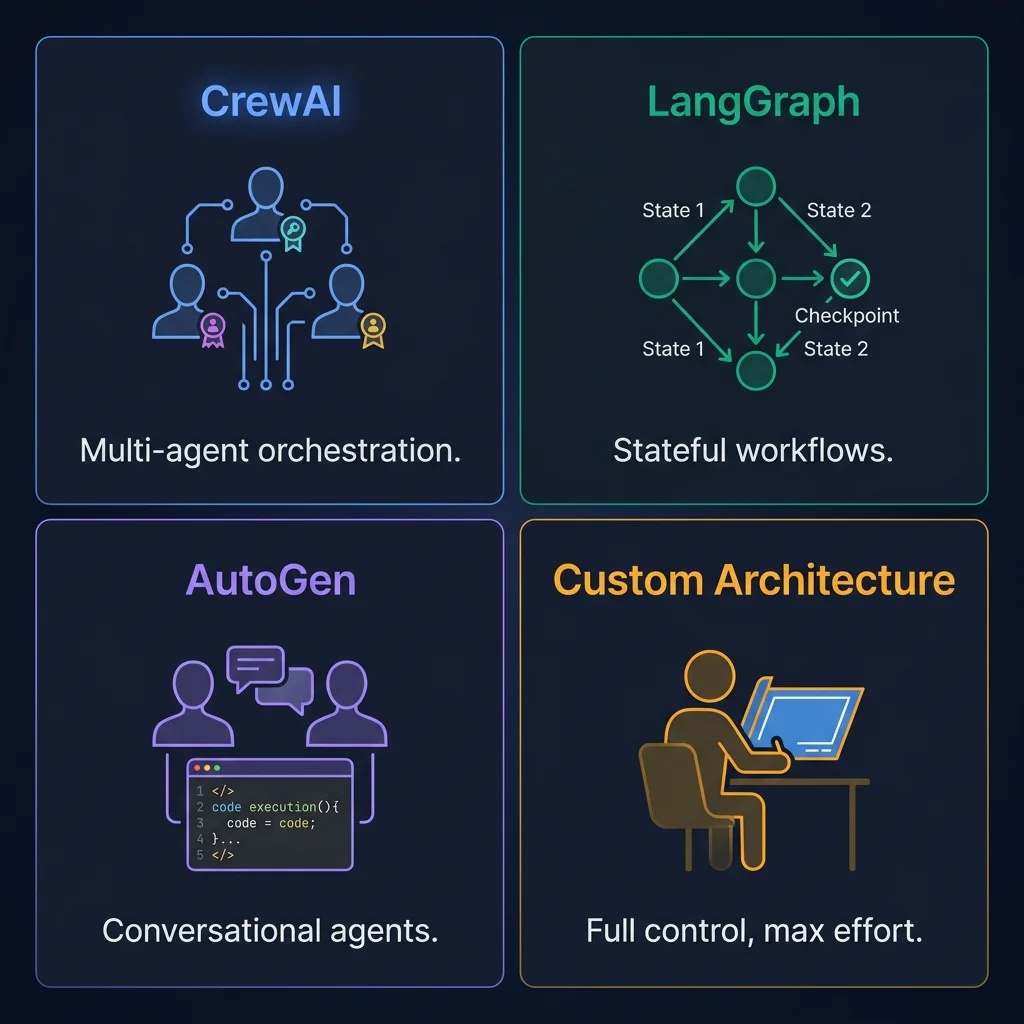
CrewAI
Multi-agent orchestration framework. Define agents with roles, goals, and tools, then orchestrate them in crews. Best for: complex multi-step workflows requiring collaboration between specialized agents. Tradeoff: higher complexity, less control over individual agent behavior.
LangGraph
Stateful agent workflow framework built on LangChain. Define agents as graph nodes with explicit state transitions. Best for: workflows with complex state management, conditional branching, and human-in-the-loop checkpoints. Tradeoff: steep learning curve, LangChain dependency.
AutoGen
Conversational multi-agent framework from Microsoft. Agents communicate via messages and can execute code. Best for: research, prototyping, and conversational agent patterns. Tradeoff: less production-ready, limited governance features.
Custom Architecture
Build your own agent loop using LLM APIs directly. Full control over every component. Best for: specialized use cases, performance-critical systems, teams with deep AI expertise. Tradeoff: maximum effort, no community support, all governance built from scratch.
FLYTEBIT's approach: We use a custom architecture for our products (PASSR, DOCKR, TESTR) because production agentic AI requires tight control over the observe-plan-act-evaluate loop. For client engagements, we evaluate the use case and recommend the right approach - sometimes a framework, sometimes custom, sometimes a hybrid.
Agent architecture explained
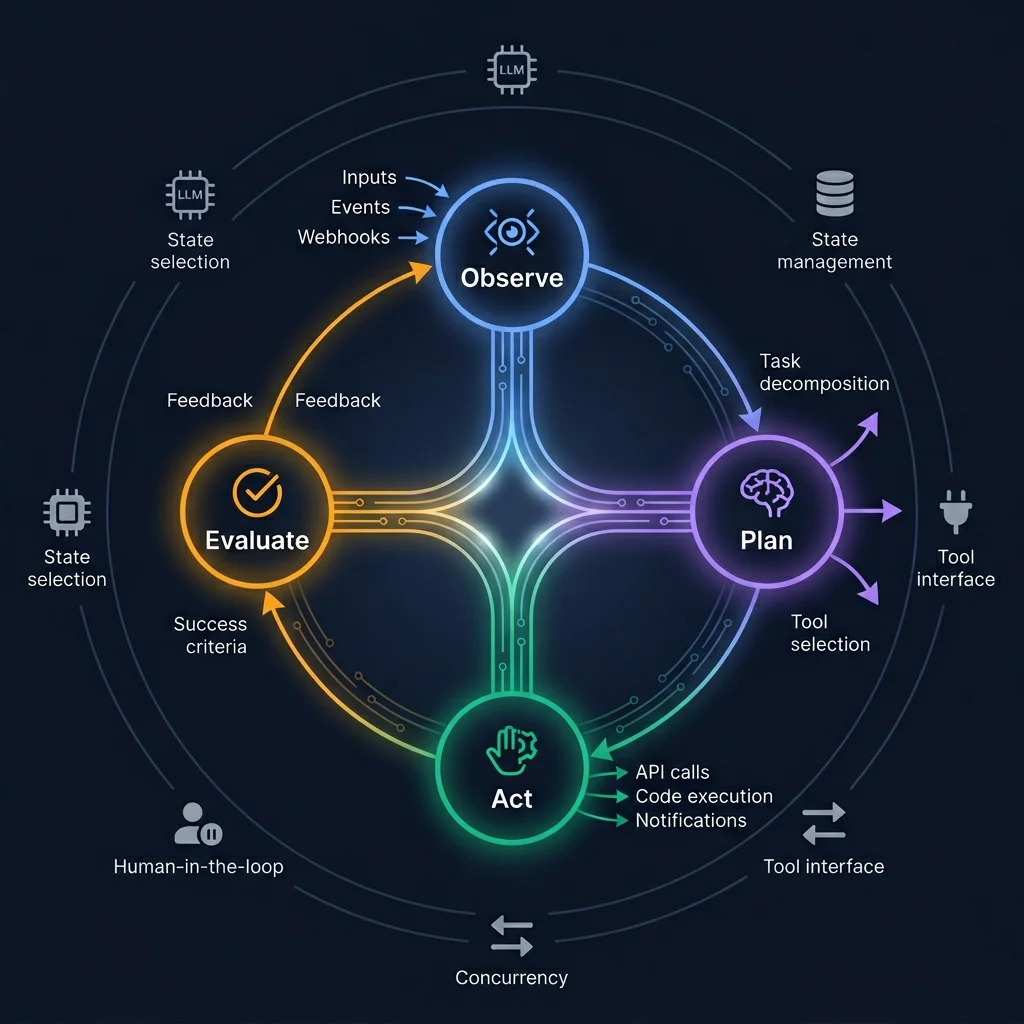
Every agentic AI system follows a variation of the observe-plan-act-evaluate loop. Understanding this loop is essential whether you build or buy.
- Observe: The agent perceives its environment through inputs - events, webhooks, scheduled triggers, user messages, or data changes. It needs to filter, prioritize, and contextualize what it observes.
- Plan: Based on its observation and goals, the agent decides what to do. This involves reasoning (often via LLM), tool selection, and task decomposition. The plan may be simple (one action) or complex (multi-step workflow with dependencies).
- Act: The agent executes its plan - calling APIs, running code, querying databases, sending notifications, or escalating to humans. Actions must be idempotent, logged, and reversible where possible.
- Evaluate: After acting, the agent checks the result against its success criteria. Did the action achieve the intended outcome? If not, it retries, adjusts its plan, or escalates. This feedback loop is what makes the system agentic rather than purely reactive.
Key architectural decisions:
- Model selection: Which LLM(s) power the reasoning? GPT-4, Claude, open-source models? Consider cost, latency, and capability tradeoffs.
- State management: How is agent state persisted? In-memory, database, or event log? State management determines recovery and auditability.
- Tool interface: How does the agent call external systems? REST APIs, function calling, MCP (Model Context Protocol)?
- Concurrency: Can the agent handle multiple tasks simultaneously? How are conflicts resolved?
- Human-in-the-loop: What decisions require human approval? How is the handoff handled? How long does the agent wait?
Guardrails and governance
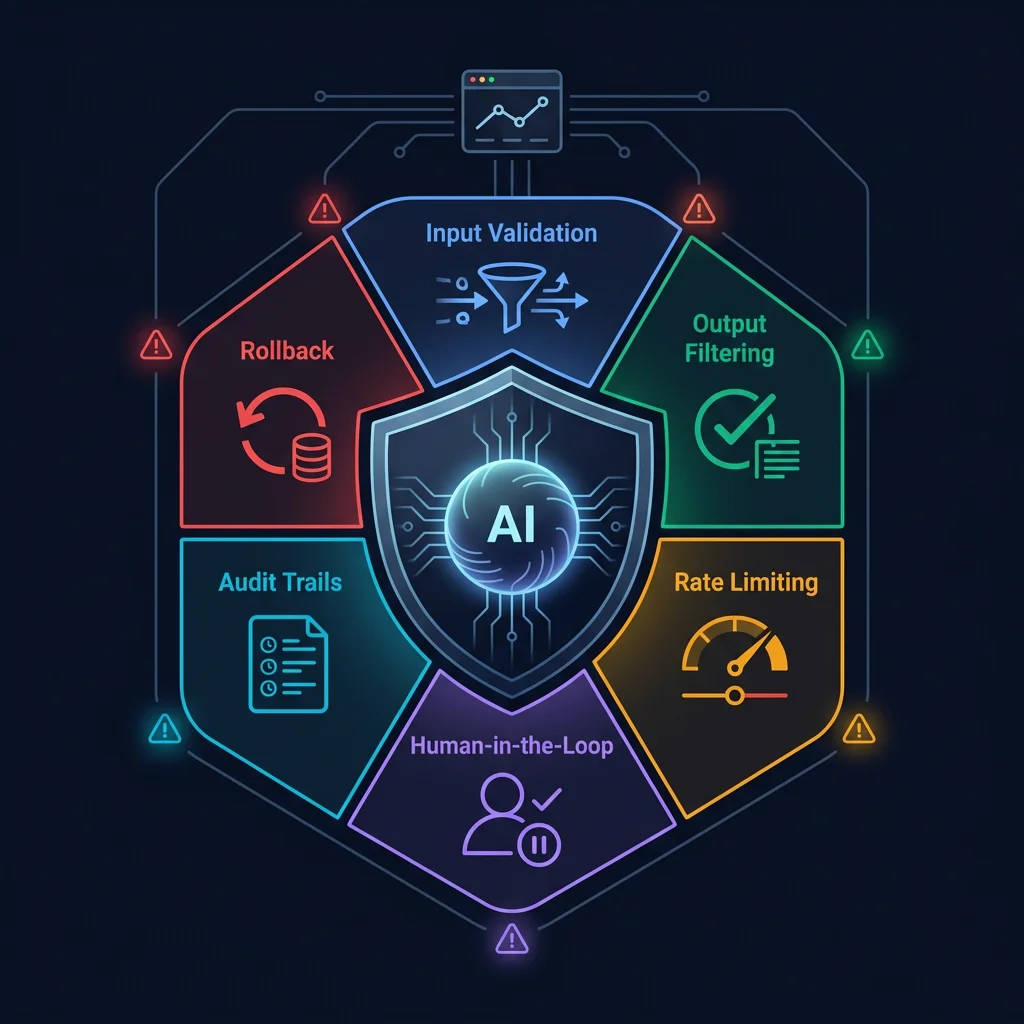
Governance is what separates production agentic AI from demos. An agent without guardrails is a liability - it can send wrong emails, execute harmful code, or make decisions that violate policy. Every agentic AI system needs:
- Input validation: Sanitize and validate all inputs before the agent processes them. Prevent prompt injection, data exfiltration, and unauthorized access.
- Output filtering: Check all agent outputs before they reach users or external systems. Filter sensitive data, validate format, and check for harmful content.
- Rate limiting: Limit how many actions the agent can take per time period. Prevent runaway loops, resource exhaustion, and cost spikes.
- Human-in-the-loop checkpoints: Define which decisions require human approval. High-impact actions (financial transactions, customer communications, infrastructure changes) should always require human sign-off.
- Audit trails: Log every decision the agent makes - what it observed, what it planned, what it did, and what the outcome was. This is essential for debugging, compliance, and improvement.
- Rollback mechanisms: Design actions to be reversible. If the agent makes a mistake, you need to undo it quickly. Database transactions, soft deletes, and staged deployments all help.
- Monitoring and alerting: Monitor the agent in production. Alert on anomalies - unexpected action patterns, error rate spikes, or governance violations.
FLYTEBIT's approach: All our products implement these guardrails in production. PASSR's reviews are transparent and auditable. DOCKR's documentation is human-reviewed before publishing. TESTR's test generation includes human-in-the-loop governance. We bring this production governance experience to every custom agentic AI engagement.
Signs you need agentic AI systems
Most teams do not realize they need agentic AI until the pain becomes visible. The signals show up in queues, cycle times, and audit gaps long before anyone frames the problem as "we need AI."
- Ticket queues accumulate overnight. Work arrives faster than your team can triage it, and the backlog grows every week.
- PR review bottlenecks stall releases. Engineers wait hours or days for a reviewer, and the wait costs more than the review.
- Data reconciliation lags between systems. Sync jobs run on schedules instead of triggers, so reports are stale by the time anyone reads them.
- Repetitive multi-step workflows exceed team capacity. The same sequence of checks, handoffs, and approvals runs every day, and it eats the hours your team should spend on harder work.
- Manual handoffs break audit trails. Work moves between tools and people with no shared log, so compliance reviews turn into archaeology digs.
If two or three of these sound familiar, the next question is whether the payoff justifies the build. The cost analysis below breaks that down.
Cost analysis
| Cost Component | Build In-House | Buy (SaaS) | Hybrid (FLYTEBIT) |
|---|---|---|---|
| AI engineering talent | $150K-$400K/yr per engineer | $0 | $0 (included in engagement) |
| Infrastructure (LLM APIs, hosting) | $2K-$20K/month | Included in subscription | $1K-$10K/month |
| Development time | 3-12 months | 1-4 weeks setup | 2-8 weeks |
| Governance & guardrails | 2-4 weeks additional dev | Vendor-provided | Production-tested, included |
| Ongoing maintenance | 0.5-1 FTE continuously | Vendor handles | Product updates included |
| Total Year 1 (estimated) | $200K-$600K+ | $12K-$120K | $20K-$200K |
The build vs buy comparison turns on opportunity cost as much as money. Every month your team spends building an agentic AI system from scratch is a month they are not building your core product. For most companies, the hybrid approach delivers the best ROI: you get a custom system built on proven foundations, with production guardrails, in weeks instead of months.
FLYTEBIT's feasibility study: We start with a feasibility study starting from $2K that defines the architecture, timeline, and ROI before any large commitment. The final cost depends on the scope and engagement model. This de-risks the engagement and gives you a clear build vs buy recommendation based on your specific situation.
Is an agentic AI system worth it?
For teams drowning in repetitive operational work, the answer is yes. Teams running agentic systems in production report 30% to 70% operational cost reductions on automated workflows. Cycle times drop from days to minutes because handoffs happen automatically instead of waiting in someone's queue.
The return shows up across two main areas:
- Direct labor savings: Engineers and operations staff stop spending hours on routine triage and manual checks.
- Faster turnarounds with fewer mistakes: Work that once waited overnight runs as soon as data arrives, and automated guardrails catch bugs before customers see them.
Most teams reach full payback within three to six months on a focused pilot. The exact return depends on your transaction volume and the scope of work.
Frequently asked questions
What platforms offer agentic AI development services? ▾
Agentic AI development services are offered by specialized AI companies like FLYTEBIT, framework providers like CrewAI and LangChain, and large consulting firms. For custom agentic AI systems with production guardrails, product-first firms like FLYTEBIT offer the best combination of speed and customization. For DIY approaches, open-source frameworks like CrewAI, AutoGen, and LangGraph provide building blocks.
What are the best tools for creating autonomous agents for business decision-making? ▾
The best tools depend on your approach. For building from scratch: CrewAI (multi-agent orchestration), LangGraph (stateful workflows), AutoGen (conversational agents). For production-ready custom systems: FLYTEBIT's Agentic AI Systems service. For no-code agent building: platforms like Flowise and Stack AI. Evaluate based on your team's AI expertise, timeline, and governance requirements.
Should I build or buy agentic AI systems? ▾
Build if you have dedicated AI engineering talent, unique requirements that off-the-shelf solutions cannot meet, and a long-term AI roadmap. Buy if you need fast time-to-value, lack in-house AI expertise, or want proven guardrails and governance. A hybrid approach - partnering with a product-first firm like FLYTEBIT that builds custom systems on proven foundations - often delivers the best balance of speed, cost, and control.
Can I build an agentic AI system myself or should I hire a pro? ▾
You can build in-house if you have engineers experienced with LLM orchestration and state management. Frameworks like LangGraph and CrewAI give you starting blocks. But production guardrails and audit trails take months from scratch. Teams without dedicated AI talent spend $50K to $200K on prototypes that stall in staging. A specialized partner gets you to production in weeks instead of quarters. Which path makes sense depends on your team's bandwidth and timeline.
What are the signs you need agentic AI systems? ▾
The signs show up in operational pain before anyone calls it an AI problem. Ticket queues growing overnight. PR reviews stalling releases for hours. Data reconciliation running on schedules instead of triggers, so reports are stale by the time anyone reads them. Repetitive multi-step workflows eating the hours your team should spend on harder work. Manual handoffs breaking audit trails because there is no shared log. If two or three of these sound familiar, agentic AI is worth evaluating on one focused workflow before scaling.
Is an agentic AI system worth it? ▾
Yes, if you put it on high-volume workflows where decisions follow clear rules. Teams shipping agentic systems see 30% to 70% cost cuts on repetitive tasks. Cycle times drop from days to minutes because handoffs happen automatically. Savings come straight from fewer review hours and less rework from mistakes. Most teams break even in three to six months on a focused rollout. The actual return depends on your transaction volume and the scope of work.
How much does it cost to build an agentic AI system? ▾
Building an agentic AI system in-house requires significant investment in AI engineering talent, infrastructure, and ongoing maintenance. A feasibility study with FLYTEBIT starts from $2K, with full engagements starting from $8K onwards. The final cost depends on the scope and engagement model. Open-source frameworks (CrewAI, LangGraph) are free but require significant engineering time to productionize.
How much does an agentic AI system cost per hour or per project? ▾
Senior AI engineers and architects bill $150 to $300 an hour. Building in-house on a project basis runs $50K to $500K. That covers salaries, API tokens, and ongoing upkeep. Working with FLYTEBIT starts with a feasibility study from $2K, with custom builds from $8K. The final cost depends on the actual scope of the work and the engagement model.
How to choose between AI software development vendors for implementing autonomous agents in enterprise workflows? ▾
Evaluate vendors on five criteria: (1) Production experience with agentic systems, not just demos or prototypes. Ask for case studies where agents ran in production for months. (2) Governance and guardrails. The vendor should have a clear approach to human-in-the-loop checkpoints, audit trails, rollback mechanisms, and output validation. (3) Integration depth. The vendor should connect agents to your existing infrastructure (databases, APIs, CI/CD, monitoring) rather than requiring a parallel system. (4) Engagement model. Product-first firms like FLYTEBIT build custom systems on proven product foundations, giving you both speed and customization. Staff augmentation firms give you bodies but no system. (5) Post-deployment support. Agentic systems need monitoring, retraining, and iteration. Confirm what happens after the initial build is delivered.
What is the difference between agentic AI and generative AI? ▾
Generative AI creates content (text, images, code) from a prompt. Agentic AI makes decisions, takes actions, and operates autonomously in a continuous loop. Generative AI is a capability; agentic AI is a system that may use generative AI as one of its tools. FLYTEBIT's products are agentic - PASSR decides what to review and how, DOCKR decides what to document and when, TESTR decides what tests to generate and validate.
What are the potential risks associated with agentic AI systems? ▾
The main risks are autonomous action errors (the agent takes the wrong action and it goes live before anyone catches it), prompt injection (a malicious input manipulates the agent into doing something it should not), cost runaway (the agent loops or calls expensive APIs before anyone notices), data exposure (the agent accesses or sends sensitive data to the wrong place), cascading failures where one agent's error triggers errors in downstream systems, and governance gaps where autonomy expands faster than the controls around it. Input validation, output filtering, rate limiting, human-in-the-loop checkpoints, audit trails, rollback mechanisms, and monitoring are what address these. They are not optional. They are what separate a production agent from a demo. The governance section above covers each one.
Why is transparency important in agentic AI systems? ▾
Because an agent acts on its own. If you cannot see what it did, why it did it, and what the outcome was, you cannot debug it, prove compliance, or trust it. Transparency is what makes an autonomous system auditable. Without it, you have a black box making decisions in your name. Audit trails log every action the agent takes: what it observed, what it planned, what it executed, and what the result was. That log is what lets you reproduce failures and answer questions from regulators. It is also how you improve the agent, because you can see which decisions led to good outcomes and which did not. The governance section above covers what to log.
Building agentic AI? Start with a feasibility study.
A 30-minute consultation will help you clarify your use case, understand the build vs buy tradeoffs, and decide whether FLYTEBIT's hybrid approach is right for you.