Autonomous AI Agents That Run Your Engineering Pipeline
Most AI tools wait to be asked. Agentic systems don't. They work in the background, watching the pipeline, catching the gaps, keeping the docs current, and surface findings when they have something worth saying.
We build agentic AI systems for any domain where decisions follow patterns and work accumulates faster than people can clear it. Not tools you prompt. Not dashboards you check. Systems that run continuously against a process, make judgment calls, and report back without being asked.
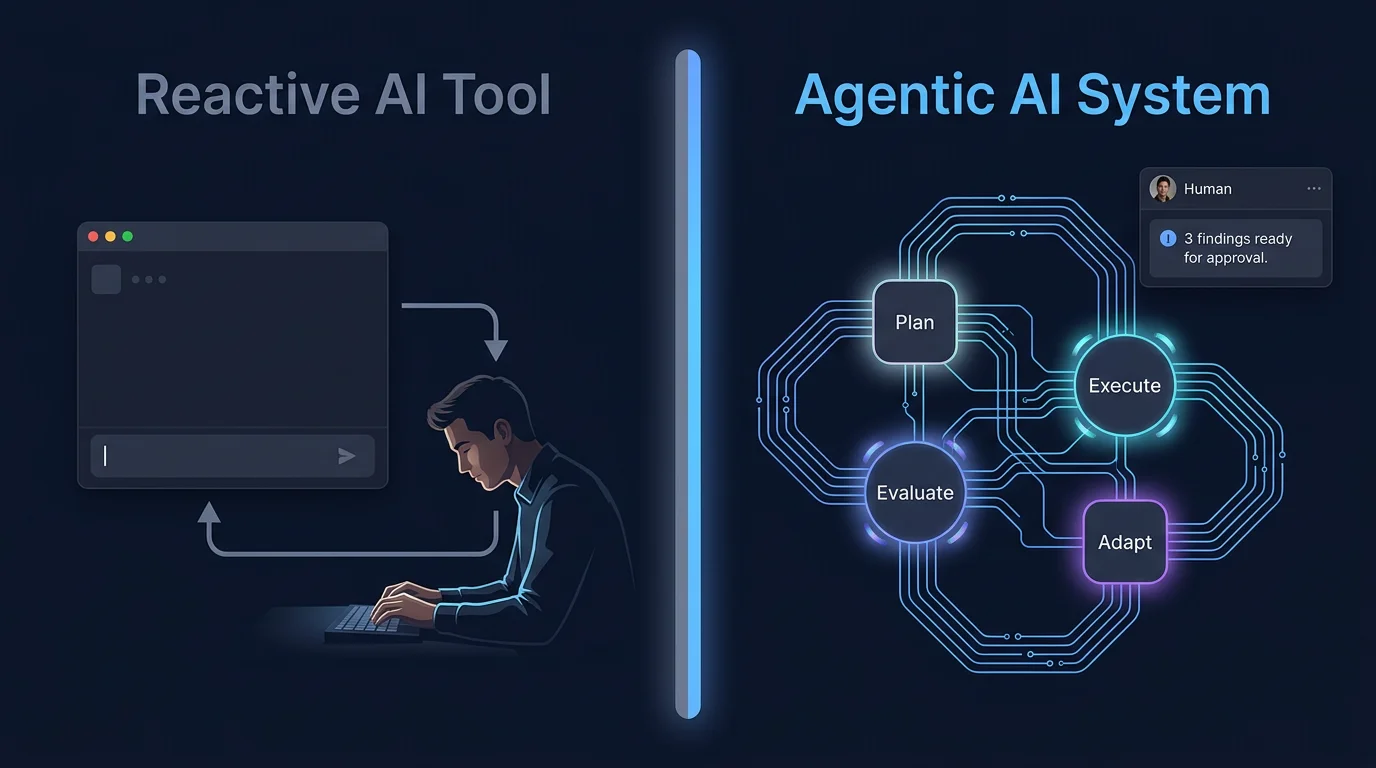
A reactive AI tool waits. You open it, give it a task, it responds, then it stops. That covers maybe 20% of the work an engineering team actually needs done.
An agentic system operates on goals, not commands. You tell it what to watch (a codebase, a support queue, a data pipeline, an operations workflow) and it decides what to do, does it, evaluates the result, and decides what to do next. When something is worth flagging, it flags it. When something needs to be updated, it updates it. It does not wait to be asked.
The practical difference: a reactive tool helps the person at the keyboard right now. An agentic system covers the work that no one is actively doing: the ticket queue building up overnight, the compliance gap accumulating between audit cycles, the monitoring that lapses under delivery pressure.
The scope
Agentic AI vs. Traditional Automation
Agentic AI systems go beyond the reactive tools most teams use today. Traditional automation executes a fixed script on a trigger. An agentic system decides what to do, executes it, evaluates the result, and decides what to do next. The same principles of watch, decide, act, report apply wherever work accumulates faster than people can clear it.
Software delivery
Documentation that stays current on every commit. PRs reviewed the moment they open. Test coverage that scales with output, not with team capacity.
Customer operations
Support queues triaged and routed autonomously. Escalations surfaced before they become incidents. Response drafts ready for human review in seconds.
Data & compliance
Pipeline anomalies caught before they compound. Regulatory requirements checked continuously against live data. Audit trails generated without manual scheduling.
Business processes
Workflows monitored for exceptions. Decisions flagged when they fall outside defined parameters. Reports generated and distributed without human scheduling.
The loop
AI Workflow Automation: How It Works
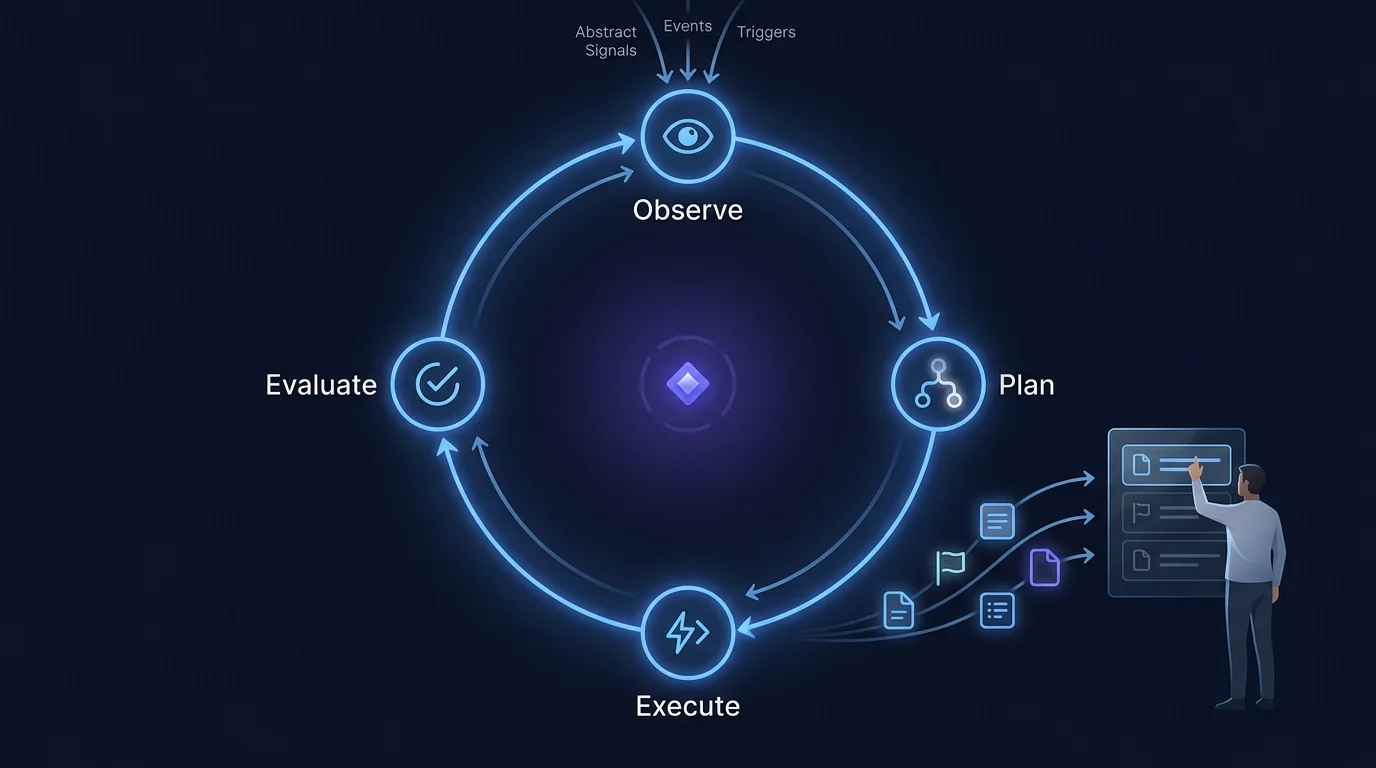
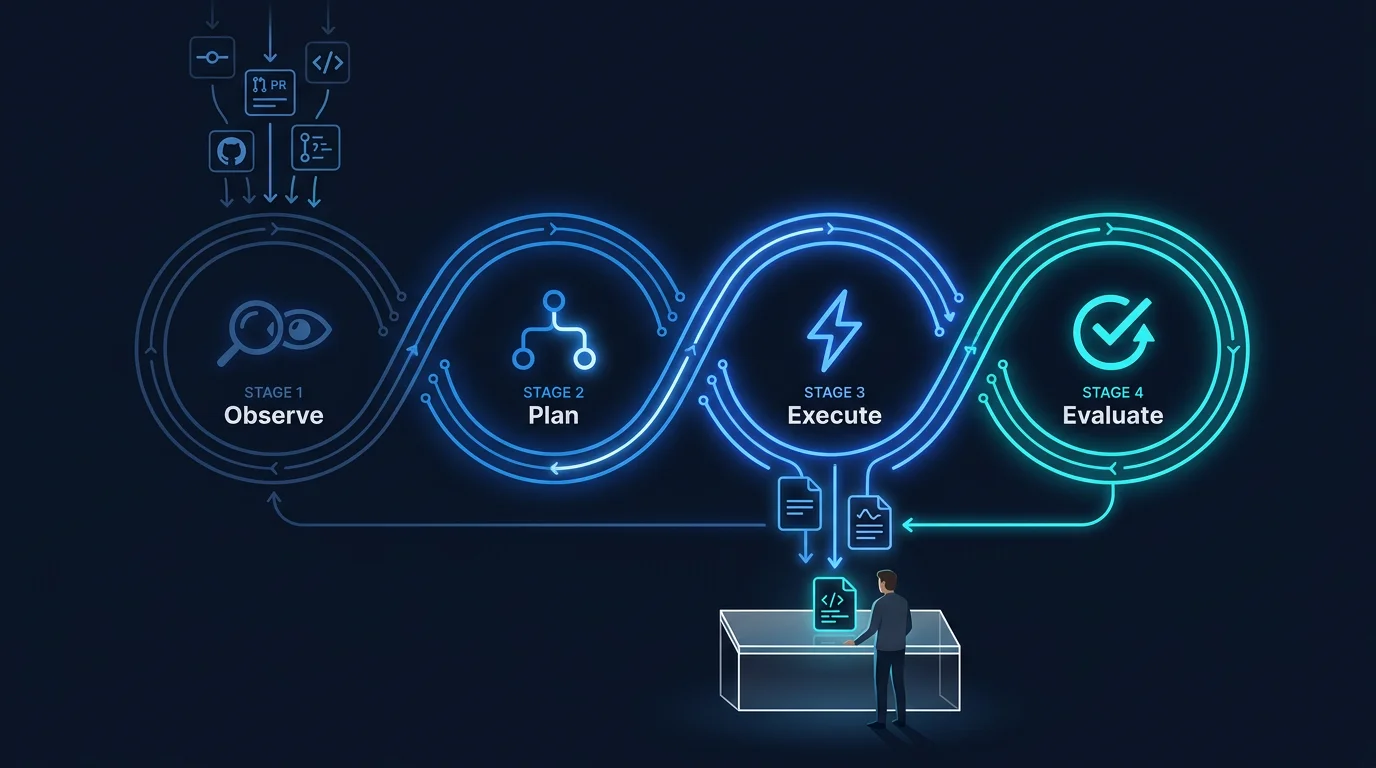
AI workflow automation is not a scheduled task. It is a continuous loop that runs against your process without human initiation.
The system observes events from your pipeline: commits, PRs, deployments, support tickets. It plans what to do based on the pattern it recognises. It executes the work (generating documentation, reviewing code, creating tests), then evaluates the result and decides what to do next.
The loop never stops. When the human arrives, the work is already done and waiting for approval. That is the difference between AI workflow automation and traditional automation. See our workflow automation service.
What we've built
Our first three agentic products
We started with software delivery. These three products cover the layers that coding assistants leave untouched (documentation, code review, and test coverage), each running autonomously, triggered by the same events your pipeline already produces.
These are live products you can deploy today. They are also a worked example of the architecture. If your domain is different, talk to us.
Watches every commit. Analyses what changed and updates documentation automatically: architecture diagrams, API references, module summaries. Always current, committed on every push.
Codebase analysisArchitecture diagramsAuto-updates on commitGitHub & GitLab
Reviews every PR across eight quality dimensions: security, availability, performance, scalability, architecture, code quality, testing, and maintainability. Every finding includes an impact assessment and a ready-to-apply fix.
Reads every function via AST, discovers what should be tested, and generates executable test code across 11+ languages with auto-generated mocks. Runs through CI/CD on every commit.
Agentic systems do not replace your existing infrastructure. They connect to it. Every system we build integrates directly with the tools you already use: GitHub, GitLab, Jira, CI/CD pipelines, Slack, and cloud infrastructure. The agents observe events from these systems, plan responses, execute work, and push results back through the same channels.
This means zero workflow change for your team. The documentation agent commits to the same repo. The review agent posts to the same PR thread. The test agent runs in the same CI/CD pipeline. Your engineers do not learn a new tool. They simply see better output in the tools they already know.
The governance model
Autonomous by default. Human by design.
The question we get most often: "What stops the system from making a bad call?" The answer is that the system does not make calls. It makes candidates. Every finding, every suggested action, every generated output is reviewed by a human before it has any effect. For systems that act on their own, our AI governance and risk engagement designs the runtime enforcement layer: scoped credentials, policy hooks, kill switches, and audit trails.
What the system does not do
Take irreversible actions without approval. Override human decisions. Operate without visibility to the team. Apply outputs directly to any system without a review step.
What the system does do
Monitor continuously and generate candidate outputs. Flag issues with full context and impact assessments. Surface actions with ready-to-apply implementations. Keep the human informed at every step.
An agentic AI system is software that pursues a goal autonomously without needing a command for every step. It plans, executes, monitors its output, and adjusts when something changes. Unlike a chatbot or a code autocomplete tool, an agentic system keeps running after you walk away.
What can agentic AI systems do?
Agentic AI systems plan multi-step workflows, call external APIs and tools, handle errors on their own, learn from outcomes, and run in the background without stopping. They break a high-level goal into subtasks, execute each one, check the result, and adjust when something fails. In production they review code, generate documentation, write tests, monitor pipelines, triage support tickets, and process transactions. No one prompts them at every step.
What is the difference between AI automation and autonomous AI agents?
AI automation executes a fixed script on a trigger. Agentic AI decides what to do, executes it, evaluates the result, and decides what to do next. Automation is deterministic. Agentic systems are adaptive. Automation handles the tasks you anticipated. Agentic AI handles the ones you didn't.
Are DOCKR, PASSR, and TESTR agentic AI systems?
Yes. Each one runs continuously in the background, triggered by code events, and makes decisions without waiting for human prompts. DOCKR analyses what changed and decides what to update. PASSR reviews every PR across eight quality dimensions and generates resolution packages. TESTR discovers what should be tested and generates the test code. All three integrate into your pipeline and report findings rather than waiting for questions.
How do agentic AI systems integrate with our existing tools?
Agentic systems are designed to integrate with your existing tools, not replace them. They connect to your data sources, APIs, and event streams, and trigger on signals your systems already produce. The specific integrations depend on the domain, but well-built systems are measured in days to deploy, not months.
What is the risk of running agentic systems in a production pipeline?
All three products are built with human-in-the-loop governance. They surface findings and generate candidates (fixes, tests, documentation updates) that a human approves before anything enters the pipeline. For autonomous systems that act on their own, our governance and risk engagement designs the enforcement layer. The system does the work. The engineer makes the final call.
What is AI agent development?
AI agent development is the process of building software agents that pursue goals autonomously. You define what the agent should watch and what outcomes it should produce. The agent then plans, executes, evaluates, and adjusts without a human prompting it at every step. FLYTEBIT builds AI agents for engineering workflows: documentation, code review, and test generation. Each agent integrates with your existing pipeline and operates under human-in-the-loop governance. A feasibility study starts from $2K. Full engagements start from $8K onwards. The final cost depends on the scope and engagement model.
What role do feedback loops play in agentic AI systems?
Feedback loops are what make a system agentic rather than scripted. After each action, the system evaluates the result against the goal: did the fix pass review, did the document match the code, did the test actually run. That outcome feeds the next planning cycle, so the agent corrects errors, converges on the goal, and adapts when conditions change. Without a feedback loop you have automation. With one, the system can pursue a goal across changing inputs. Read the full breakdown.
What are some examples of agentic AI systems?
Production examples include documentation agents that rewrite docs on every commit (DOCKR), code review agents that score every pull request across eight quality dimensions (PASSR), and test generation agents that discover coverage gaps and write the tests (TESTR). Beyond engineering: support agents that triage and draft responses, compliance agents that check live data against regulatory rules, and operations agents that watch pipelines and remediate anomalies.
Is ChatGPT or Copilot agentic AI?
Not by default. ChatGPT and GitHub Copilot are reactive assistants: they respond to a prompt, produce output, and stop. They do not pursue a goal across time, decide what to do next, or act on your systems without being asked. ChatGPT becomes part of an agentic system when it is wrapped in a loop with tools, memory, and a goal; the model is a component, not the agent.
What is a significant current limitation of agentic AI systems?
Reliability compounds across steps. If each action is 95% correct, a ten-step autonomous run lands near 60% overall, so unmonitored autonomy drifts. Other real limits: cost grows with reasoning depth, evaluation frameworks are still immature, and governance gets hard once agents take actions with side effects. This is why production systems need scoped permissions, eval gates, and a kill switch designed in from the start.
Talk to Us About Autonomous AI Agents for Your Pipeline
Start with a conversation. We will map your current pipeline and show you exactly where agentic systems would close the gaps.