Complete guide

AI in software development: what actually works

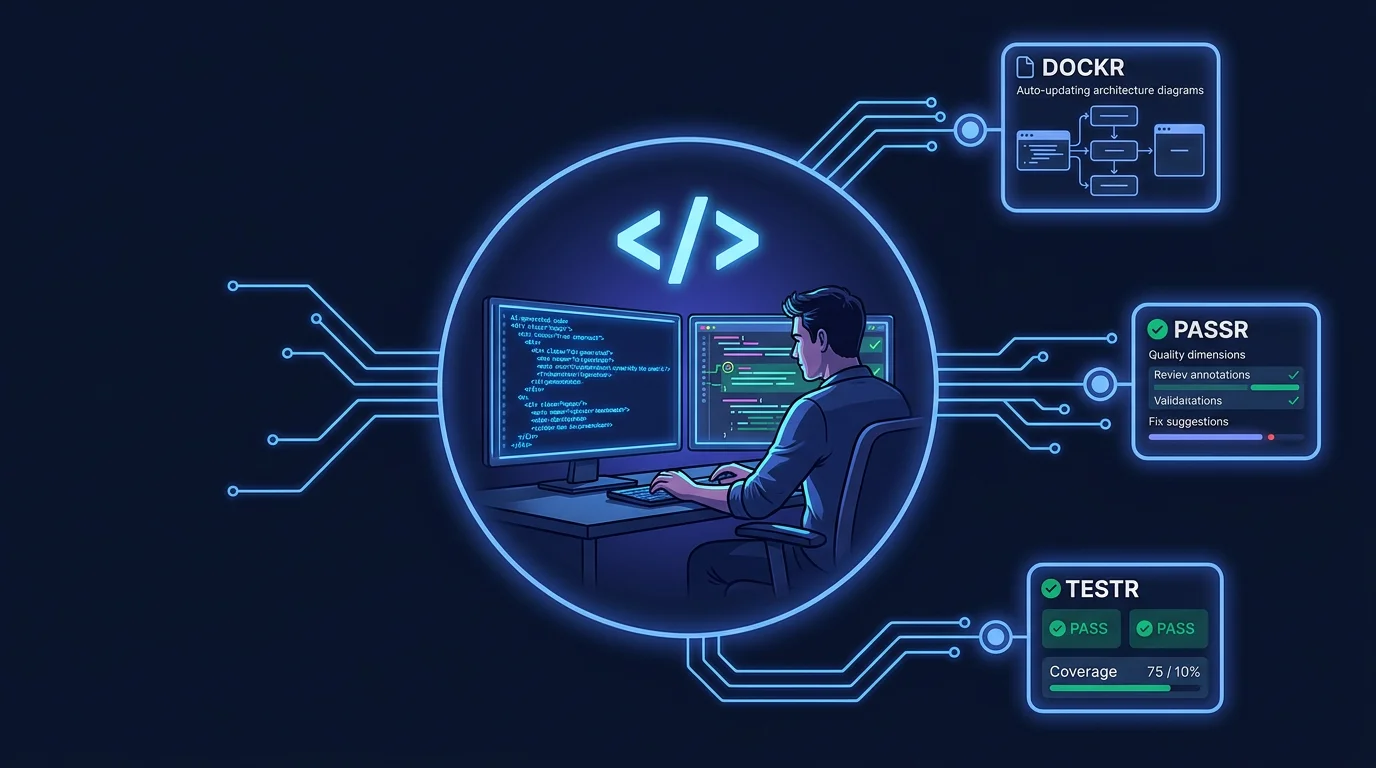
A developer at a workstation with AI-generated code streaming on one monitor and review annotations on the other, connected by circuit-trace lines to documentation, testing, and review nodes

Most teams that buy AI coding tools see no change in their sprint. The code moves faster. The delivery doesn't.

We have spent the last two years building agentic AI systems and running transformation engagements for engineering teams. The pattern is always the same. The tool works. The rollout doesn't. This guide explains why, and what to do about it.

Read the guide
A developer at a workstation with AI-generated code streaming on one monitor and review annotations on the other, connected by circuit-trace lines to documentation, testing, and review nodes
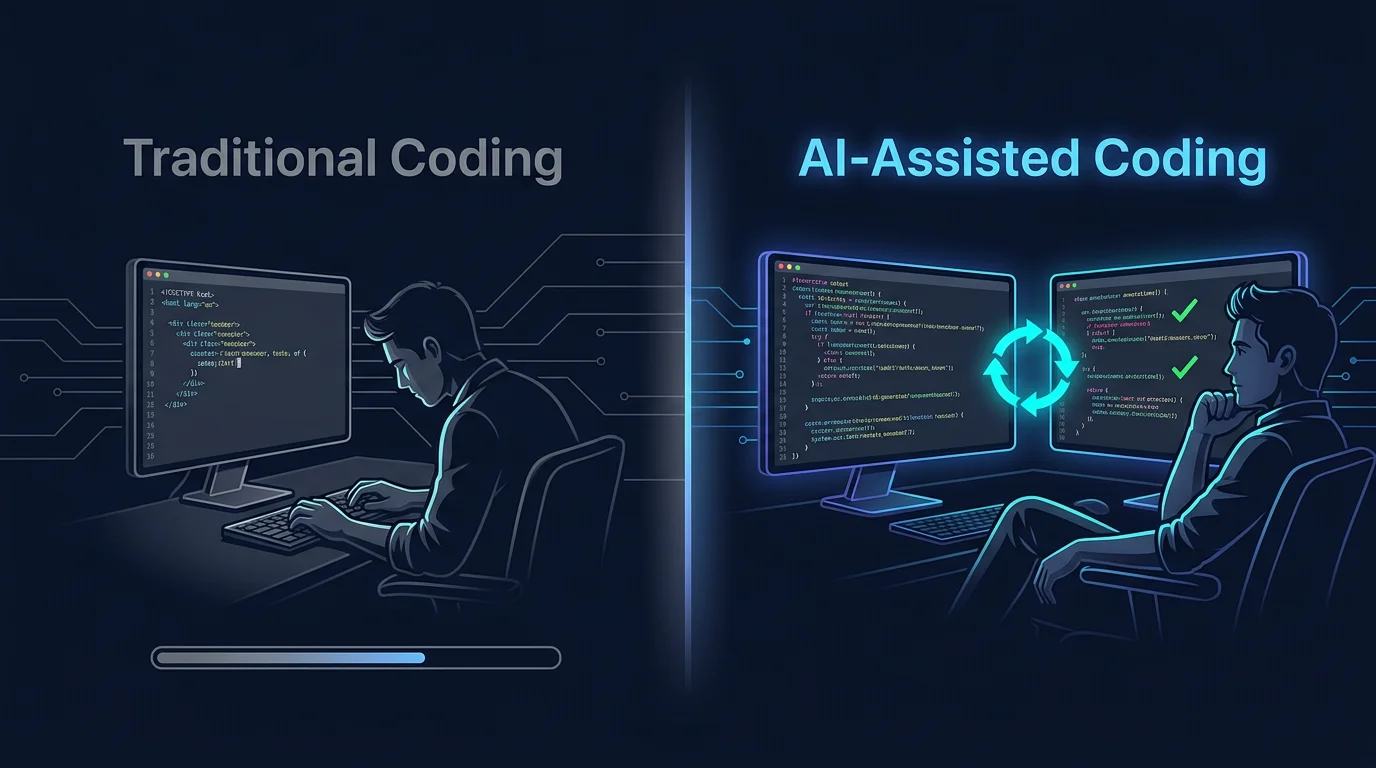
Split-screen comparison showing traditional coding on the left with a developer typing line by line, and AI-assisted coding on the right with a developer reviewing AI-generated code streams

What is AI in software development?

Split-screen comparison showing traditional coding on the left with a developer typing line by line, and AI-assisted coding on the right with a developer reviewing AI-generated code streams

AI in software development means using machine learning models to write, review, test, and document code. The developer describes intent in natural language. The model generates the implementation. The developer validates, corrects, and owns the output.

This is not science fiction. GitHub Copilot, Cursor, and similar tools are already in daily use across most engineering teams.

The tools are good. The problem is almost never the tool.
84%
of developers using or planning to use AI coding tools
51%
of professional developers use AI tools every day

AI in application development vs. traditional coding

In traditional coding, the developer writes every line manually. Speed is limited by typing and syntax recall. Context lives in the developer's head. Iteration means rewriting code.

In AI-assisted development, the developer directs the model, reviews the output, and validates against requirements. Speed is limited by judgment and prompt quality. Context lives in the brief and the prompt. Iteration means steering, not rewriting.

The role shifts from author to architect-and-reviewer. This is a genuine improvement for the individual developer. But it changes almost nothing about the pipeline that surrounds them.

DimensionTraditional codingAI-assisted coding
Primary activityWriting every line manuallyDescribing intent, reviewing output
Speed limiterTyping and syntax recallJudgment and prompt quality
Context storageDeveloper's memoryBrief and prompt
Iteration styleRewrite codeSteer output
RoleAuthorArchitect-and-reviewer

How to develop AI-powered software the right way

Most teams start by buying the tool and announcing it in Slack. Three sprints later, the PR queue is longer, the test coverage is the same, and the tech lead is spending more time on reviews than ever.

The right approach starts with a feasibility study. Map your current state. Identify what's blocking transformation at each layer. Fix the blockers. Then roll out tools and process changes together.

We run this as a two-stage engagement. Stage 1 is a four-week audit of your development landscape. Stage 2 is the transformation itself, scoped from the findings. There is no fixed timeline imposed before we understand your situation.

AI automation across the full SDLC

Individual AI coding assistants help the developer write code. They do nothing for the documentation, review, testing, and governance layers that determine whether the sprint actually moves.

We built three products to cover the layers the coding assistants ignore.

DOCKR

Living documentation

Watches every commit. Analyses what changed and updates documentation automatically - architecture diagrams, API references, module summaries. Always current, committed on every push.

Codebase analysis Architecture diagrams Auto-updates on commit GitHub & GitLab

PASSR

Autonomous code review

Reviews every PR across eight quality dimensions - security, availability, performance, scalability, architecture, code quality, testing, and maintainability. Every finding includes an impact assessment and a ready-to-apply fix.

8-dimension analysis Security scanning Ready-to-apply fixes PR-level reporting

TESTR

AI-generated testing

Reads every function via AST, discovers what should be tested, and generates executable test code across 11+ languages with auto-generated mocks. Runs through CI/CD on every commit.

AST-based analysis 11+ languages Auto-generated mocks CI/CD native

Why most AI rollouts stall

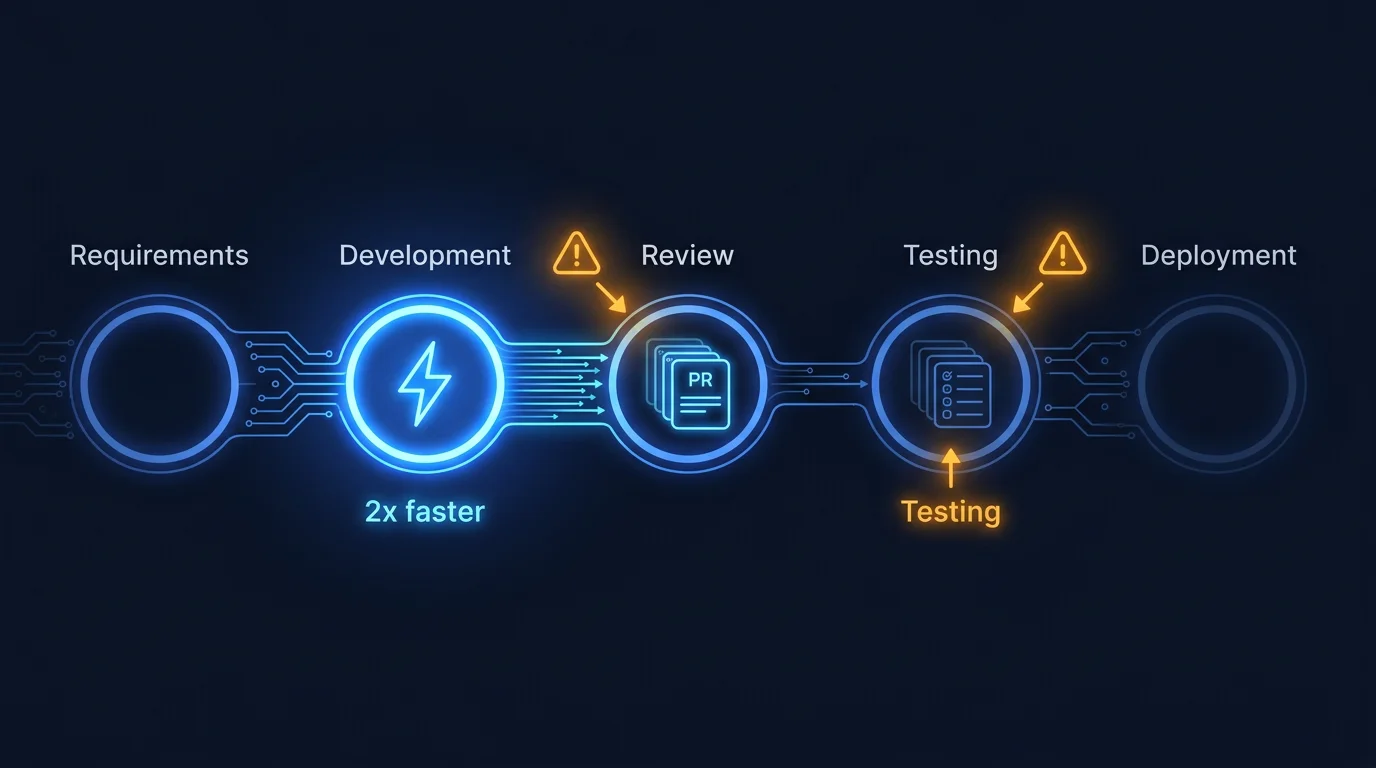
A horizontal pipeline of five connected nodes showing Requirements, Development, Review, Testing, and Deployment. The Development node blazes bright while Review and Testing show warning indicators and piled-up queues
7.2%
decrease in delivery stability per 25% increase in AI adoption
1.5%
drop in throughput per 25% increase in AI adoption

The tools make developers faster. The pipeline around them stays the same. The bottleneck moves downstream.

Think of a software delivery pipeline as a chain. Each link has a throughput limit. AI coding accelerates one link (development). Everything else stays the same speed. Review queues grow. Testing phases become the new bottleneck. Architecture coherence slowly erodes.

This is the expectation gap. The promise was faster sprints. The reality is faster code sitting in the same slow queue.

We wrote a six-part series on this called Vibe Thinking. It covers what needs to change at every layer of the organization, from the developer to the boardroom.

A horizontal pipeline of five connected nodes showing Requirements, Development, Review, Testing, and Deployment. The Development node blazes bright while Review and Testing show warning indicators and piled-up queues

FAQ

What is AI in software development?

AI in software development means using machine learning models to write, review, test, and document code. Developers describe intent in natural language. The model generates the implementation. The developer validates, corrects, and owns the output.

Why do most AI coding tool rollouts fail to improve delivery?

The tools improve individual developer speed, but the surrounding pipeline stays the same. Reviews, testing, requirements, and governance don't speed up automatically. The bottleneck moves downstream instead of disappearing.

How is AI application development different from traditional coding?

In traditional coding, the developer writes every line. In AI-assisted development, the developer describes intent, the model generates code, and the developer validates the output. The role shifts from author to architect-and-reviewer.

What is the right way to adopt AI in software development?

Start with a feasibility study that maps your current state. Identify what's blocking transformation at each layer. Fix the blockers. Then roll out tools and process changes together, not separately.

What AI automation tools work across the full SDLC?

Documentation automation (DOCKR), autonomous code review (PASSR), and AI-generated testing (TESTR) cover the documentation, review, and testing layers of the pipeline. They integrate into GitHub, GitLab, and CI/CD.

Talk to us about your AI transformation

We have run feasibility studies and full transformations for engineering teams across fintech, healthtech, SaaS, and enterprise software. The first step is a 30-minute call to understand your current state.