
Why choosing the right AI partner matters
AI projects fail at a rate of 60-80% depending on which study you read. The most common root cause is not the technology - it is the partnership. Companies hire a firm that understands AI demos but not production systems, or a firm that can build a model but cannot integrate it into existing workflows.
The cost of choosing wrong is significant. Beyond the direct engagement cost, you lose months of internal time, create technical debt that future teams must unwind, and erode organizational trust in AI as a capability. A good partner accelerates your AI journey by years. A bad partner sets it back by the same.
This guide gives you a structured framework to evaluate AI consulting firms and development companies. It is written from the perspective of FLYTEBIT Technologies, a product-first AI company, but the framework applies to any firm you are considering - including our competitors.
Consulting vs development: which do you need?
This guide focuses on choosing an AI development partner, a firm that builds and deploys AI systems. If you instead need help defining your AI strategy, roadmap, or governance framework before building anything, you are looking for an AI consulting partner.
The evaluation criteria differ. Consulting partners are evaluated on strategic depth and governance design. Development partners are evaluated on technical depth and delivery track record. Some firms do both.
Not sure which you need? See our companion guide: How to Choose an AI Consulting Partner.
The 8-step evaluation framework
Walk through these steps in order. Each step has specific questions to ask and criteria to evaluate. Skip none of them.
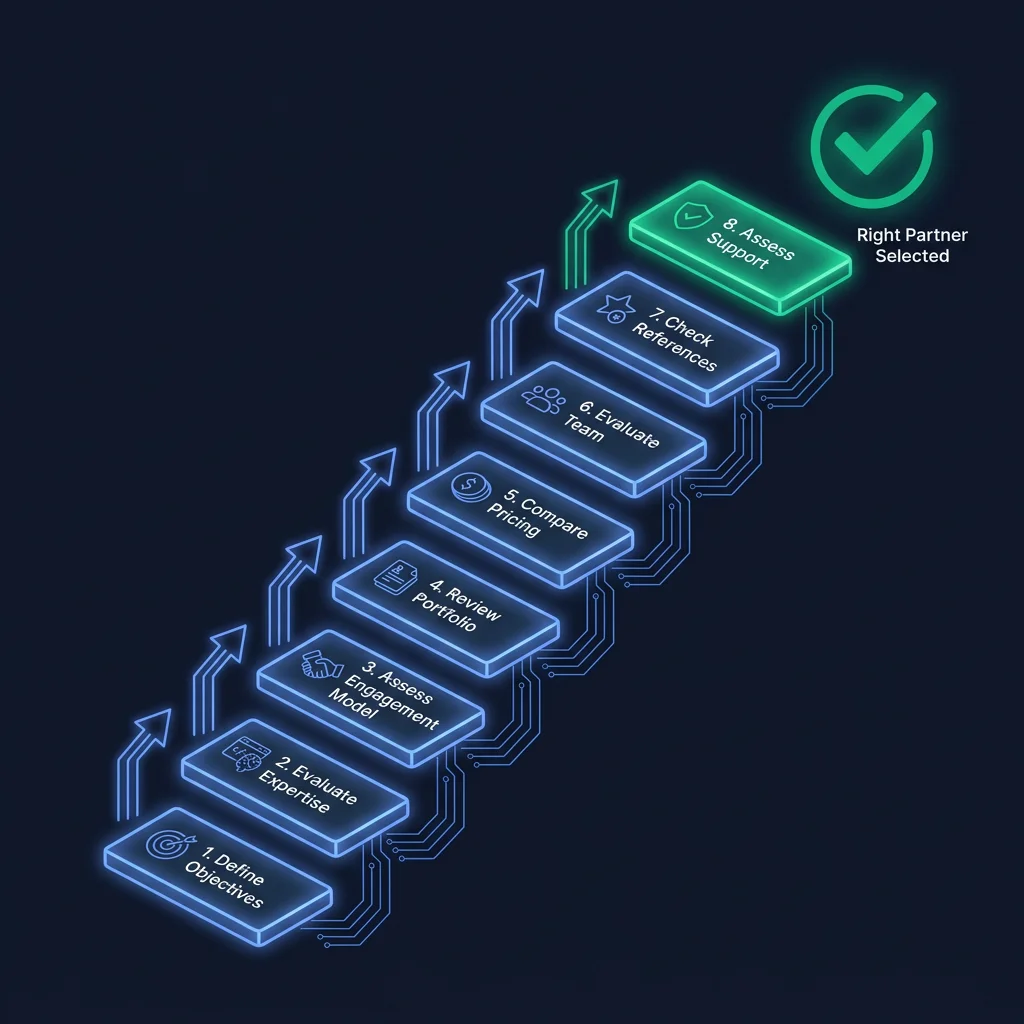
Define your AI objectives
Before evaluating partners, write down what you want AI to do for your business. Are you automating a specific workflow, building a customer-facing AI product, or transforming your entire engineering organization? Your objectives determine what type of partner you need.
Questions to ask yourself:
- What specific problem will AI solve?
- Is this a one-time project or an ongoing capability?
- What does success look like in 90 days? In 12 months?
- Do we have internal AI expertise, or do we need full external delivery?
Evaluate technical expertise and depth
Look for demonstrated experience in your specific AI domain - agentic AI, generative AI, ML Ops, or computer vision. Ask for case studies, architecture diagrams, and technical references. A real AI partner can explain their approach at the model, pipeline, and infrastructure level.
Questions to ask the firm:
- Can you walk me through the architecture of a recent AI system you built?
- What models, frameworks, and infrastructure do you use?
- How do you handle model evaluation, drift detection, and retraining?
- What is your approach to AI safety, guardrails, and human-in-the-loop governance?
Assess the engagement model
Determine whether the firm offers staff augmentation, project-based delivery, or product-first consulting. Staff augmentation gives you bodies; project-based delivery gives you a deliverable; product-first consulting gives you a system that runs continuously. Match the model to your internal capacity.
Key distinction: Product-first firms like FLYTEBIT bring proprietary AI products (DOCKR, PASSR, TESTR) alongside consulting, which means you get battle-tested systems instead of everything built from scratch.
Review portfolio and case studies
Ask for 2-3 relevant case studies with measurable outcomes. Look for specifics: what problem was solved, what architecture was used, what the timeline was, and what the business impact was. Vague claims about "AI transformation" are a red flag.
What to look for:
- Quantified results (e.g., "reduced review time by 70%", not "improved efficiency")
- Industry relevance to your domain
- Technical depth in the case study (not just business outcomes)
- References you can independently verify
Compare pricing structures
AI consulting pricing varies widely. Understand what is included, what is extra, and how change requests are handled. The cheapest option often costs more in the long run due to rework and missed requirements.
Common pricing models:
- Hourly: $50-$300+ per hour depending on seniority and region
- Fixed-price: $10K-$500K per project with defined scope
- Retainer: $5K-$50K/month for ongoing AI development and support
- Product + consulting: Lower consulting cost offset by product licensing
Evaluate team structure and seniority
Ask who will actually work on your project. Many firms sell with senior partners but deliver with junior developers. Request the team composition, years of experience per role, and how much direct access you get to senior architects.
Red flag: If the firm cannot tell you who specifically will be on your team before the contract is signed, you are likely getting whoever is available, not whoever is best suited.
Check references and independent reviews
Ask for 2-3 client references you can speak with directly. Check Clutch, G2, and Google reviews. Look for patterns in feedback - consistent comments about communication, delivery, or quality are more telling than individual ratings.
Where to check:
- Clutch: Verified reviews for consulting and IT services
- G2: Product reviews if the firm has AI products
- LinkedIn: Employee profiles and company page activity
- GitHub: Open-source contributions and public repositories
Assess post-delivery support
AI systems need monitoring, retraining, and iteration. Ask what happens after the project ends. Do they offer ongoing support? How are model updates handled? What is the cost of post-launch maintenance?
The best partners treat delivery as the beginning of the relationship, not the end. FLYTEBIT's product-first approach means the AI systems we deploy (DOCKR, PASSR, TESTR) are continuously updated as part of the product lifecycle - you do not need a separate maintenance contract to keep them current.
Engagement models compared
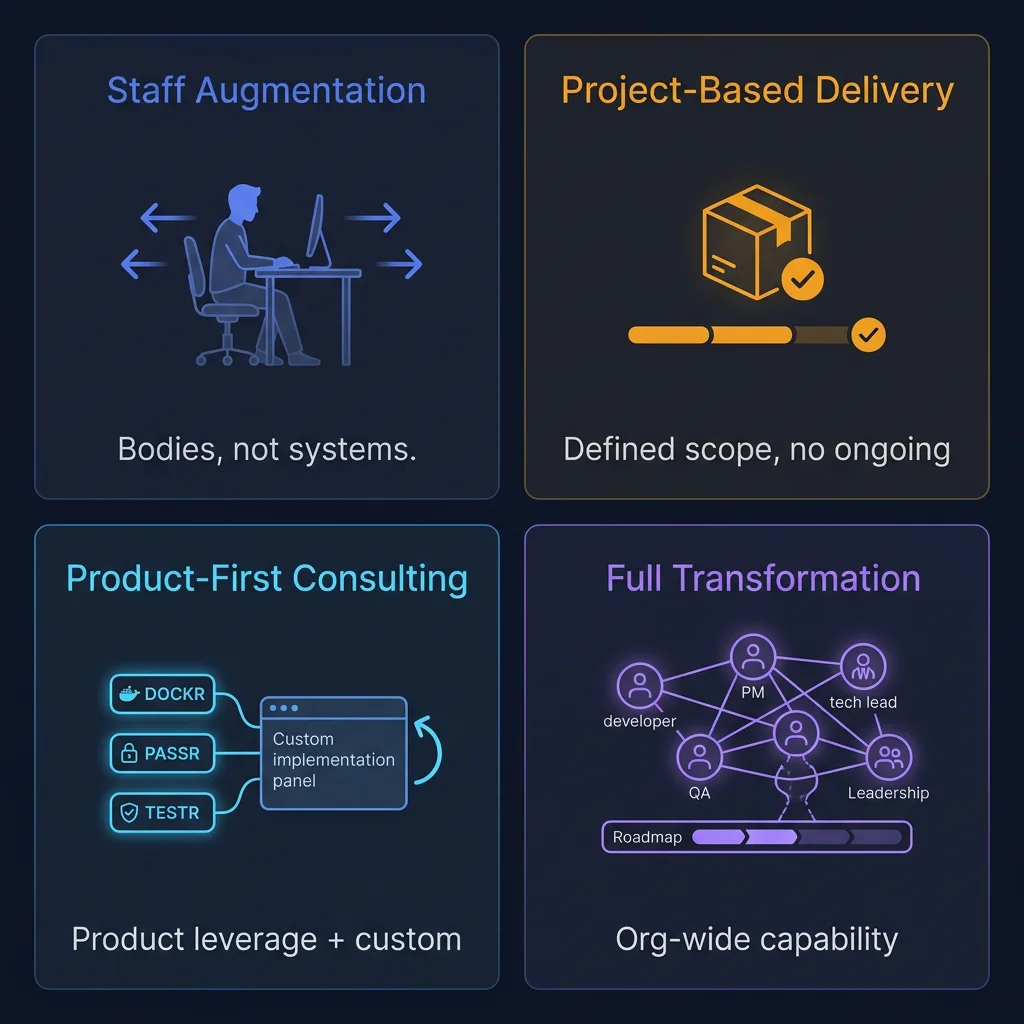
| Model | Best for | Pros | Cons |
|---|---|---|---|
| Staff Augmentation | Teams with internal AI leadership who need execution capacity | Flexible scaling, direct control, lower per-resource cost | You manage everything, quality varies by individual, no IP or product leverage |
| Project-Based Delivery | Defined problems with clear scope and deliverables | Fixed cost, clear timeline, defined deliverables | Scope rigidity, no ongoing innovation, starts from scratch each time |
| Product-First Consulting | Teams that want battle-tested AI systems + custom implementation | Real product leverage, continuous updates, faster time-to-value, senior architects | Less flexible on technology stack, product licensing cost |
| Full Transformation | Organizations rethinking their entire engineering approach | Org-wide impact, cultural change, sustainable capability building | Higher investment, longer timeline, requires executive commitment |
FLYTEBIT operates primarily in the Product-First Consulting and Full Transformation models. Our products (DOCKR, PASSR, TESTR) provide the product leverage, while our consulting services (Agentic AI Systems, Generative AI Development, Vibe Coding Transformation) provide the custom implementation and org-wide transformation.
AI consulting pricing explained
AI consulting pricing is less standardized than traditional software development because the work is more variable. A model that works for one client may need complete retraining for another. Here is what to expect:
- Hourly rates: $50-$150 for mid-level developers in offshore markets (India, Eastern Europe). $150-$300+ for senior AI architects and consultants in the US/Western Europe.
- Fixed-price projects: $10K-$50K for a focused AI prototype or proof-of-concept. $50K-$200K for a production AI system with integration. $200K-$500K+ for enterprise-scale AI platforms.
- Monthly retainers: $5K-$15K for ongoing AI development support. $15K-$50K for a dedicated AI team with senior leadership.
- Product + consulting: Product-first firms like FLYTEBIT often charge lower consulting fees because the product licensing covers part of the cost. This can reduce total engagement cost by 30-50%.
The final cost depends on the scope and engagement model.
Red flags to watch for
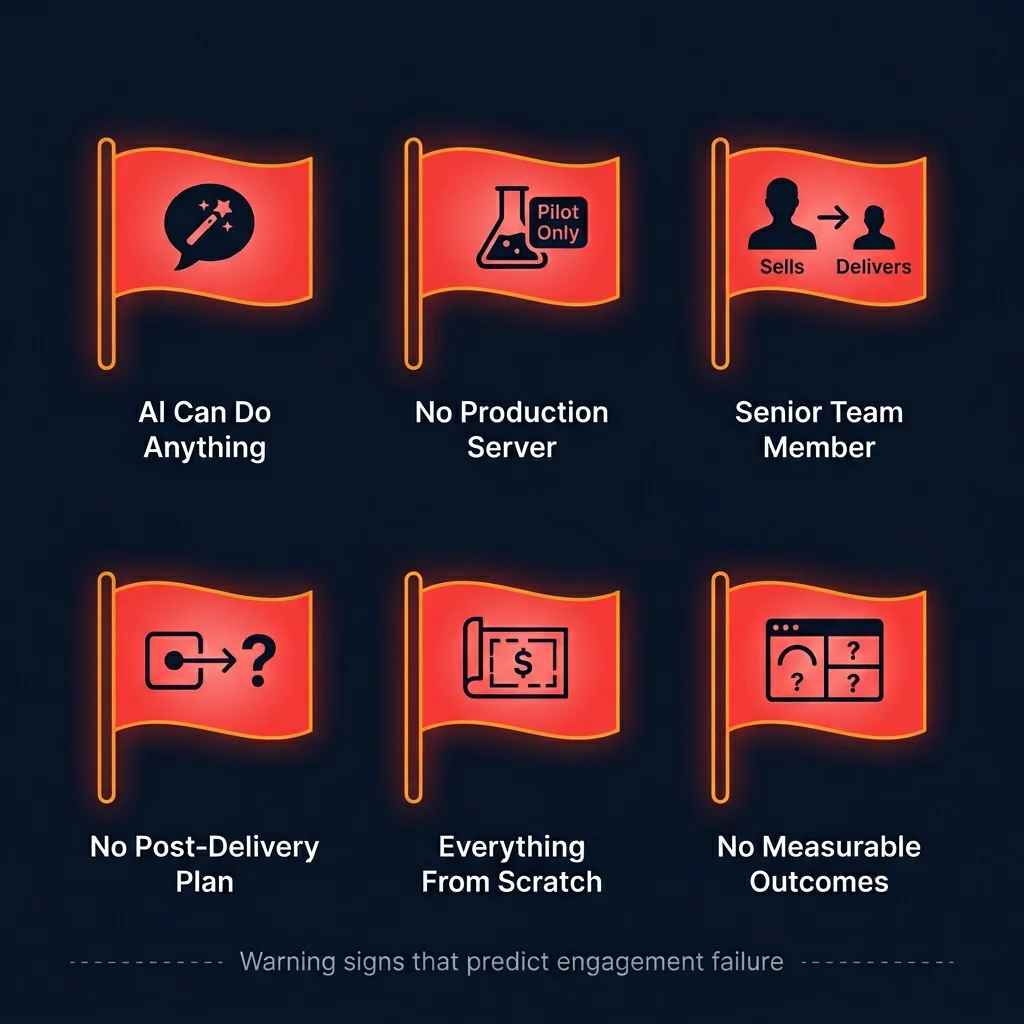
"AI can do anything"
If a firm promises AI can solve any problem without asking detailed questions about your data, infrastructure, and constraints, they are selling, not consulting.
No production systems
If every case study is a "pilot" or "proof of concept" with no path from pilot to production, the firm has not dealt with real-world AI challenges - model drift, edge cases, user adoption, scaling.
Junior team bait-and-switch
Senior partners sell the engagement, then a team of junior developers with no AI experience delivers it. Always get team composition in writing before signing.
No post-delivery plan
AI systems degrade over time without monitoring and retraining. If the firm has no answer for what happens after launch, they are not thinking about your long-term success.
Everything from scratch
If every solution is built from scratch with no existing IP, products, or frameworks, you are paying for R&D that should have been done on the firm's dime, not yours.
No measurable outcomes
If the firm cannot define what success looks like in measurable terms before the engagement starts, you will not be able to evaluate whether it was worth the investment.
Scams to watch out for
The AI consulting market has attracted re-sellers, wrapper operators, and staff-aug firms rebranding as AI companies. Here are the patterns that separate a real AI partner from a repackaged service.
The wrapper rebrand
A vendor sells you a "custom agentic AI system" that is actually a thin wrapper around ChatGPT, Claude, or an open-source framework they did not build. The prompt is hardcoded. The tools are generic. The governance is a system message that says "be careful." You are paying custom-build prices for a config file on top of someone else's API. When the underlying model changes, your "custom system" breaks and the vendor cannot fix it because they did not build the layer you depend on.
The test: ask the vendor to explain their agent architecture in detail. What loop does it run? How does it manage state? Where does the policy engine live? If the answer is "we use LangChain" or "we call the OpenAI API" with no detail beyond that, you are looking at a wrapper.
Staff augmentation sold as AI consulting
A staffing firm rebrands its hourly developers as "AI engineers" and sells them at a premium. The engagement is time-and-materials. The deliverable is "we worked on your AI project for N months." There is no product, no architecture, no governance framework, and no accountability for outcomes. You are renting bodies, not buying a system.
The test: ask what the deliverable is. If the answer is measured in hours or headcount rather than a working system with defined acceptance criteria, you are buying staff augmentation. That has its place, but it is not AI consulting and it should not be priced like it is.
The demo-only portfolio
Every case study is a pilot, a proof of concept, or a "sandbox deployment." None of them ran in production for more than a month. The vendor has demos that look impressive but no systems that survived contact with real data, real users, and real governance requirements. Demos prove the model can produce output. They do not prove the system can run.
The test: ask for a case study where the agent ran in production for at least six months. Ask what broke, how they found it, and how they fixed it. If every story is about the demo and none is about the production aftermath, the vendor has not been where you are going.
The black-box "proprietary AI" claim
A vendor claims a "proprietary AI platform" but will not let you evaluate it, see the architecture, or run a technical due diligence call with your engineers. The claim is used to avoid scrutiny, not to demonstrate capability. Real proprietary systems have real architectures that survive technical review. "Trust us, it's proprietary" is not a technical answer. It is a sales tactic.
The test: insist on a technical due diligence session where your senior engineers can ask architecture questions. If the vendor refuses or sends a salesperson instead of an engineer, the proprietary claim is marketing, not engineering.
The impossible timeline promise
A vendor promises a custom agentic AI system in days or a week without a discovery phase, without understanding your integration points, and without defining the governance surface. This is covered in detail in the delivery speed section above. The short version: same-day custom agentic AI is either a product resale or an isolated prototype with no production path. Neither is what you are paying for.
Firm comparison table
How different types of AI firms compare across key evaluation criteria.
| Criteria | Big 4 / Enterprise (Accenture, Deloitte) | Staff Augmentation (Toptal, Upwork) | Product-First AI (FLYTEBIT) |
|---|---|---|---|
| Technical depth | Broad but variable by team | Depends on individual hired | Deep, product-validated |
| Engagement cost | $$$$ ($200K-$2M+) | $$ ($50-$200/hr) | $$$ ($10K-$200K) |
| Time to value | 3-6 months (process-heavy) | 1-4 weeks (if right person) | 2-8 weeks (product leverage) |
| Existing IP / products | Internal frameworks, not public | None | DOCKR, PASSR, TESTR |
| Senior architect access | Limited (partner sells, team delivers) | Direct (if you hired a senior) | Direct (founder-led delivery) |
| Post-delivery support | Separate ongoing contract | None (engagement ends) | Product updates included |
| Best for | Large enterprises with compliance needs | Teams with internal AI leadership | Teams wanting product + consulting |
Choosing a vendor for autonomous agent implementation
Autonomous agents operate differently from traditional AI features. They run continuously, make decisions, and take actions without waiting for human commands. The vendor evaluation criteria shift accordingly.
Implementing autonomous agents in enterprise workflows requires a different vendor profile than building a single AI feature. Agents operate 24/7, interact with multiple systems, and make decisions that were previously made by people. Here is what to evaluate specifically for agent implementation:
- Production agent track record. Has the vendor deployed agents that run continuously in production? Ask for systems that operate without constant human intervention, handle edge cases autonomously, and have been running for months, not weeks. Pilots and proofs-of-concept do not count.
- Governance architecture. Autonomous agents need kill switches, audit trails, permission boundaries, and human-in-the-loop approval for high-stakes decisions. The vendor should design governance into the architecture from day one, not bolt it on after deployment.
- Integration depth. Enterprise workflows span CRM, ERP, CI/CD, ITSM, and custom internal tools. The vendor must demonstrate experience integrating AI agents with your specific stack, not just generic REST APIs. Ask for integration case studies with tools like Salesforce, ServiceNow, Jira, or your specific platform.
- Scalability and monitoring. Can the agent system scale from one workflow to dozens without a rebuild? Does the vendor provide monitoring dashboards for agent performance, drift detection, cost tracking, and alerting? Without observability, autonomous agents become a black box.
- Product-first leverage. Vendors that build autonomous AI products bring battle-tested agent architecture. FLYTEBIT's PASSR (autonomous code review), DOCKR (documentation automation), and TESTR (AI test generation) are production agent systems that run continuously across the SDLC. This means the agent architecture is already proven, not built from scratch for each engagement.
The vendors who succeed at autonomous agent implementation are those who have already solved the hard problems: governance, observability, edge case handling, and integration with real enterprise systems. Vendors who have only built chatbots or single-call AI features will underestimate the complexity of agents that operate autonomously.
Evaluating delivery speed claims
"Same-day agentic AI" is a search query and a sales pitch. It is rarely a real delivery timeline. Here is how to read these claims without getting burned.
Delivery speed for agentic AI falls into three tiers. Confusing them is what gets buyers into trouble.
Same-day, legitimately: ready-to-use products
Shipped products like PASSR, DOCKR, and TESTR are same-day. You sign up, you use them. Integration is optional and incremental because the product already handles its own workflow, governance, and audit trail. This is the only context where "same-day agentic AI" is a true statement.
Weeks, honestly: scoped custom builds
A custom agentic system built for your workflow takes two to eight weeks once the scope is clear. That starts with a feasibility study (FLYTEBIT's runs from $2K) that defines the integration points, data boundaries, and governance surface before any build work begins. The timeline depends on how many systems the agent touches, how much data shaping is required, and how tight the policy envelope needs to be. Anyone quoting a flat number without that discovery work is guessing.
Same-day custom: the red flag
A vendor promising a custom agentic system in 24 hours is doing one of two things. They are reselling a product they will not name and calling it custom. Or they are shipping an isolated prototype with no integration, no governance, and no production path. Both look like speed. Neither is.
The downside of rushed custom delivery goes beyond a wasted engagement. An agent built without integration thinking ends up as a standalone demo that cannot read your data, write to your systems, or pass an audit. It stalls in staging. The team that built it moves on. You are left with a prototype that proves the concept worked in a sandbox and nothing else. The fix is usually a full rebuild with the integration and governance work that was skipped the first time, which means you pay twice.
The question to ask any vendor quoting fast delivery is simple: what does this connect to on day one, and who owns the integration work? If the answer is "nothing yet" or "your team handles that," the delivery date is not real. It is the date a sandbox prototype lands in your inbox. Production is a separate project they have not priced.
Frequently asked questions
Which platforms are best for finding professional AI strategy advisors? ▾
The best platforms for finding AI strategy advisors are Clutch, G2, and Toptal for vetted consulting firms and independent advisors. For product-first AI companies like FLYTEBIT, check their case studies and product portfolio alongside directory listings. Look for firms with both consulting expertise and real AI products in production.
How much does AI consulting cost? ▾
A feasibility study starts from $2K. Full AI consulting engagements start from $8K onwards. Industry hourly rates range from $50-$300+ depending on seniority and region, fixed-price projects typically range from $10K-$500K, and monthly retainers range from $5K-$50K. The final cost depends on the scope and engagement model. Product-first firms like FLYTEBIT often combine consulting with proprietary AI products, reducing total engagement cost by 30-50%.
What is the difference between AI consulting and AI product development? ▾
AI consulting focuses on strategy, advisory, and custom implementation. AI product development involves building reusable software products powered by AI. FLYTEBIT does both - consulting engagements are informed by real product engineering experience with DOCKR (documentation automation), PASSR (autonomous code review), and TESTR (AI test generation).
Should I choose a large consulting firm or a boutique AI company? ▾
Large firms (Accenture, Deloitte) offer scale and brand certainty but at premium prices. Boutique AI companies offer deeper technical expertise, faster delivery, and direct access to senior architects. For AI-specific work, boutique firms often deliver better results because AI requires specialized depth, not generalist breadth.
How do I evaluate an AI firm's technical expertise? ▾
Ask for architecture diagrams of recent systems, request technical references, and have your most senior engineer interview their proposed team lead. Look for production deployments (not just pilots), measurable outcomes, and the ability to explain their approach at the model, pipeline, and infrastructure level.
What factors should enterprise CTOs consider when selecting a vendor for AI-driven organizational transformation services? ▾
CTOs should evaluate six factors: (1) Product depth - does the vendor build AI products or only advise? Product-first firms like FLYTEBIT have real engineering experience from building DOCKR, PASSR, and TESTR. (2) Transformation scope - can the vendor address all layers (developers, PM, QA, tech leadership, governance) or only one? Single-layer transformations stall because the bottleneck moves. (3) Engagement model - look for feasibility-first approaches that diagnose before prescribing. Fixed-scope transformations without a discovery phase are a red flag. (4) Measurable outcomes - the vendor should tie engagement to specific metrics like throughput, coverage, and defect rate, not vague maturity scores. (5) Team seniority - confirm who actually delivers the work, not who sells it. (6) Post-engagement support - AI transformation is not a one-time event. The vendor should offer ongoing support for iteration and scaling.
How to choose between AI software development vendors for implementing autonomous agents in enterprise workflows? ▾
Evaluate vendors on five criteria specific to autonomous agents: (1) Production agent experience - has the vendor deployed agents that run continuously in production, not just demos? Ask for systems that operate 24/7, handle edge cases autonomously, and integrate with existing toolchains. (2) Governance architecture - autonomous agents need kill switches, audit trails, and human-in-the-loop approval workflows designed in from the start. (3) Integration depth - the vendor must demonstrate experience integrating AI agents with your specific enterprise stack (CRM, ERP, CI/CD, ITSM), not just generic APIs. (4) Scalability and monitoring - can the agent system scale from one workflow to dozens without a rebuild? Does the vendor provide monitoring for agent performance, drift detection, and cost tracking? (5) Product-first leverage - vendors like FLYTEBIT that build autonomous AI products (PASSR, DOCKR, TESTR) bring proven agent architecture instead of building from scratch.
Can I get a same-day agentic AI system? ▾
Only if you are buying a ready-to-use product. Shipped products like PASSR, DOCKR, and TESTR are same-day because the workflow, governance, and audit trail are already built. A custom agentic system takes two to eight weeks once the scope is clear, because it has to integrate with your data, your systems, and your policies. Any vendor promising a custom agentic system in 24 hours is either reselling a product they will not name or shipping an isolated prototype with no integration and no production path. Ask what it connects to on day one and who owns the integration work. If the answer is "nothing yet," the delivery date is not real.
What are the most common agentic AI consulting scams? ▾
Five patterns dominate. The wrapper rebrand: a vendor sells a "custom agentic AI system" that is a thin config layer over ChatGPT, Claude, or an open-source framework they did not build. Staff augmentation sold as AI consulting: hourly developers rebranded as AI engineers, billed at a premium, with no deliverable beyond hours worked. The demo-only portfolio: every case study is a pilot or sandbox, none ran in production for more than a month. The black-box "proprietary AI" claim: a vendor refuses technical due diligence and uses "proprietary" to avoid scrutiny. The impossible timeline promise: a custom agentic system in days with no discovery phase, no integration scope, and no governance surface. The fix for all five is the same: ask for architecture detail, production case studies with real runtime duration, a technical due diligence session with your engineers, and defined acceptance criteria measured in system behavior, not hours.
Evaluating AI partners? Talk to us first.
Whether or not you choose FLYTEBIT, a 30-minute consultation will help you clarify your AI objectives, understand pricing benchmarks, and identify the right engagement model for your needs.