
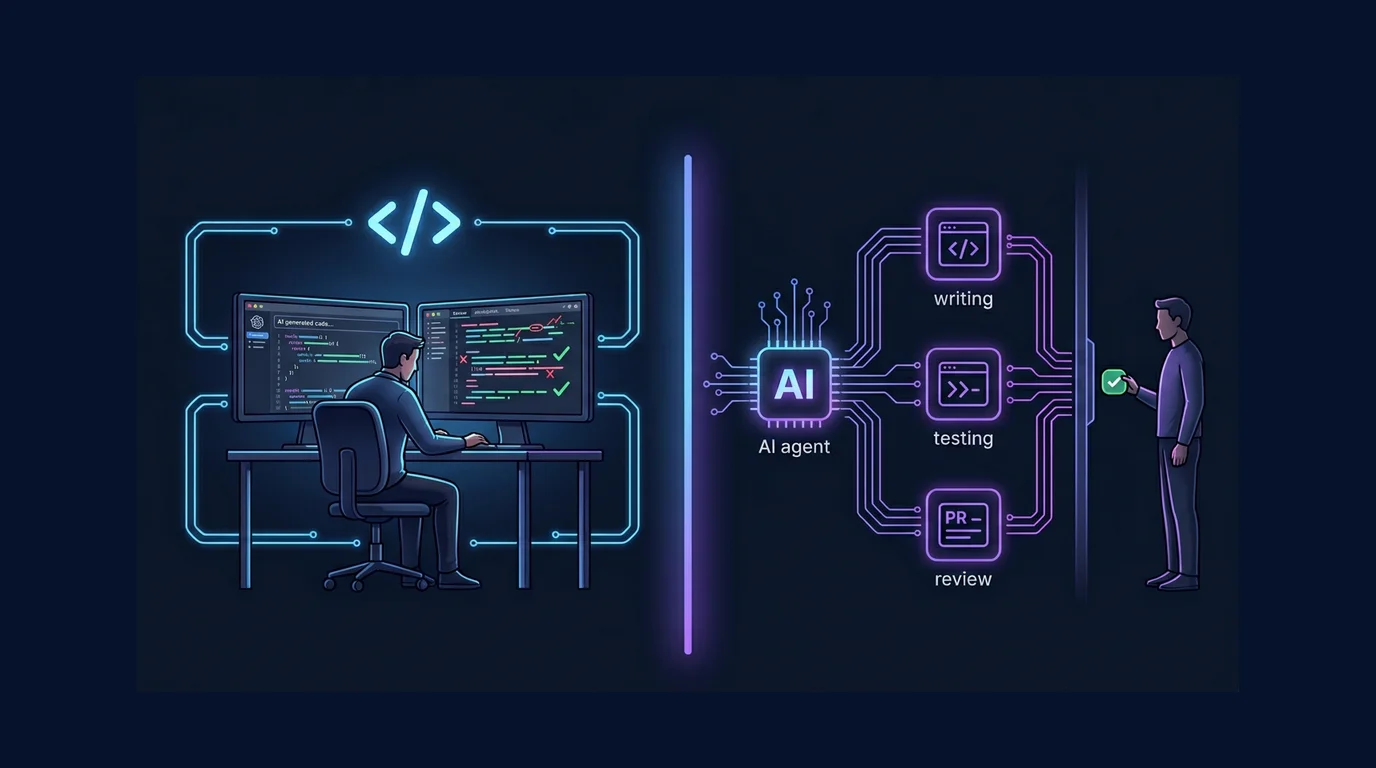
A CTO tells me their team is “using AI to write code.” I ask what they mean. They mean Copilot. Their developers type prompts, the AI suggests completions, the developer reviews every line and merges. Another CTO says the same thing. They mean Devin. An agent picks up a ticket, writes the code, runs the tests, opens a PR, and responds to review comments. A tech lead reviews the diff and approves.
Same sentence. Two different transformations happening inside two engineering orgs. The industry uses “AI coding” as a catch-all, and the confusion is causing real damage. Teams over-trust tools they think are autonomous. Teams under-use tools they think are assistants. Teams invest in the wrong transformation because they diagnosed the wrong paradigm.
One makes the developer faster. The other rewrites what “developer” means. Getting them mixed up is where engineering orgs get hurt.
Two paradigms, one name
Vibe coding is what most teams are doing today. The developer uses AI as an assistant. Copilot, Cursor, Claude Code in chat mode. The developer writes a prompt, the AI generates code, the developer reads the output, edits it, and ships it. The human is the author. The AI is the accelerator. Every line of code that ships has been read and approved by the person who prompted it.
The software development lifecycle stays human-paced. Code generation gets faster, but the developer is still present at every stage. Requirements still arrive from a PM. Review still happens at PR time. Testing still happens before deploy. The shape of the pipeline doesn’t change. One link in the chain got faster.
I wrote about this in the Vibe Thinking series. The problem with vibe coding isn’t the coding part. The problem is that the org around the developer doesn’t change. The developer got faster, the sprint didn’t. The bottleneck moved to review, to testing, to requirements, to governance. That is a pipeline problem, and it has a pipeline fix. We called it Vibe Coding Transformation.
Agentic engineering is different. The AI agent is the author. The human is the approver. Tools like Devin, SWE-Agent, GitHub Copilot Workspace, and Claude Code in agent mode don’t wait for the developer to prompt them line by line. You give them a task. They write the code. They run the tests. They read the test failures. They fix the code. They open a PR. They respond to review comments. The human reviews the final diff and decides whether to ship. If approved, the agent deploys.
The developer isn’t present during execution. The developer is present at approval. That is a different job. The software development lifecycle doesn’t get faster. It gets reshaped. Stages collapse. Review and testing merge into a single automated gate that runs before the human ever sees the PR. Requirements and development merge when the agent reads the brief and starts building without waiting for a human to decompose the work. The pipeline doesn’t have the same shape anymore.
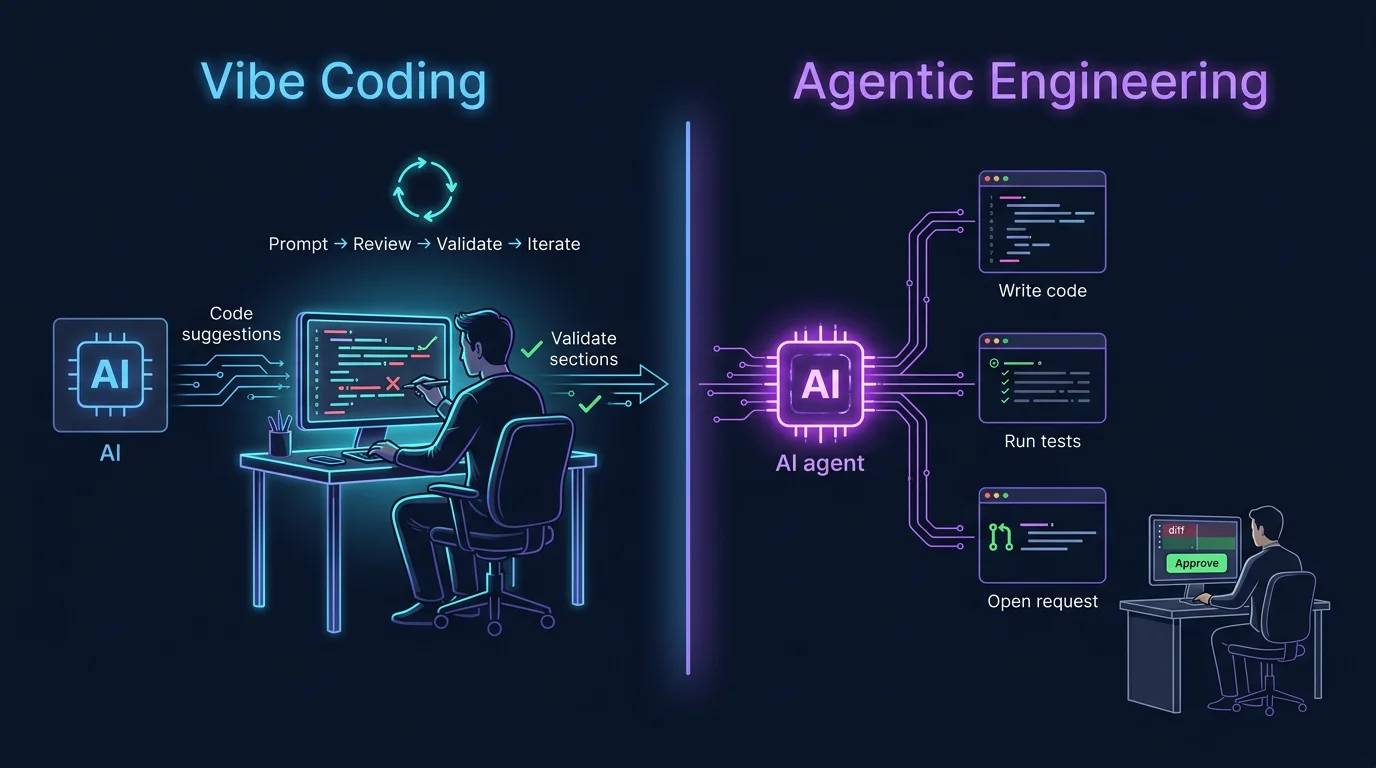 Vibe coding: the developer is present at every step. Agentic engineering: the developer is present at approval only.
The gray area
The distinction sounds clean until you look at the tools. Claude Code has a chat mode and an agent mode. GitHub Copilot started as autocomplete and became Copilot Workspace, which can execute multi-step tasks. Cursor can suggest code inline or run an agent that edits multiple files autonomously.
The same tool can be either paradigm depending on how you use it. A developer using Cursor’s autocomplete to speed up boilerplate is vibe coding. A developer who tells Cursor’s agent to “implement the payment retry logic, write tests, and open a PR” is doing agentic engineering. The tool didn’t change. The workflow changed.
The diagnostic is simple. If you’re reviewing every line before it ships, you’re vibe coding. If you’re approving a diff you didn’t watch get written, you’re doing agentic engineering. The distinction depends on where the human sits in the process. Present during execution, or present at approval. The tool is irrelevant to the diagnosis.
Most teams today live in the gray area. They use Copilot for autocomplete (vibe coding) and occasionally ask Claude Code to implement a full feature (agentic engineering). That mixed mode is fine. But it means you need guardrails for both paradigms, because the failure modes are different.
How the SDLC changes
In the Vibe Thinking series, I mapped the software delivery pipeline as a chain: requirements, development, review, testing, deployment. Each link has a throughput limit. Vibe coding makes the development link faster. Agentic engineering changes what happens at every link.
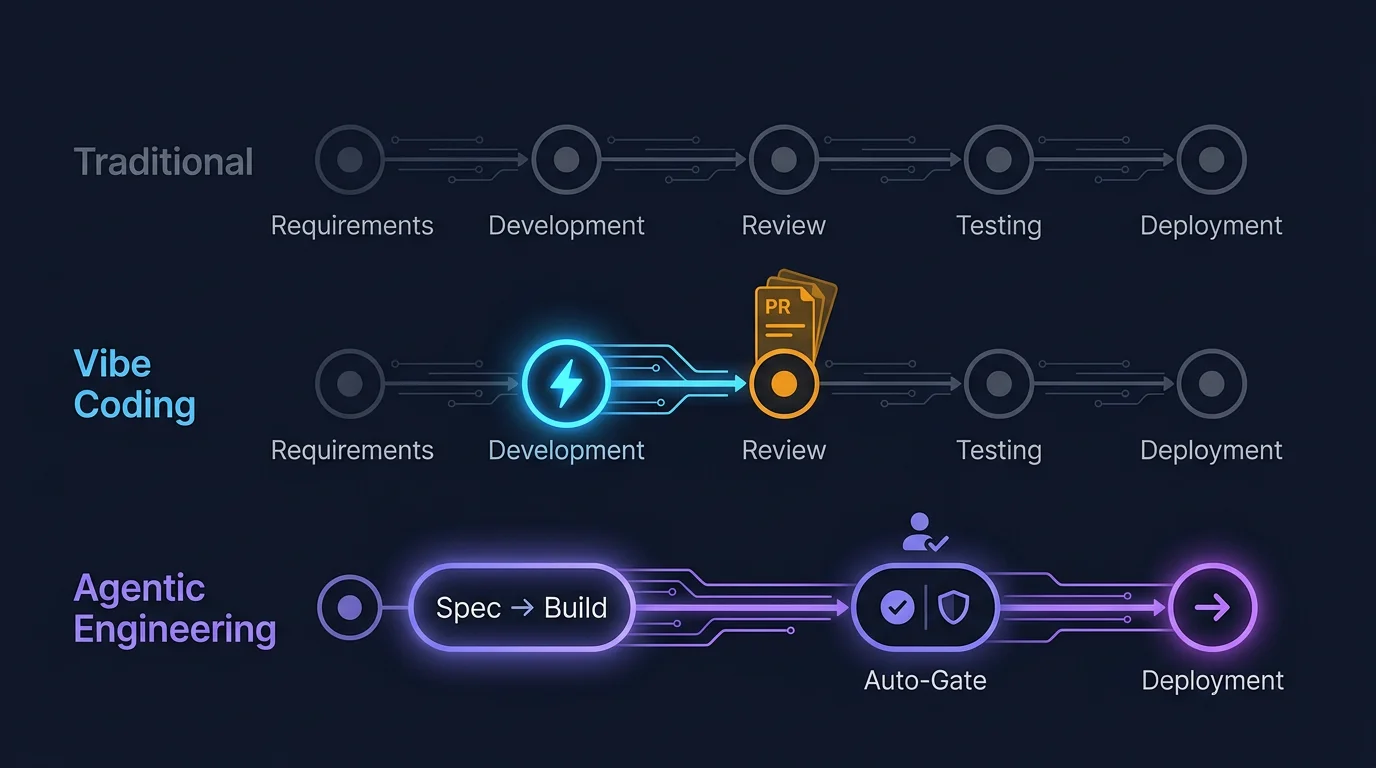 Vibe coding accelerates each stage. Agentic engineering collapses stages together.
Requirements.
- In traditional development, a PM writes user stories and the developer interprets them.
- In vibe coding, the PM writes precision briefs because vague requirements produce vague prompts, and vague prompts produce wrong code faster. The developer uses AI to help refine the brief, but the PM is still the author.
- In agentic engineering, the agent reads the brief, asks clarifying questions, and generates a spec. The PM’s job shifts from writing stories to writing outcome definitions precise enough that an agent can build from them without human interpretation. The brief becomes a contract.
Development.
- In traditional development, the human writes code.
- In vibe coding, the human directs AI and reviews output. The developer is an architect and reviewer, not a typist.
- In agentic engineering, the agent writes code autonomously. The human reviews the diff. The skill shift is from writing code to evaluating code you didn’t author. That is a different muscle. Some developers are good at it. Many aren’t, and they don’t find out until the agent ships something subtle and the human can’t explain why it works.
Review.
- In traditional development, a senior developer manually reviews every PR.
- In vibe coding, the senior developer reviews a larger volume of AI-assisted PRs. The review burden goes up, not down, because AI tools produce more code. This is where PASSR matters. Automated first-pass review on every PR means the senior developer spends their time on architecture and intent, not syntax and security patterns.
- In agentic engineering, the agent self-reviews before opening the PR. But an agent reviewing its own code has a blind spot: it won’t catch issues outside its training patterns, and it tends to validate its own assumptions. PASSR runs independently, reviewing across eight dimensions (performance, availability, security, scalability, correctness, architecture, code quality, testing) without relying on the agent’s self-assessment. The human reviews exceptions and architecture decisions. The review queue as a concept starts to dissolve. What replaces it is a gate: if PASSR and the agent both pass, the human reviews the design. If either flags something, the human reviews the code.
Testing.
- In traditional development, QA writes tests at the end of the sprint.
- In vibe coding, the developer writes some tests, AI helps generate more, and TESTR can auto-generate coverage from source code on every commit. Testing shifts left, but it’s still a distinct step.
- In agentic engineering, the agent generates and runs tests continuously. It writes the test, runs it, reads the failure, fixes the code, and reruns. Testing isn’t a phase. It’s embedded in the agent’s execution loop. But the agent’s tests can be shallow or self-reinforcing. TESTR runs independently, generating coverage from source code on every commit to verify the agent’s tests actually cover the codebase. The human monitors coverage trends and intervenes when the agent’s tests miss edge cases the human can see but the agent can’t.
Deployment.
- In traditional development, releases are manual and weekly.
- In vibe coding, CI/CD pipelines handle daily releases. The developer merges, the pipeline runs, the code ships.
- In agentic engineering, the agent triggers deployment after all gates pass and the human approves. The human monitors production metrics and intervenes on incidents. The deployment step disappears from the developer’s day. It becomes something that happens after approval, verified by automated gates, observed by the human.
| Stage | Traditional | Vibe coding | Agentic engineering |
|---|---|---|---|
| Requirements | PM writes user stories, developer interprets them | PM writes precision briefs, AI helps refine | Agent reads brief, asks clarifying questions, generates spec |
| Development | Human writes code | Human directs AI, reviews output | Agent writes autonomously, human reviews diff |
| Review | Senior dev manually reviews every PR | Senior dev reviews larger volume, PASSR assists | Agent self-reviews, PASSR validates, human approves exceptions |
| Testing | QA writes tests at end of sprint | Dev writes tests, AI helps, TESTR auto-generates | Agent generates and runs tests continuously |
| Deployment | Manual releases, weekly cadence | CI/CD pipeline, daily releases | Agent deploys after gates pass and human approves, human monitors |
Vibe coding accelerates each stage. Agentic engineering collapses stages together. The first makes the same pipeline faster. The second builds a different pipeline.
Where they differ
Four dimensions separate these paradigms in ways that matter for how you run an engineering org.
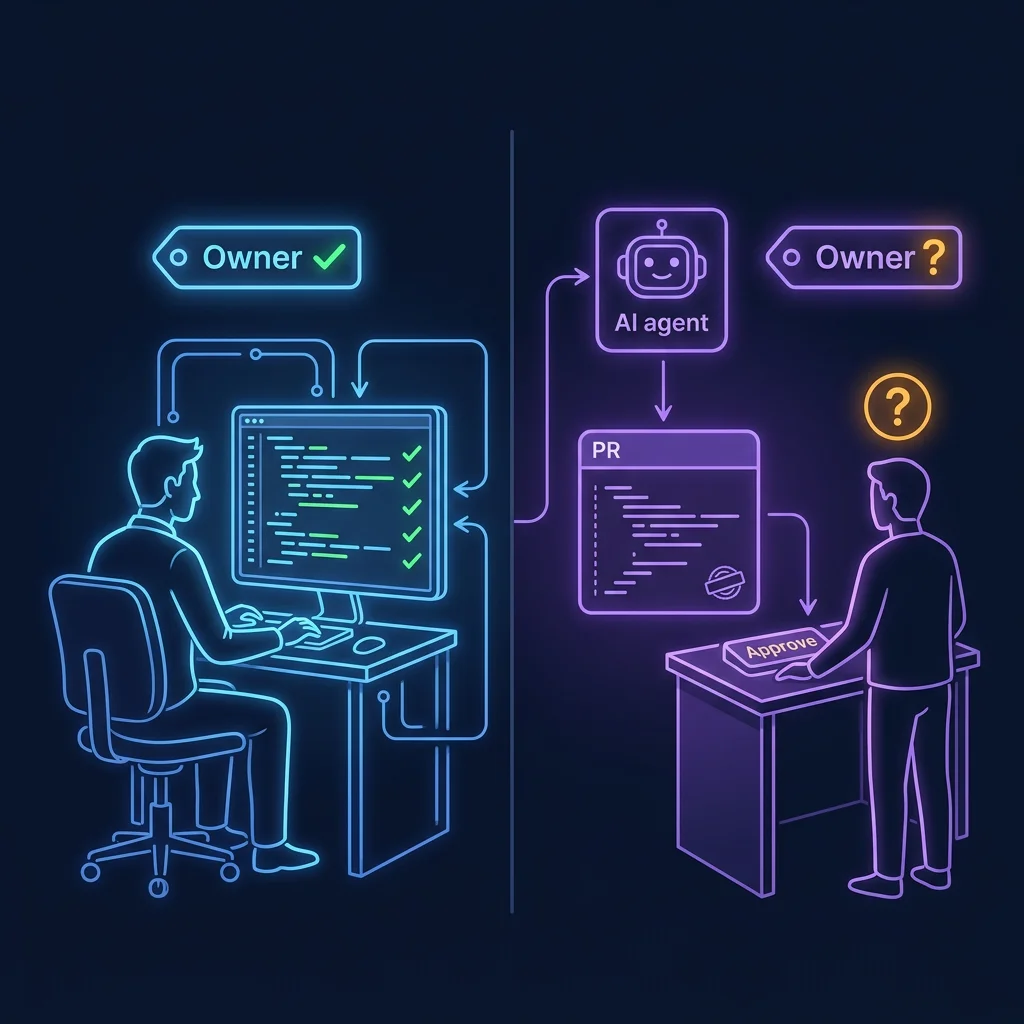
Ownership. In vibe coding, the developer owns every line because they reviewed it. They may not have typed it, but they read it, understood it, and decided to ship it. In agentic engineering, ownership gets blurry. The agent wrote the code. The human approved the diff. But did the human read every line? Did they understand every pattern the agent used? When something breaks in production, who owns the fix? The developer who approved a diff they didn’t fully trace, or the agent that generated code it can’t debug in production?
The fix is the same in both paradigms: every merged line has a named human accountable for it. Stated explicitly, not assumed. The agent writes code. The human owns it. That is a policy decision, not a developer convention.
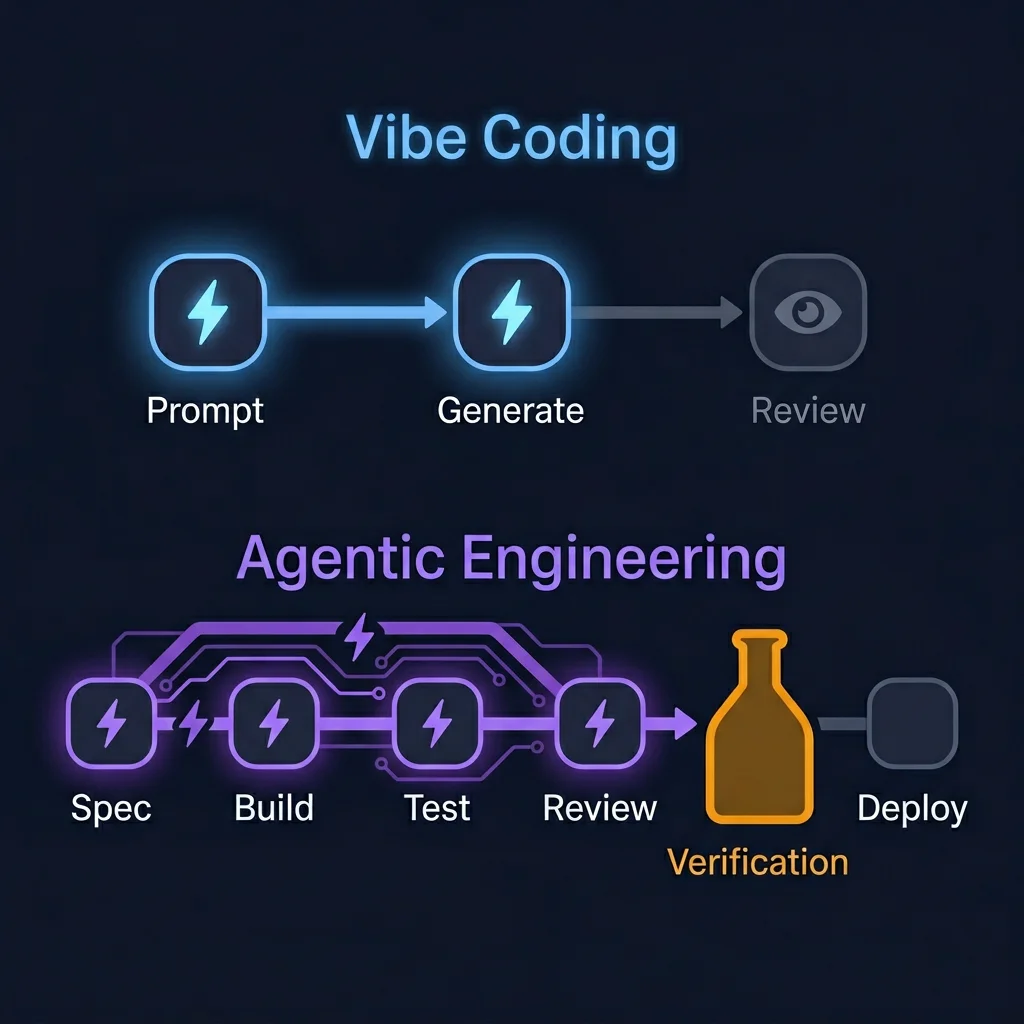
Speed versus verification. Vibe coding’s speed gain is in code generation. Verification is still human-paced. The developer reads the output, edits it, and decides to ship. That loop is fast but it’s still a human loop. Agentic engineering’s speed gain is end-to-end. The agent writes, tests, reviews, and deploys in minutes. Verification becomes the bottleneck. You can’t approve what you can’t verify fast enough. If your review and testing infrastructure is manual, agentic engineering doesn’t help. It makes the problem worse. The agent ships faster into a verification queue that can’t keep up.
This is where PASSR and TESTR stop being nice-to-haves. In vibe coding, they reduce review burden. In agentic engineering, they are the only reason the paradigm works. Without automated review and automated testing, the human approver becomes the bottleneck, and you’re back to human-paced development with extra steps.
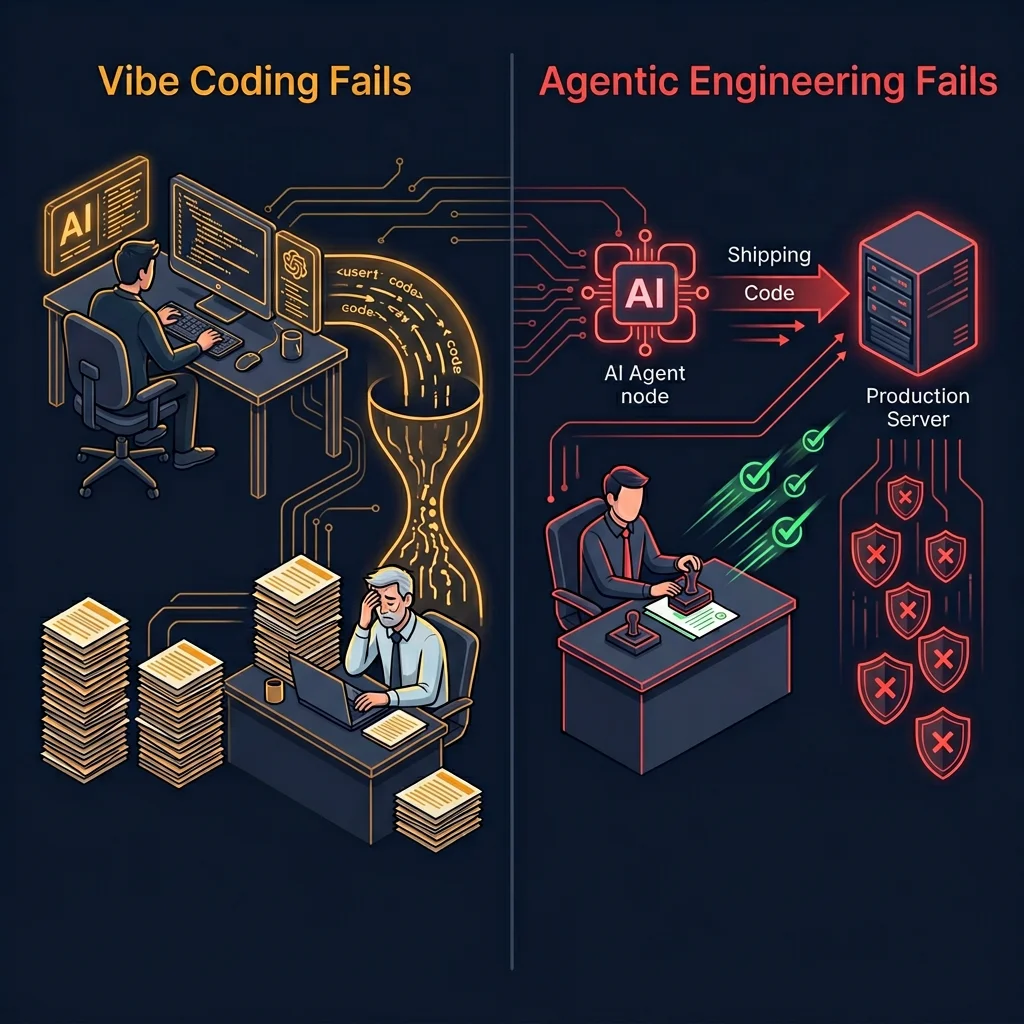
Failure modes. Vibe coding fails when the org around the developer doesn’t change. More code goes into the same slow pipeline. Quality degrades under volume. Senior engineers burn out reviewing PRs. The sprint doesn’t move. I’ve seen this at every team we consulted with. The diagnosis is always the same: the developer got faster, the org didn’t.
Agentic engineering fails differently. The agent ships wrong code at machine speed. The human approver rubber-stamps because they can’t review fast enough. Security debt accumulates silently because nobody is reading the code. A production incident surfaces code that nobody in the company can explain. The failure is faster and quieter than vibe coding failure, and harder to recover from.
Both paradigms fail when the org hasn’t been redesigned. But they fail differently, and the fix is different. Vibe coding failure needs pipeline redesign. Agentic engineering failure needs verification and governance infrastructure.
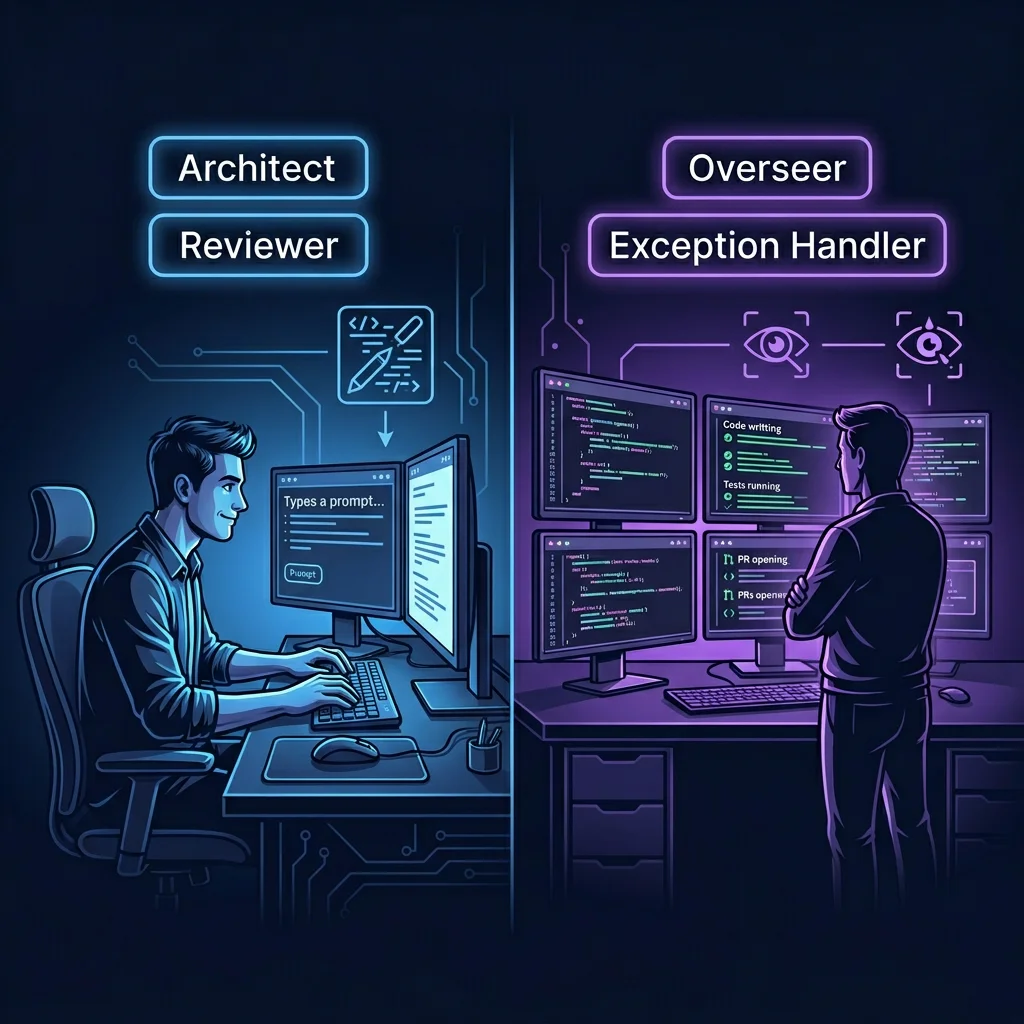
What the human does. In vibe coding, the human is an architect and reviewer. They write prompts, validate output, and own quality. Their craft shifts from typing to directing. In agentic engineering, the human is an overseer and exception handler. They monitor agent output, intervene on architecture decisions, and handle edge cases the agent can’t reason about. Their craft shifts from directing to evaluating.
The skill shift from writing code to evaluating code you didn’t author is real. Some developers adapt fast. Others struggle, and the struggle has nothing to do with technical ability. It is comfort with code you didn’t reason through yourself. That comfort takes time to build.
| Dimension | Vibe coding | Agentic engineering |
|---|---|---|
| Ownership | Developer owns every line. They reviewed it, understood it, shipped it. | Ownership gets blurry. Agent wrote the code, human approved the diff. Needs explicit accountability policy. |
| Speed vs verification | Speed gain in code generation. Verification stays human-paced. | Speed gain is end-to-end. Verification becomes the bottleneck. PASSR and TESTR are the only reason it works. |
| Failure modes | More code into same slow pipeline. Quality degrades. Senior engineers burn out reviewing. | Agent ships wrong code at machine speed. Human rubber-stamps. Security debt accumulates silently. |
| Human role | Architect and reviewer. Writes prompts, validates output, owns quality. | Overseer and exception handler. Monitors agent output, intervenes on architecture and edge cases. |
What breaks when you confuse them
A team thinks they’re doing agentic engineering. They bought Copilot licenses and told the developers to “use AI to write code.” The developers prompt, the AI generates, the developers merge without careful review because “the AI handles it.” Six months later, a security audit finds OWASP Top 10 vulnerabilities across the codebase. The team over-trusted a tool that was never autonomous. Copilot is an assistant. It generates code based on patterns in its training data. It doesn’t verify, test, or validate. The team treated a vibe coding tool as an agentic engineering platform and skipped the review step that vibe coding requires.
Another team is doing agentic engineering. They deployed Devin to handle bug fixes and small features. But the engineering manager treats it like Copilot. They require a developer to review every intermediate step the agent takes, manually run the tests the agent already ran, and rewrite code the agent produced before merging. The agent’s eight-minute task takes three hours of human oversight. The team gets none of the speed benefit and all of the overhead. They under-used an agent because they treated it like an assistant.
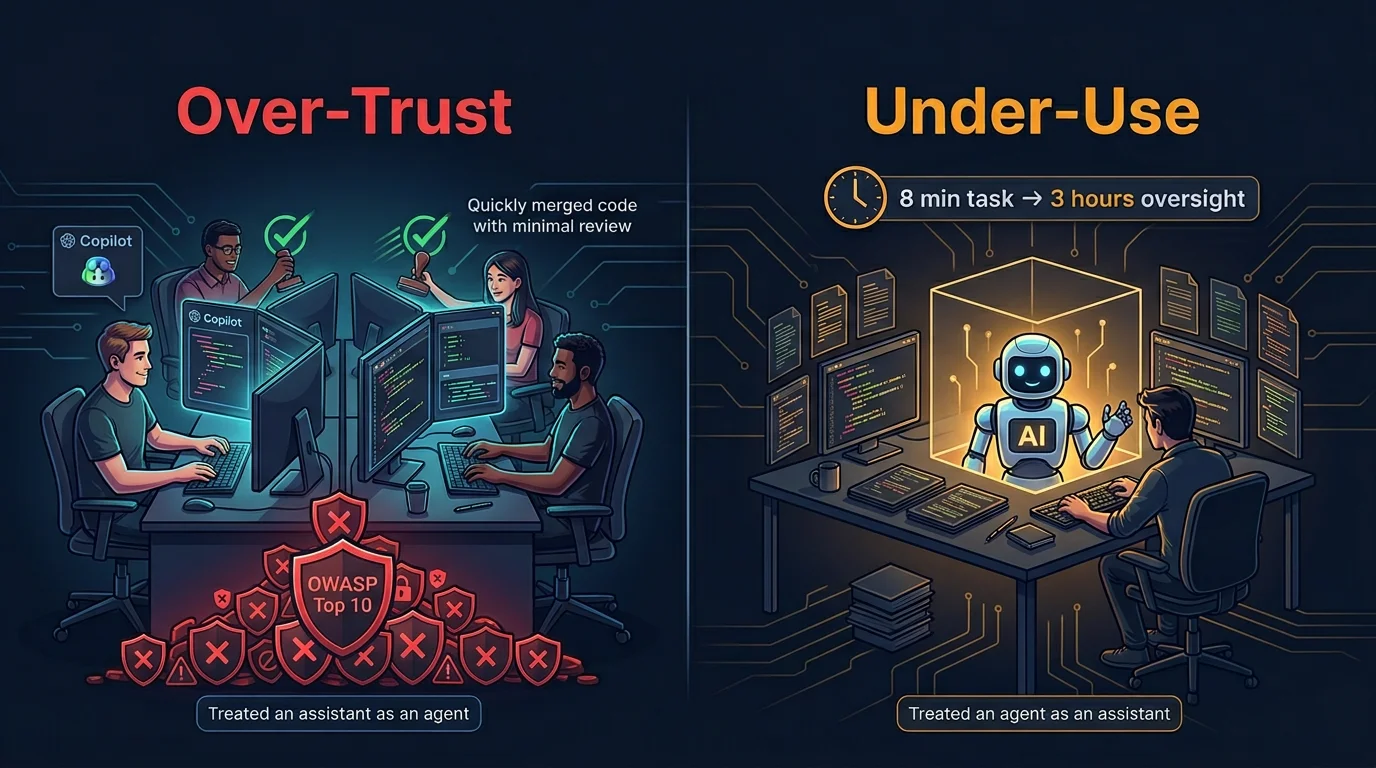 Two opposite mistakes with the same root cause: diagnosing the wrong paradigm.
The first team was vibe coding but treated it as agentic engineering. They needed stricter review discipline because Copilot doesn’t self-review. The second team was doing agentic engineering but treated it as vibe coding. They needed to trust the agent’s autonomous workflow and stop reviewing every intermediate step. Both teams diagnosed the wrong paradigm.
The transition path
You don’t jump from traditional development to agentic engineering. There’s a maturity curve, and skipping stages is where teams get hurt.
Stage one is traditional development. No AI tools. The human does everything. Most orgs passed this stage in 2024.
Stage two is vibe coding. AI assists the developer. The developer is still in every step. This is where most orgs are today. The problem at this stage isn’t the AI. The problem is the pipeline around the developer. Review queues back up. Testing becomes a bottleneck. Requirements arrive vague and produce wrong code faster. The fix is Vibe Coding Transformation: redesign the four layers (requirements, review, testing, governance) so the org keeps pace with the AI-accelerated developer.
Stage three is agentic engineering. AI agents execute autonomously. The human approves and oversees. This is where the industry is heading. Gartner predicts 55% of software engineering teams will be building LLM-based features by 2027, shifting the developer role from writing code to orchestrating AI systems. The shift from orchestrating to approving is a small step from there.
You can’t skip stage two. Agentic engineering requires the org to have already redesigned its pipeline. If your review process is manual, the agent’s PR sits in the same queue as every other PR. If your testing is a phase at the end of the sprint, the agent’s code waits for the same human testers. If your governance is a monthly compliance check, the agent ships faster than your governance can track. The agent doesn’t fix a broken pipeline. It exposes the breakage at higher speed.
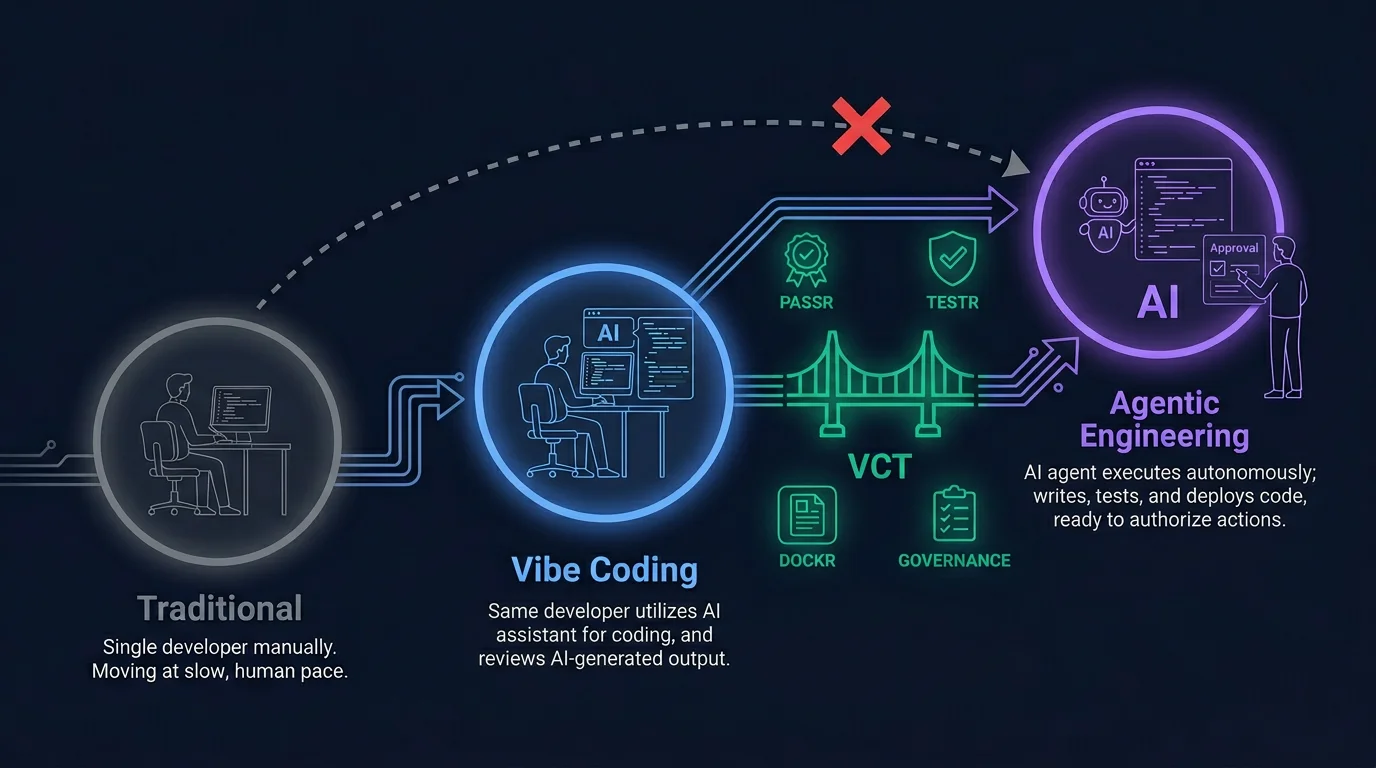 Vibe Coding Transformation is the prerequisite, not the alternative, to agentic engineering.
Vibe Coding Transformation is the prerequisite, not the alternative, to agentic engineering. The org redesign that VCT delivers (automated review, continuous testing, commit-speed governance, precision requirements) is the infrastructure that makes agentic engineering safe. Without it, you’re giving an autonomous agent a fast car and a broken steering wheel.
What this means for your org
If you’re in traditional development, start with vibe coding. Don’t chase agents yet. Fix your pipeline first. Get your review cycle under a day. Get your CI/CD pipeline running on every commit. Get your requirements precise enough that a developer doesn’t need a meeting to understand the task. Then give developers Copilot or Cursor and let them accelerate.
If you’re in vibe coding, you’re ready to start experimenting with agentic workflows. Pick well-defined, well-tested work. Bug fixes. Small features with clear acceptance criteria. Keep humans in the loop for architecture decisions and security-sensitive changes. Monitor what the agent produces. If your review and testing infrastructure can’t keep up with the agent’s output, you’re not ready. Go back and fix the pipeline.
If you’re moving to agentic engineering, your review, testing, and governance layers must be automated first. PASSR on every PR. TESTR generating coverage on every commit. DOCKR keeping documentation current so the agent has accurate ground truth. Agents without automated guardrails ship faster into worse outcomes. The guardrails come first. The agent comes second.
What we built
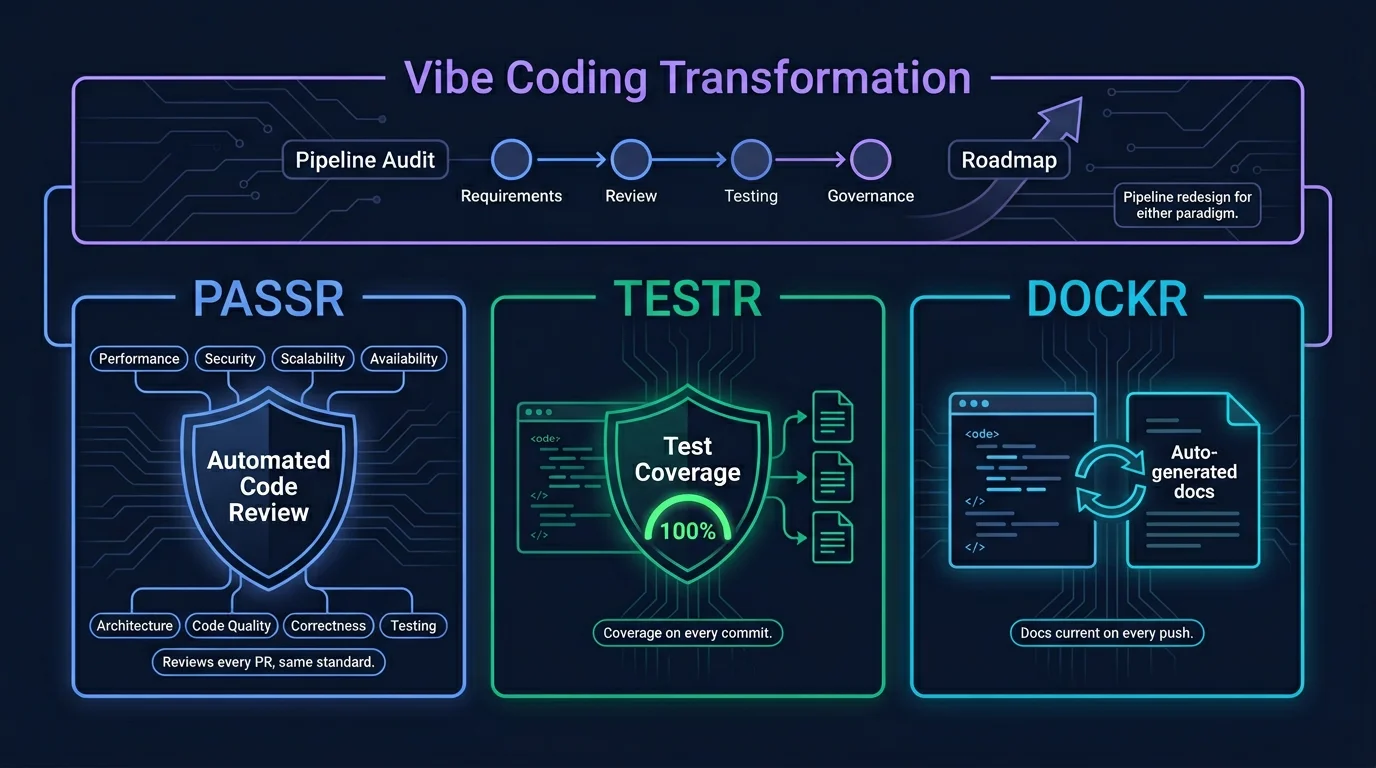 Three products under one transformation engagement. Paradigm-agnostic infrastructure for both vibe coding and agentic engineering.
PASSR runs automated review on every PR across eight dimensions: performance, availability, security, scalability, correctness, architecture, code quality, and testing. It works the same way whether the PR was written by a developer using Copilot or by an autonomous agent. The review standard doesn’t change based on who wrote the code. The agent’s output gets the same scrutiny as the human’s.
TESTR generates tests from source code on every commit. When a developer writes code, TESTR ensures coverage keeps pace. When an agent writes code at machine speed, TESTR ensures coverage keeps pace. The testing layer doesn’t care who the author is. It cares that every function has tests.
DOCKR documents the codebase on every push. Agents need accurate ground truth to reason about the code they’re modifying. Stale docs produce hallucinated interfaces and deprecated calls. DOCKR keeps the documentation current so both developers and agents work from the same accurate picture of the codebase.
Vibe Coding Transformation is the consulting engagement that redesigns the org for either paradigm. We audit your pipeline across the four layers, identify the bottlenecks, and deliver a transformation roadmap. Whether you’re scaling vibe coding or preparing for agentic engineering, the pipeline work is the same. The org has to be ready for the speed before the speed arrives.
Working With Flytebit
At FLYTEBIT TECHNOLOGIES, Vibe Coding Transformation is a structured engagement, not a workshop and a tool licence. We audit your pipeline, identify where the bottlenecks have moved, and build the infrastructure that makes either paradigm safe to operate at speed.
Not sure where your organisation stands today? The Vibe Coding Transformation Readiness Quick Check takes five minutes and gives you a per-function view of where your pipeline is most exposed.
Related Reading
Understand the full org transformation:
👉 Vibe Thinking: the full org transformation
Why developer-only AI adoption fails and what a full-pipeline redesign looks like across requirements, review, testing, and governance.
Learn about AI code review in both paradigms:
👉 AI code review: from nice-to-have to mission-critical
Why AI code review is infrastructure, not a feature, and how it works whether your PRs come from developers or autonomous agents.
Go deeper on agentic AI:
👉 What is agentic AI? A complete guide
The fundamentals of autonomous AI systems and how they differ from the AI assistants your developers are already using.
See the documentation layer:
👉 The developer’s dilemma: why your documentation is always outdated
Why documentation rot breaks both vibe coding and agentic engineering, and how automated documentation fixes it.
Key Takeaways
- ✅ Vibe coding and agentic engineering are different paradigms: Vibe coding means AI assists the developer, who is present at every step. Agentic engineering means AI executes autonomously, and the human is present at approval only.
- ✅ The same tool can be either paradigm: The distinction depends on where the human sits in the process, not which tool you bought. If you review every line, you're vibe coding. If you approve a diff you didn't watch get written, you're doing agentic engineering.
- ✅ Vibe coding accelerates the SDLC. Agentic engineering reshapes it: Vibe coding makes each stage faster. Agentic engineering collapses stages together, merging review and testing into automated gates.
- ✅ Confusing the paradigms leads to the wrong fix: Over-trusting an assistant as an agent causes security debt. Under-using an agent as an assistant wastes the speed benefit. Both failures come from diagnosing the wrong paradigm.
- ✅ You can't skip vibe coding on the way to agentic engineering: Vibe Coding Transformation is the prerequisite. The pipeline must be redesigned (automated review, continuous testing, commit-speed governance) before agents can operate safely.
- ✅ PASSR, TESTR, and DOCKR work in both paradigms: They are paradigm-agnostic infrastructure. PASSR reviews every PR with the same standard. TESTR generates coverage regardless of author. DOCKR keeps ground truth current for both developers and agents.

Ready to Transform Your Business with AI?
Let's discuss how Agentic AI and intelligent automation can help you achieve your goals.