
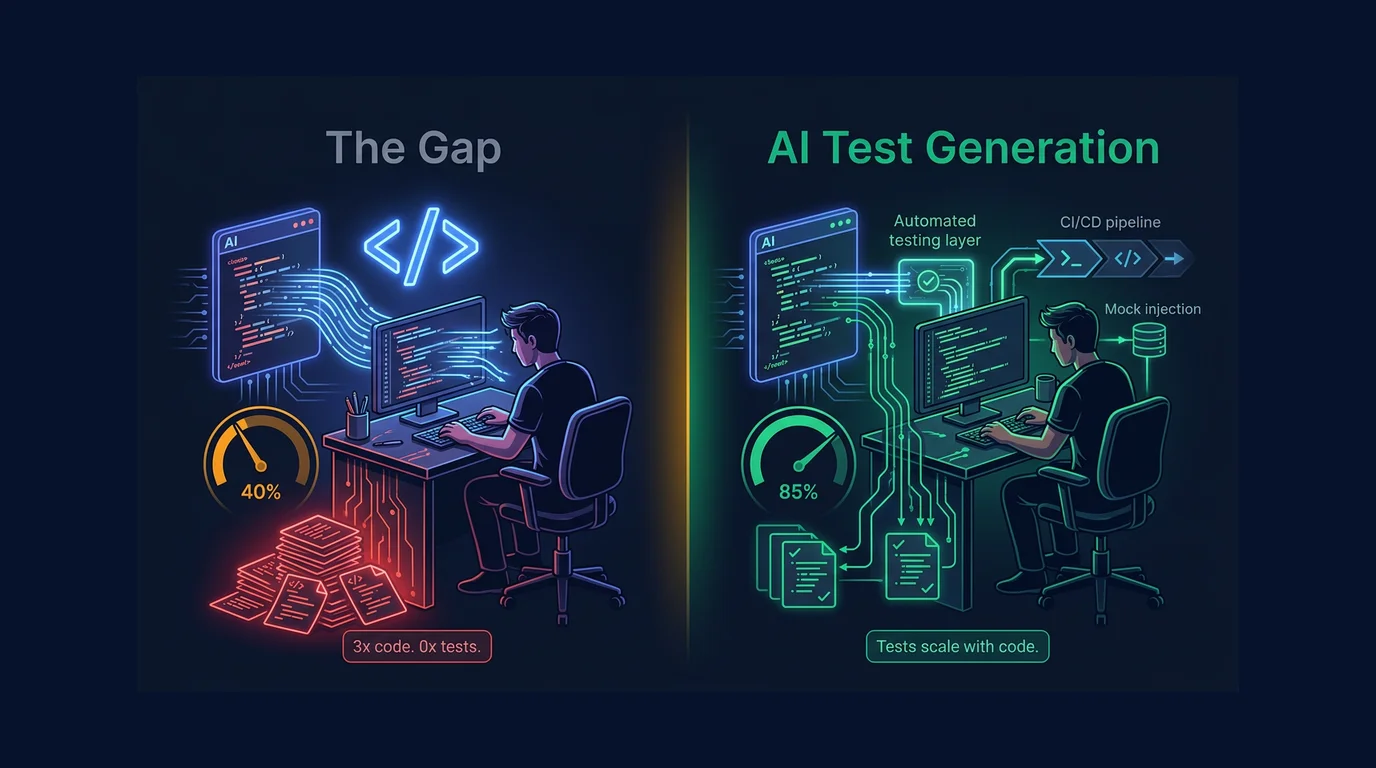
Your developers ship three times more code with AI tools. Your test coverage didn’t move.
It’s a math problem. Code volume tripled. Test-writing capacity stayed the same. The gap widens every sprint, and every untested function is a production incident waiting to happen.
82% of teams had at least one production failure linked to AI-generated code in the past six months. The cause isn’t bad developers or lazy testing. When code volume triples and test-writing capacity stays flat, coverage decays.
AI test generation is the only solution that scales with output. I’m not talking about “AI helps you write tests,” which is what Copilot does. That hasn’t closed the gap. I’m talking about a system that reads your code, discovers what should be tested, writes executable tests with mocks, runs them in CI/CD, and learns from failures to improve coverage over time. On every commit. No end date.
Why your current testing approach can’t keep up
Three approaches dominate testing today. All three leave the coverage gap unaddressed.
Manual unit testing is the default. Developers write tests after writing code. In practice, that means tests get written when there’s time, which means they get written late or not at all. Coverage depends on individual discipline, not system design. When a team ships faster with AI tools, the time available for writing tests doesn’t increase. It shrinks. More code means more PRs to review and more features to ship. The test backlog grows silently.
Copilot inline test suggestions help developers write tests faster, but the developer still has to decide what to test, ask for the test, review it, set up mocks manually, and integrate it into the suite. It’s faster than writing from scratch, but it doesn’t solve the coverage problem. The developer chooses what to test based on what they remember about the function, not what the code actually does. Edge cases get missed. Mocks get hand-written. And nothing tracks whether the generated tests actually run, pass, or cover the right branches over time.
Coverage tools like Istanbul, coverage.py, and JaCoCo measure what’s covered. They tell you the gap. They don’t fill it. A coverage report that says “42% branch coverage” tells you the problem but doesn’t fix it. The developer still has to look at the report, figure out which branches are uncovered, write tests for them, and re-run. Few teams do this systematically. The coverage report becomes a guilt-inducing dashboard that everyone ignores.
The missing layer is something that reads code, discovers what should be tested, writes the tests, creates the mocks, runs them, and tracks the results without manual intervention.
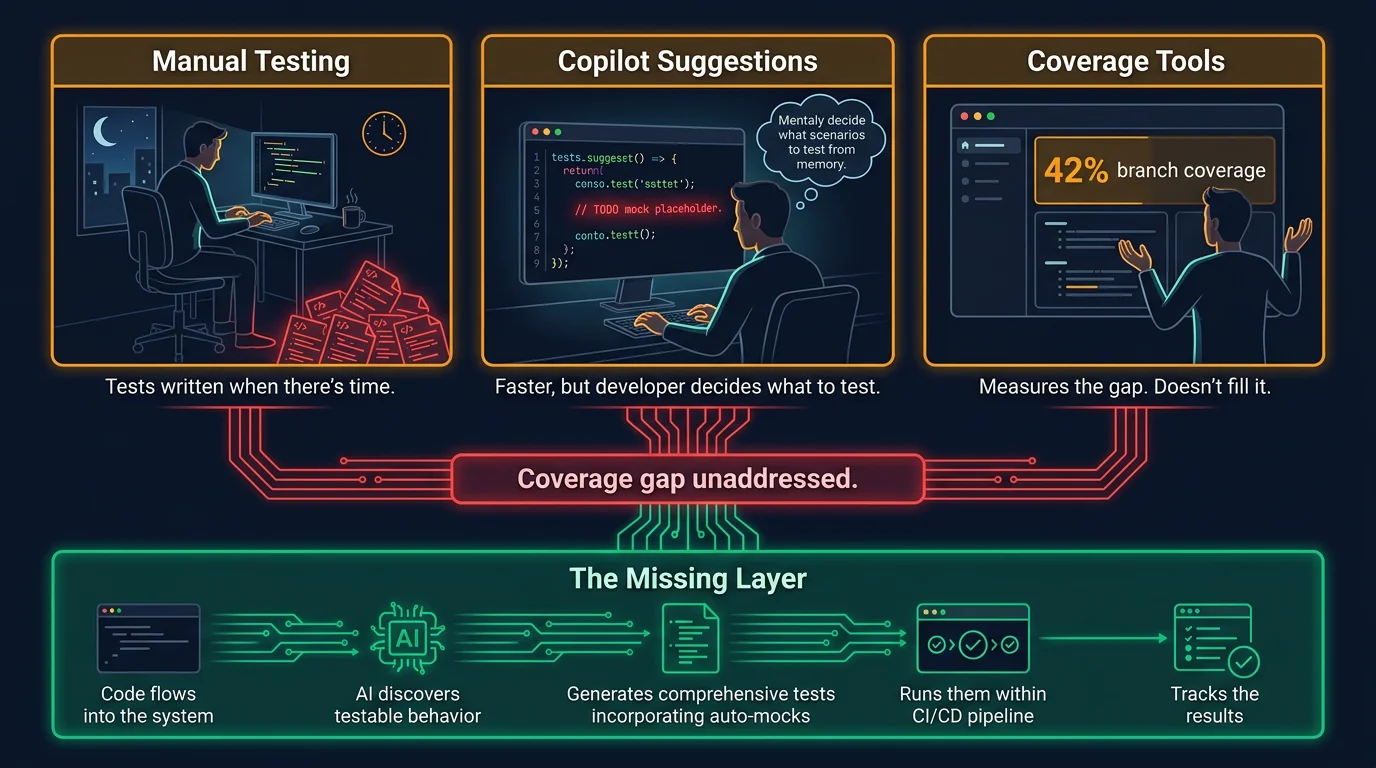 Three approaches dominate testing today. All three leave the coverage gap unaddressed. AI test generation is the missing layer.
How AI test generation works: the four-stage pipeline
AI test generation isn’t a single prompt that says “write a test for this function.” It’s a pipeline with four stages, each producing structured output that feeds the next. The pipeline runs on every commit, processes every changed function, and builds a growing repository of tests that tracks your codebase as it evolves.
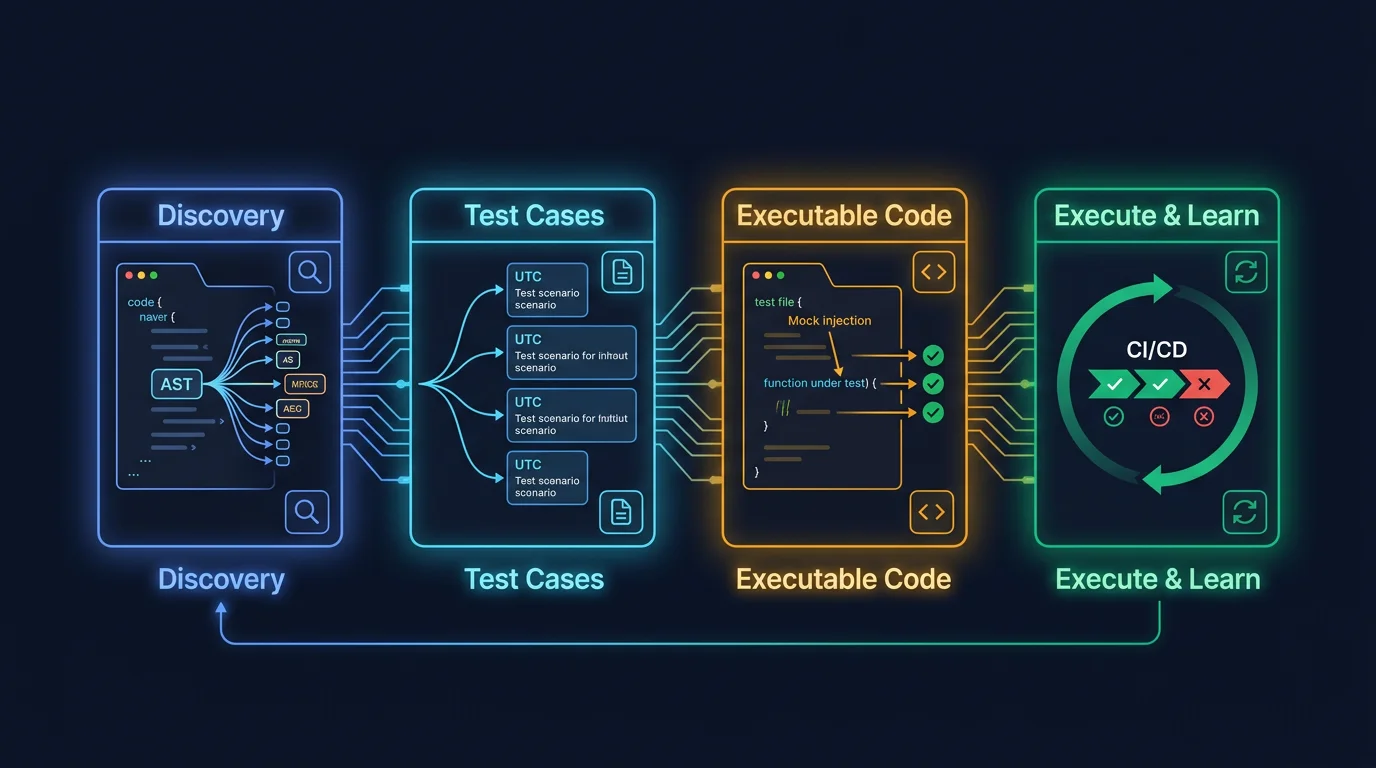 The four-stage AI test generation pipeline: discovery, test cases, executable code with mocks, and execution with a learning loop
Stage 1: Code analysis (discovery)
The pipeline starts by reading the code. The full function, its dependencies, its call graph, and its control flow. Not just the diff.
AST parsing extracts the structure. For each function or method, the system identifies:
- Function signature (parameters, return type, visibility)
- Control flow (if/else branches, loops, switch cases, early returns)
- Error paths (try/catch blocks, thrown exceptions, error returns)
- Data flows (variable assignments, transformations, mutations)
- External dependencies (database calls, HTTP clients, message queues, file I/O)
This works across 11+ languages. Python, JavaScript/TypeScript, Java, Go, C#, Ruby, Rust, PHP, C/C++, and more. Each language has its own AST format, but the extraction logic is the same: find every branch, every error path, every external call, and every edge case the code actually exercises.
The output of Stage 1 is a structured inventory of testable behavior. For each function, the system knows: here are the branches, here are the error paths, here are the boundaries, here are the external dependencies that need mocking. This is the raw material for test generation.
Stage 2: Test case generation (what to test)
From the code analysis, the AI generates Unit Test Cases. A UTC is a structured description of a single test scenario:
- Name: what the test validates
- Purpose: why this behavior matters
- Risk if not tested: what breaks in production if this path is untested
- Preconditions: what state the system must be in before the test
- Test steps: what the test does
- Expected result: what should happen
For each function, the system generates UTCs across four categories:
Happy path: the normal input, the expected output. The thing the function is supposed to do.
Boundary conditions: empty input, null, zero, negative, max value, off-by-one, empty collection, single-element collection. The edges where bugs hide.
Error scenarios: exceptions, timeouts, network failures, invalid input, permission denied. The paths that break in production but pass in development because they rarely get tested.
Security-related variations: injection attempts, auth bypass, input validation failures, data leakage. The paths that attackers probe and defenders miss.
Each UTC is human-readable. A developer can read the test case description and understand what’s being tested and why, without reading the test code. This matters because the UTC is the contract between the AI and the human. The human reviews the UTC and decides whether the test is worth running.
Stage 3: Executable test code generation (how to test)
UTCs are descriptions. The pipeline needs executable code, tests that compile, run, and produce pass/fail results.
For each UTC, the system generates a test function in the target framework:
| Language | Framework |
|---|---|
| Python | pytest |
| JavaScript/TypeScript | Jest |
| Java | JUnit |
| C# | NUnit/xUnit |
| Go | go test |
| Ruby | RSpec |
| Rust | built-in test framework |
| PHP | PHPUnit |
| C/C++ | Unity/GoogleTest |
The generated test code includes test setup, mock injection for external dependencies, the test action (calling the function under test with the specified input), assertions that encode the expected behavior from the UTC, and teardown.
The piece that separates real test generation from test suggestion is mock generation.
The output of Stage 3 is a test file that compiles and runs. It produces a pass or fail result. The developer doesn’t have to finish a partial snippet or fill in TODO comments. The test is complete and executable.
Stage 4: Execution, failure analysis, and learning
Tests that don’t run are worse than no tests. They create false confidence. A test file sitting in a repository that hasn’t been executed in three months is a liability. The code has changed, the test hasn’t, and the team doesn’t know if it still passes.
How it plugs into your pipeline
AI test generation doesn’t replace your existing CI/CD setup. It runs alongside it. The system connects to your repository via webhooks (GitHub, GitLab, Bitbucket, or any Git-based provider). On every push, it receives the commit payload, identifies which files changed, and triggers the pipeline for the affected functions.
The generated tests run alongside your existing test suite, not instead of it. If your pipeline already runs pytest, jest, or gradle test, the AI-generated tests are added to that same execution. They use the same framework, the same runner, and the same reporting infrastructure. Your existing tests continue to run exactly as they did before. The AI-generated tests are additive. More coverage, same pipeline, no configuration changes.
Execution results flow back to the system for tracking. Pass, fail, skip, duration, environment, all recorded. Engineering leaders see results in the portal, not buried in CI logs. Developers see failures in their PR thread, not in a separate dashboard they have to remember to check.
On every commit, the pipeline:
- Identifies which tests are affected by the changed code
- Executes them in the appropriate framework, alongside your existing test suite
- Captures results (pass, fail, error, skip)
- Records execution metadata (duration, environment, logs)
- Reports failures back to the PR thread and the portal
On failure, the system goes beyond pass/fail. AI-driven failure analysis produces:
- Which assertion in which test failed
- Which code path caused the failure (mapped back to specific lines)
- A root cause explanation in natural language
- A step-by-step debugging narrative
- A suggested fix with actual replacement code the developer can paste
The developer reads the analysis, understands why the test failed, applies the fix (or challenges the finding), and pushes. The cycle repeats.
The learning loop is what makes coverage grow over time instead of decaying. Untested paths discovered during analysis trigger new UTC proposals. Chronic failure areas get flagged for deeper coverage. Patterns from approved tests inform future generation. Coverage expands with every commit.
TESTR is built as a testing system. It generates, executes, analyzes, learns, and grows continuously. Webhook-triggered, pipeline-native, designed to run alongside your existing test infrastructure without replacing it.
When code changes: incremental coverage that doesn’t reset
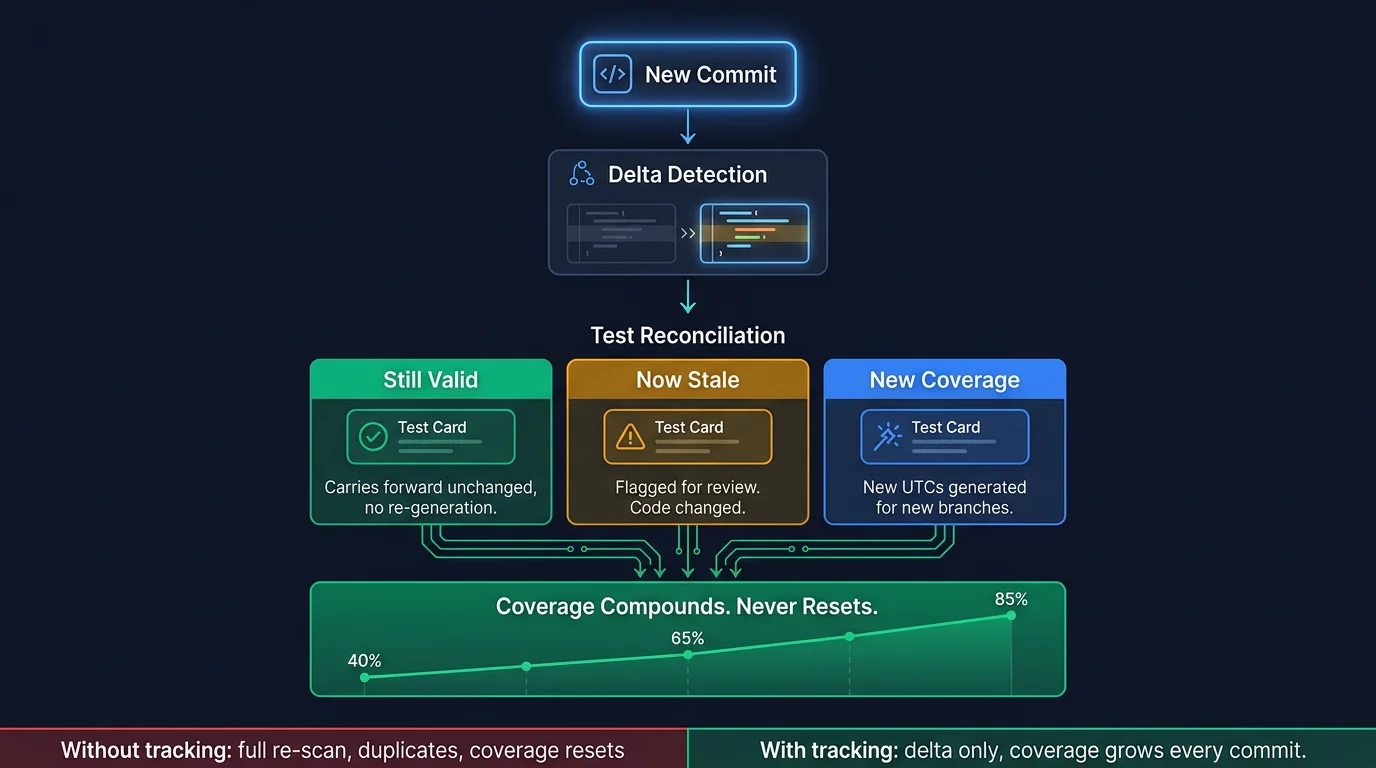 On every commit, the system processes only the delta. Existing tests carry forward. Coverage compounds, never resets.
Code changes. That’s the entire point of a codebase. Functions get modified, branches get added, signatures get refactored, dependencies shift. Code will change. What matters is what happens to your test coverage when it does.
Most testing tools have a reset problem. Coverage tools re-scan from scratch every run. They have no memory of what was tested before. Copilot doesn’t know what’s already covered. It regenerates or misses existing tests. When a function changes, the developer is back to square one: figure out what’s still relevant, what’s broken, what’s new, and write tests for the delta. Manually.
AI test generation solves this differently.
Delta detection
On every commit, the system compares the new version of the code against the last analyzed version. It identifies which functions changed, which branches were added or removed, which function signatures were modified, and which dependencies shifted.
The system doesn’t re-analyze the entire codebase. It processes only the delta, the functions that changed and their dependents. This means the pipeline runs in seconds, not minutes, for a typical commit.
Test reconciliation
Existing UTCs are mapped against the new code. Each UTC falls into one of three categories:
Still valid. The branch the UTC tests hasn’t changed. The test carries forward unchanged. No re-generation or duplicates. The developer doesn’t need to do anything. The test runs on the next CI cycle and passes.
Now stale. The branch the UTC tested was removed or significantly modified. The test is flagged as stale and marked for review. The developer sees: “This test covered the old behavior. The code has changed. Review the replacement.”
New coverage needed. The changed code introduced new branches, new error paths, or new boundary conditions that no existing UTC covers. The system generates new UTCs automatically and proposes them for review. The developer reviews only the net-new test cases.
Three scenarios in practice
Scenario A: Function unchanged. The existing tests carry forward with zero compute wasted on re-analysis. The function’s coverage is already recorded, so the system moves on.
Scenario B: Function modified, new branch added. A developer adds a Pro tier check to the CSV export function from our earlier example. The system detects the new branch, generates 2 new UTCs (Pro tier under the limit, Pro tier over the limit), and proposes them. The existing 6 tests carry forward unchanged. The developer reviews 2 new UTCs, approves them, and the test suite now covers 8 scenarios. Coverage grew with the code. No manual test writing.
Scenario C: Function refactored, signature change, logic restructured. The function parameters change. The internal logic is reorganized. The system flags all existing UTCs for this function as stale because the tests were written against the old signature and logic. It generates new UTCs for the refactored function and proposes them. The developer reviews the full replacement: old tests vs new tests. The old tests are archived, not deleted. They remain in the portal for reference and audit.
Why this is the difference between a tool and a system
A real testing system tracks tests across the lifetime of the codebase, not just the first commit.
Without incremental tracking, every commit triggers a full re-scan. The system re-generates tests for functions that didn’t change. Developers see duplicate test proposals for branches that are already covered. The noise teaches them to ignore the system. Coverage resets instead of growing.
With incremental tracking, coverage compounds. Every commit adds to the baseline. Nothing resets. The coverage number on your dashboard only goes up, because the system remembers what was tested yesterday and only proposes what’s new today.
This is what makes AI test generation sustainable over time. The system that still works when the codebase has 10,000 functions and 50,000 tests, and a developer changes one function on a Tuesday afternoon. It processes the delta, proposes the right new tests, and carries everything else forward.
Mock generation: the hardest problem
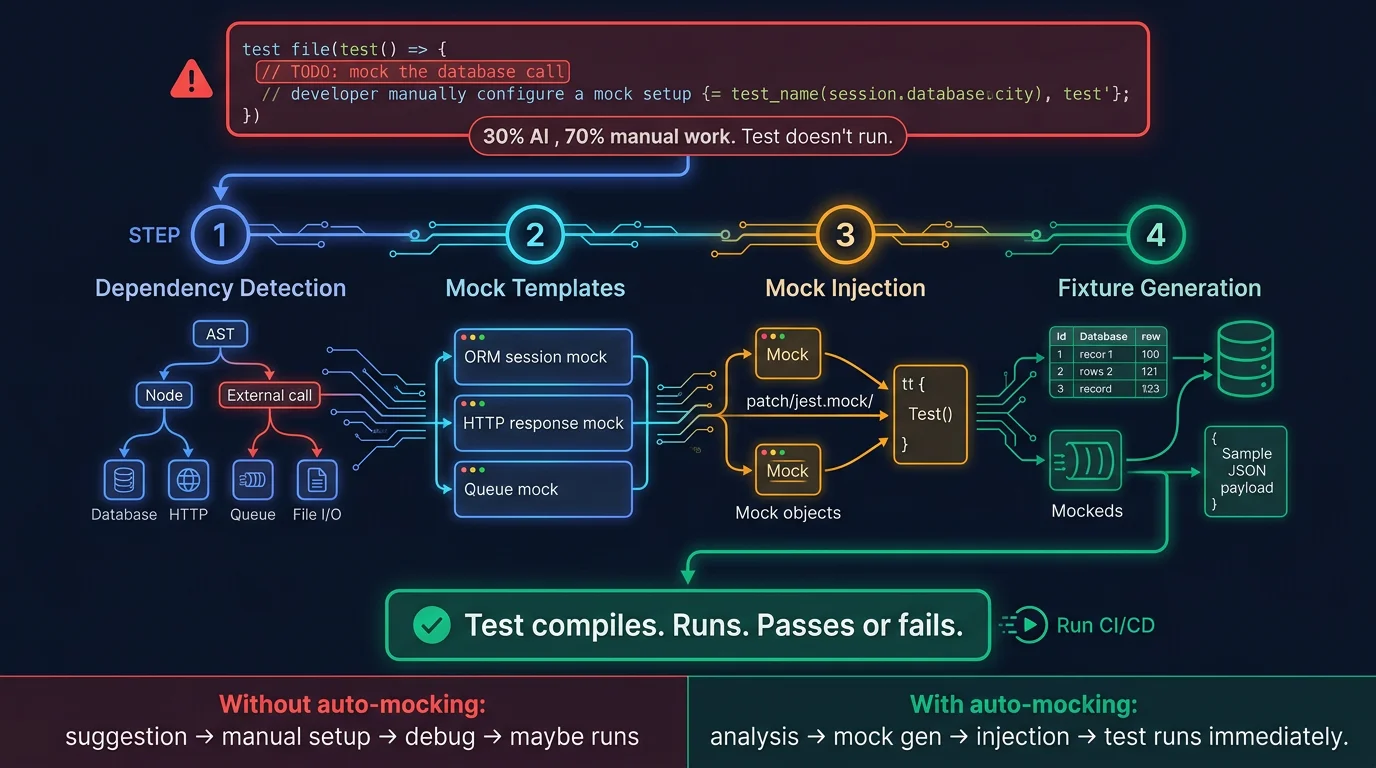 Mock generation is what separates real test generation from test suggestion. Without auto-mocking, tests don’t run.
Most AI test tools generate test logic and stop there. The developer gets a test function with a comment that says // TODO: mock the database call. The test doesn’t run. The developer has to manually set up mocks, figure out what to stub, configure the test framework’s mocking library, and debug the mock setup until the test passes. At that point, the “AI-generated test” is 30% AI and 70% manual work.
This is why most AI test generation efforts fail in production. The test logic is correct, but the mocks are missing, and a test that doesn’t run is a test that doesn’t exist.
TESTR approaches mock generation in four steps:
-
Dependency detection from AST analysis. During Stage 1, the system identifies every external call in the function: database queries, HTTP requests, message queue publishes, file system reads. Each dependency is classified by type.
-
Mock template generation. For each dependency type, the system generates a framework-appropriate mock. Database calls get the ORM session or raw connection mocked with predefined result sets. HTTP clients get the request/response cycle mocked with status codes and payloads. Message queues get the publish/consume interface mocked to capture messages without sending. File I/O gets mocked to return in-memory fixtures.
-
Mock injection. The generated test code wires the mocks into the function under test using the framework’s dependency injection or patching mechanism. In Python, that’s
unittest.mock.patch. In JavaScript, that’sjest.mock. In Java, that’s Mockito. The developer doesn’t configure anything. The mock setup is part of the generated test. -
Fixture generation. For each mocked dependency, the system generates realistic test fixtures, sample data that matches the expected shape. A mocked database query returns a list of sample records. A mocked HTTP response returns a realistic JSON payload. The fixtures are derived from the function’s actual usage patterns, not random data.
Without auto-mocking, AI-generated tests fail to run. A test that doesn’t run is worse than no test because it creates the illusion of coverage while providing zero protection. Mock generation turns a test suggestion into a test that runs.
AI test generation vs Copilot vs coverage tools
| Dimension | Copilot inline | Coverage tools | AI test generation (TESTR) |
|---|---|---|---|
| Discovers what to test | No, developer decides | No, measures only | ✓ Yes, from code analysis |
| Generates executable tests | Partial, on demand, per file | No | ✓ Yes, every commit, every function |
| Auto-generates mocks | No, developer hand-writes | No | ✓ Yes, DB, HTTP, queues, file I/O |
| Runs in CI/CD | No, IDE only | Yes, measures coverage | ✓ Yes, executes and reports |
| Failure analysis | No | No | ✓ Yes, root cause + suggested fix |
| Tracks across commits | No | No | ✓ Yes, incremental, reconciles |
| Coverage grows over time | No | No | ✓ Yes, learning loop |
| Human approval required | N/A (developer writes) | N/A (passive tool) | ✓ Yes, UTCs reviewed before activation |
Teams need all three. Copilot accelerates individual test writing. Coverage tools measure the gap. AI test generation fills the gap continuously. They serve different layers of the testing pipeline, and treating them as interchangeable is why the coverage number never moves.
What changes when you add AI test generation
Developer. No more “I’ll write tests later.” Tests arrive on the first commit. Feedback comes before the PR opens. The developer learns from the generated tests, seeing which branches were tested and why, without spending hours writing boilerplate test setup. They focus on code instead of test infrastructure.
Tech lead / staff engineer. Coverage is no longer a sprint negotiation. It’s a default output of shipping code. The conversation shifts from “we need to improve coverage” to “let’s review the test cases the system generated and make sure they’re testing the right things.” The senior engineer reviews test quality, not test quantity. They spend time on architecture and mentoring, not writing test fixtures.
QA. Shift from manual regression to exploratory testing and edge cases automation can’t catch. TESTR covers unit-level behavior. Does the function do what it’s supposed to do. QA covers user-level behavior. Does the login flow redirect the browser, preserve the session, and render the dashboard. Different layers, complementary coverage.
CTO / VP engineering. Coverage metrics that don’t decay. Defect escape rate drops. The board sees test quality as a number, not an assumption. When someone asks “what did we get for our AI tooling spend,” the answer includes “our test coverage grew from 40% to 85% without adding QA headcount.”
Release / DevOps. Fewer hotfixes. Pipeline confidence. Every PR has test results attached. Flaky tests are identified and tracked instead of ignored.
The human-in-the-loop principle
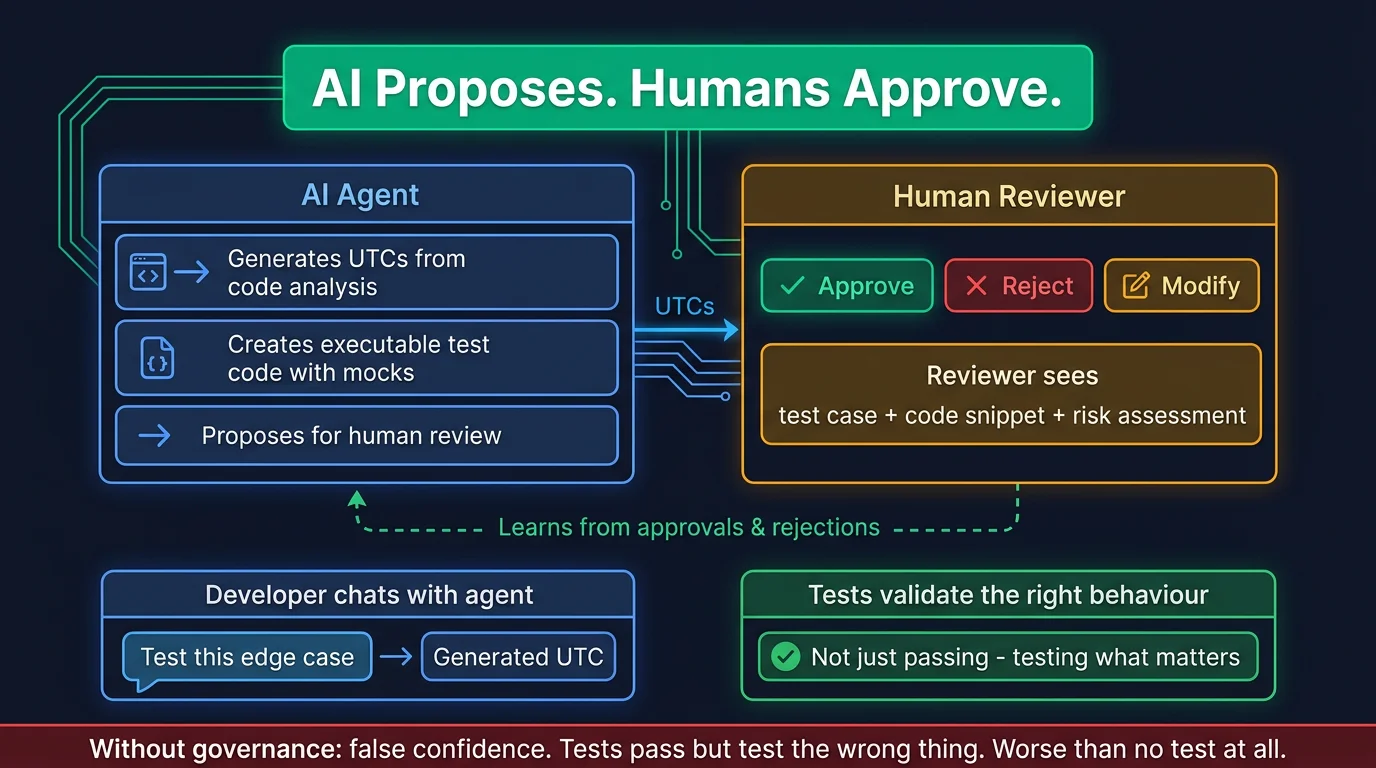 AI proposes tests. Humans approve. Governance prevents false confidence. The system learns from every review.
AI test generation without governance is dangerous. A system that automatically generates and runs tests without human review creates two problems: false confidence (the tests pass, but they test the wrong thing) and noise (low-value tests slow down the pipeline without catching real issues).
TESTR’s design principle is straightforward: AI proposes. Humans approve.
Every generated UTC goes through a review workflow. Reviewers see the test case description, the linked code snippet, and the risk assessment. They approve, reject, or modify. No test runs in a production pipeline without human approval. This ensures the team controls what’s being tested and why.
The AI learns from approvals and rejections. When a reviewer rejects a UTC, the system records why. When a reviewer modifies a test case, the system learns the pattern. Over time, the generated tests become more targeted, aligned with the team’s standards, the codebase’s conventions, and the product’s actual risk profile.
Developers can also chat with the agent to get the specific test cases they need. Not every generated UTC is exactly what the team needs. A developer might want a specific edge case tested, a particular input variation, or a test that reflects a production incident they’ve seen. The agent is interactive. A developer describes the scenario they want tested, and the system generates a UTC and executable test for that specific case. The developer guides the coverage. The AI does the heavy lifting of writing the test code, setting up mocks, and wiring it into the pipeline.
Auto-generated tests that run without review create false confidence. A test that passes but asserts the wrong thing is worse than no test. It tells you everything is fine when it isn’t. Governance is the layer that makes AI-generated tests trustworthy. It ensures humans review what’s being tested and why, so the tests validate the right behavior instead of just passing.
Real-world example: how TESTR handles a function
Consider a Python function that exports user data to CSV:
def export_user_csv(db_session, api_client, user_id, tier):
    user = db_session.query(User).filter(User.id == user_id).first()
    if not user:
        raise ValueError("User not found")

    rows = db_session.query(Order).filter(Order.user_id == user_id).all()
    if len(rows) == 0:
        return {"csv": "", "message": "No orders found"}

    if len(rows) > 10000 and tier == "free":
        return {"csv": "", "message": "Upgrade to Pro for exports over 10,000 rows"}

    try:
        enriched = api_client.post("/enrich", {"rows": [r.to_dict() for r in rows]})
    except TimeoutError:
        return {"csv": "", "message": "Enrichment service timed out, try again"}

    csv_buffer = generate_csv(enriched["data"])
    return {"csv": csv_buffer, "message": "ok"}
Stage 1, Code analysis. The system identifies 5 branches: user not found, no orders, 10k threshold on free tier, API timeout, and success. It finds 2 external dependencies: db_session (database) and api_client (HTTP). It maps 2 error paths: ValueError and TimeoutError. And it catches 1 boundary condition: exactly 10,000 rows (off-by-one risk).
Stage 2, UTC generation. The system generates 6 UTCs:
- Happy path: user exists, orders exist, under 10k, API succeeds, CSV returned
- User not found: raises ValueError
- No orders: returns empty CSV with message
- Free tier over 10k: returns upgrade message, no CSV
- API timeout: returns timeout message, no CSV
- Exactly 10,000 rows on free tier: boundary test (does the > check exclude exactly 10k?)
Each UTC includes risk-if-not-tested: “If the 10k boundary is off by one, free tier users can export full datasets, bypassing the paywall.”
Stage 3, Executable test code. The system generates a pytest file. db_session is mocked with unittest.mock.MagicMock. .query().filter().first() returns a sample User object, .query().all() returns a list of sample Order objects. api_client is mocked with unittest.mock.MagicMock. .post() returns a sample enriched payload, or raises TimeoutError for the timeout test. Each test function calls export_user_csv with the mocked dependencies and asserts the return value or raised exception. The test file runs and passes or fails with no manual setup.
Stage 4, Execution. The test runs in CI on the next commit. All 6 tests pass. Coverage for this function: 100% of branches. The developer didn’t write a single line of test code.
Next sprint. The function changes. A new branch is added for Pro tier with a row limit of 50,000. The system detects the delta, generates 2 new UTCs (Pro tier under 50k, Pro tier over 50k), and proposes them for review. The existing 6 tests carry forward unchanged. The developer reviews the 2 new UTCs, approves them, and the test suite now covers 8 scenarios. Coverage grew with the code.
Why this matters now
The coverage gap compounds. Every sprint, your team ships new code. Some of it gets tested. Most of it doesn’t. The untested code builds on top of older untested code. Three sprints in, you have a foundation of untested functions that your new features depend on. A regression surfaces in production that traces back to an edge case no one wrote a test for, because no one had time.
AI coding tools accelerated this problem. Developers generate code 3-5x faster. The code works in the prompt. It compiles. It passes the happy path. But the edge cases (null inputs, timeout scenarios, boundary conditions) are untested. And AI-generated code has more of these edge cases, not fewer, because the developer didn’t write every line and may not understand every branch.
82% of teams had at least one production failure from AI-generated code in the past six months. That number will go up, not down, as more teams adopt AI coding tools without scaling their test coverage.
The teams that win the next two years will not be the ones that generate the most code. They will be the ones that test the most code, continuously, without adding manual work to developers who are already shipping as fast as they can.
AI test generation is a pipeline that discovers, generates, executes, and learns. The coverage gap is a math problem. This is the math solution.
Working with Flytebit
At FLYTEBIT TECHNOLOGIES, we build agentic AI systems that run in the background so your team can focus on what matters. See how agentic AI systems work across the full development pipeline.
TESTR is our AI-powered testing platform that discovers testable behavior from source code, generates executable unit tests with auto-generated mocks, and runs them in CI/CD with root cause analysis on every failure. If your test coverage hasn’t moved despite shipping faster with AI tools, we can help you understand exactly where the gaps are and what to do about them.
Not sure where your organisation stands today? The Vibe Coding Transformation Readiness Quick Check takes five minutes and gives you a per-function view of where your pipeline is most exposed.
Stay tuned for our upcoming product launch.
Ready to get started?
- Visit us at: flytebit.com
- Follow FLYTEBIT TECHNOLOGIES on LinkedIn for insights and updates
- to discuss your specific use cases
Related reading
Learn how AI changes code review:
AI code review: from nice-to-have to mission-critical
Why the PR queue became a parking lot and how AI code review fills the gap between code generation and code quality.
Understand the broader transformation:
Vibe coding vs agentic engineering
The difference between AI as an assistant and AI as an author, and why confusing them costs engineering teams.
Key takeaways
- The coverage gap is arithmetic, not motivation. Code volume tripled with AI tools. Test-writing capacity stayed flat. Coverage decays every sprint.
- AI test generation is a four-stage pipeline. Code analysis, test case generation, executable test code with mocks, and execution with failure analysis and learning.
- Mock generation is what separates real test generation from test suggestion. Without auto-mocking, AI-generated tests don't run, and a test that doesn't run is worse than no test.
- Incremental tracking means coverage compounds. The system remembers what was tested and only proposes net-new tests. Coverage never resets.
- Human-in-the-loop is non-negotiable. AI proposes tests. Humans approve. Developers can chat with the agent to guide coverage. Governance prevents false confidence.
- Copilot, coverage tools, and AI test generation serve different layers. Copilot accelerates individual test writing. Coverage tools measure the gap. AI test generation fills it continuously.

Ready to Transform Your Business with AI?
Let's discuss how Agentic AI and intelligent automation can help you achieve your goals.