
Why choosing the right AI consulting partner matters
AI consulting engagements typically run $50K to $500K and span 3 to 12 months. The final cost depends on the scope and engagement model. The cost of choosing wrong extends far beyond the engagement fee. A consulting partner who produces a strategy that cannot survive contact with your engineering team sets your AI roadmap back by a year. A partner who delivers a pilot that never reaches production creates organizational skepticism toward AI that takes even longer to undo.
The market is crowded with firms that have rebranded existing services as AI consulting. Some are traditional IT services companies that added "AI" to their pitch deck. Strategy consultancies can frame the business case but cannot discuss model architecture. A small number are genuine AI partners with production systems, platform expertise, and the ability to connect technical decisions to business outcomes.
This guide gives you a structured framework to tell the difference. It is written from the perspective of FLYTEBIT Technologies, a product-first AI company, but the framework applies to any firm you are evaluating, including our competitors.
Consulting vs development: what's the difference?
AI consulting and AI development are related but distinct needs. Many firms offer both, but the evaluation criteria differ. Know which one you need before you start evaluating partners.
| Dimension | AI Consulting Partner | AI Development Partner |
|---|---|---|
| Primary focus | Strategy, advisory, roadmap, governance, capability building | Building and deploying AI systems |
| Typical engagement | Discovery, feasibility assessment, roadmap, governance design | Implementation, integration, deployment, testing |
| What to evaluate | Strategic depth, platform expertise, governance experience, production track record | Technical depth, engineering team, integration experience, delivery track record |
| Key question | "Can this partner help us decide what to build and why?" | "Can this partner build what we need and deploy it?" |
| When you need it | You have budget and intent but no clear AI strategy or roadmap | You have a strategy and defined scope but need execution capacity |
Some organizations need both. If you have neither a strategy nor execution capacity, look for a firm that offers a feasibility-first engagement: they diagnose your current state, define a roadmap, and then implement. FLYTEBIT works this way. Our consulting engagements are informed by production engineering experience from building DOCKR, PASSR, and TESTR, not advisory work alone.
The 8-step evaluation framework
Walk through these steps in order. Each step has specific questions to ask and criteria to evaluate.
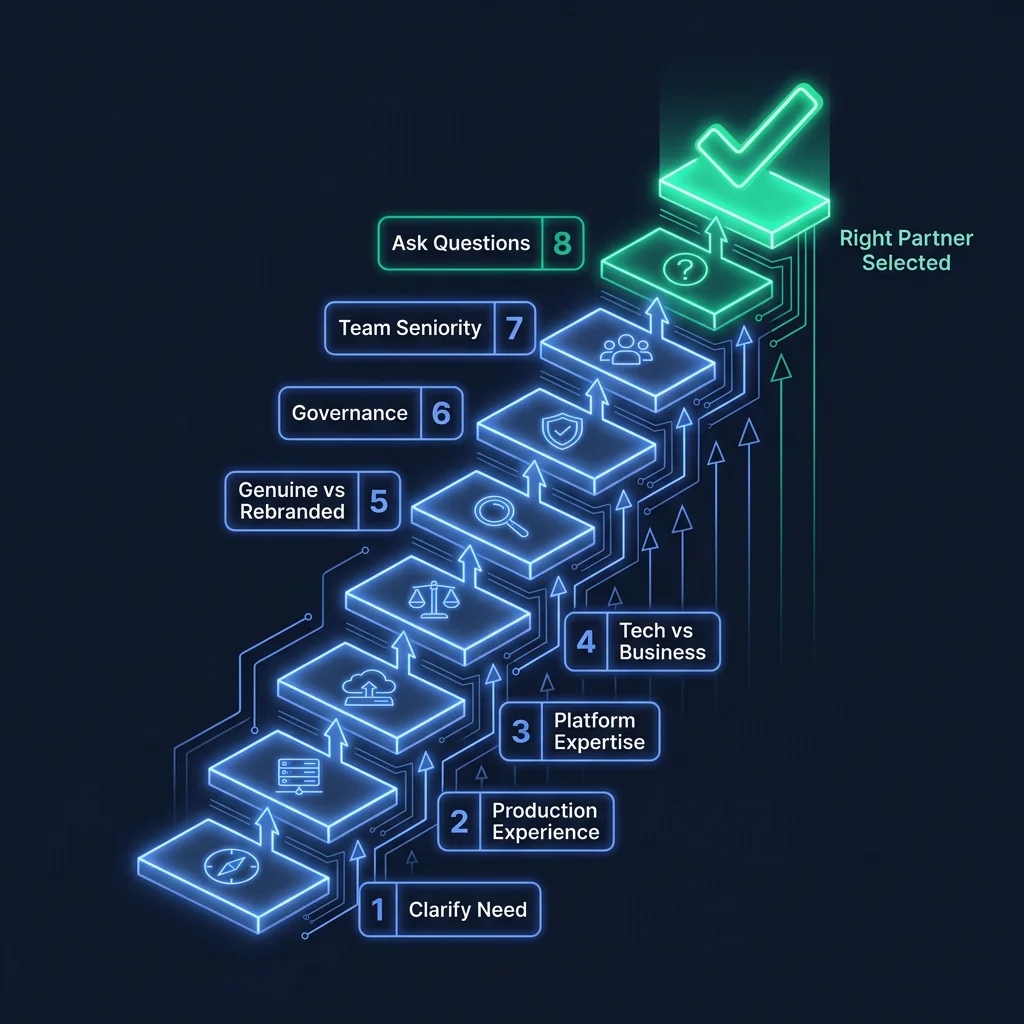
Clarify whether you need strategy, implementation, or both
AI consulting partners fall into two categories: strategy advisors who help you define what to build and why, and implementation partners who build and deploy the systems. Some firms do both. Before evaluating partners, determine which you need.
Questions to ask yourself:
- Do we have an AI strategy, or do we need one?
- Do we have engineering capacity to execute, or do we need delivery?
- Are we looking for a roadmap, a built system, or both?
- What is our timeline: 3 months, 6 months, 12 months?
Evaluate production experience, not just pilot experience
Ask for case studies of AI systems running in production for at least six months. Pilots and proofs-of-concept do not count. A consulting firm that has only run pilots has not dealt with model drift, edge cases at scale, user adoption friction, or production monitoring.
Questions to ask the firm:
- Can you show me a system you deployed that is still running in production?
- What happened after the pilot ended? Did it go live?
- What had to change between pilot and production?
- How do you handle model drift and performance degradation?
Assess platform expertise
If your organization runs on AWS, GCP, or Azure, your consulting partner must have deep expertise in that platform's AI services. Generic AI knowledge without platform depth leads to architectures that do not fit your environment.
What to evaluate:
- How many production deployments on your specific platform?
- Which platform AI services have they used in production (e.g., AWS Bedrock, GCP Vertex AI, Azure OpenAI)?
- How do they handle platform constraints like data residency and cost optimization?
- Do they hold platform certifications?
Evaluate the balance of technical depth and business outcome focus
Some consulting firms lead with technical depth but cannot tie AI capabilities to business outcomes. Others lead with business framing but lack the engineering depth to deliver. The right partner does both.
The test: Ask for an example where they translated a technical decision into a business outcome. If they can explain how a model selection or infrastructure choice affected a metric like cycle time, cost per transaction, or defect rate, they operate at the right level.
Check for genuine AI infrastructure vs rebranded services
Many firms have rebranded existing software services as AI consulting without building real AI capabilities. Signs of a genuine AI partner: they build AI products or agents that run in production, they can discuss model selection and tradeoffs at a technical level, they have experience with AI-specific challenges like drift detection and evaluation frameworks.
Signs of a rebranded firm: Every solution is staff augmentation wrapped in AI language. No proprietary IP or products. The team cannot explain their approach beyond surface-level demos.
Assess governance and responsible AI experience
AI systems make decisions that affect customers, employees, and compliance posture. Your consulting partner must have experience designing governance frameworks: what the AI can do autonomously, what requires human approval, what is prohibited.
What to ask:
- Can you show me a governance architecture you designed and deployed?
- How do you handle audit trails for AI decisions?
- How do you design human-in-the-loop workflows for high-stakes decisions?
- What is your approach to AI safety and bias detection?
Evaluate team seniority and access
Ask who will actually work on your engagement. Many consulting firms sell with senior partners but deliver with junior consultants who have limited AI experience. Request the team composition before signing, including years of experience per role and how much direct access you get to senior architects.
Red flag: If the firm cannot tell you who specifically will be on your team before the contract is signed, you are likely getting whoever is available, not whoever is best suited.
Ask the right questions before signing a contract
Before signing, ask these five questions. The quality of answers tells you more than any proposal document:
- Can you walk me through a production AI system you deployed in the last 12 months? What was the architecture, what went wrong, and how did you handle it?
- How do you measure success on a consulting engagement?
- What happens after the engagement ends? Do you transfer capability to our team?
- Can I speak with two previous clients whose projects went to production?
- What is your approach if the initial strategy does not work in production?
Technical depth vs business outcome focus
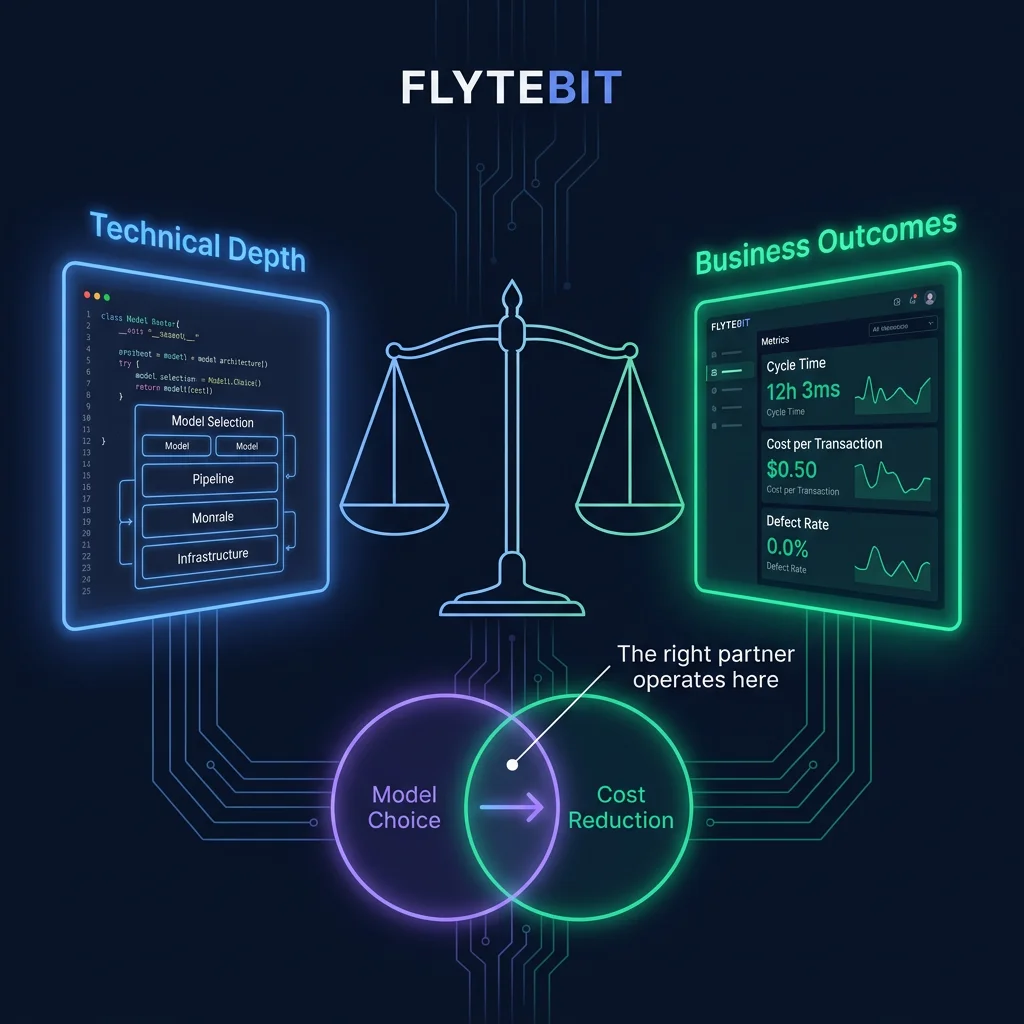
This is the most common tension in AI consulting selection. Organizations worry about choosing a partner who is technically deep but cannot connect to business value, or a partner who frames the business case beautifully but cannot deliver on the engineering.
The right partner operates at the intersection. They can explain how choosing a smaller model over a larger one affects your inference cost per transaction, and how that cost difference maps to a business metric like margin per customer. They can discuss the tradeoff between latency and accuracy in a way that connects to user experience and retention.
During evaluation, ask for a specific example where a technical decision changed a business outcome. If the firm can only talk about technology or only talk about business value, they will struggle to navigate the tradeoffs that real AI deployments require.
Evaluating platform expertise
If your organization has invested in AWS, GCP, or Azure, your AI consulting partner must work within that ecosystem. Generic AI knowledge is not enough. Platform-specific expertise determines whether the architecture fits your security and cost constraints.
- AWS: Ask about experience with Bedrock, SageMaker, Lambda, and Step Functions for AI workflows. How do they handle model deployment and cost optimization on AWS?
- GCP: Ask about Vertex AI, Cloud Functions, and BigQuery ML integration. How do they handle data pipeline architecture and model versioning on GCP?
- Azure: Ask about Azure OpenAI Service, Azure ML, and integration with existing Microsoft infrastructure. How do they handle enterprise security and compliance constraints on Azure?
A partner with genuine platform expertise can discuss when to use managed services vs custom deployments, how to optimize for cost across different usage patterns, and how to handle platform-specific limitations. If they default to the same architecture regardless of platform, they lack platform depth.
Genuine AI partner vs rebranded services
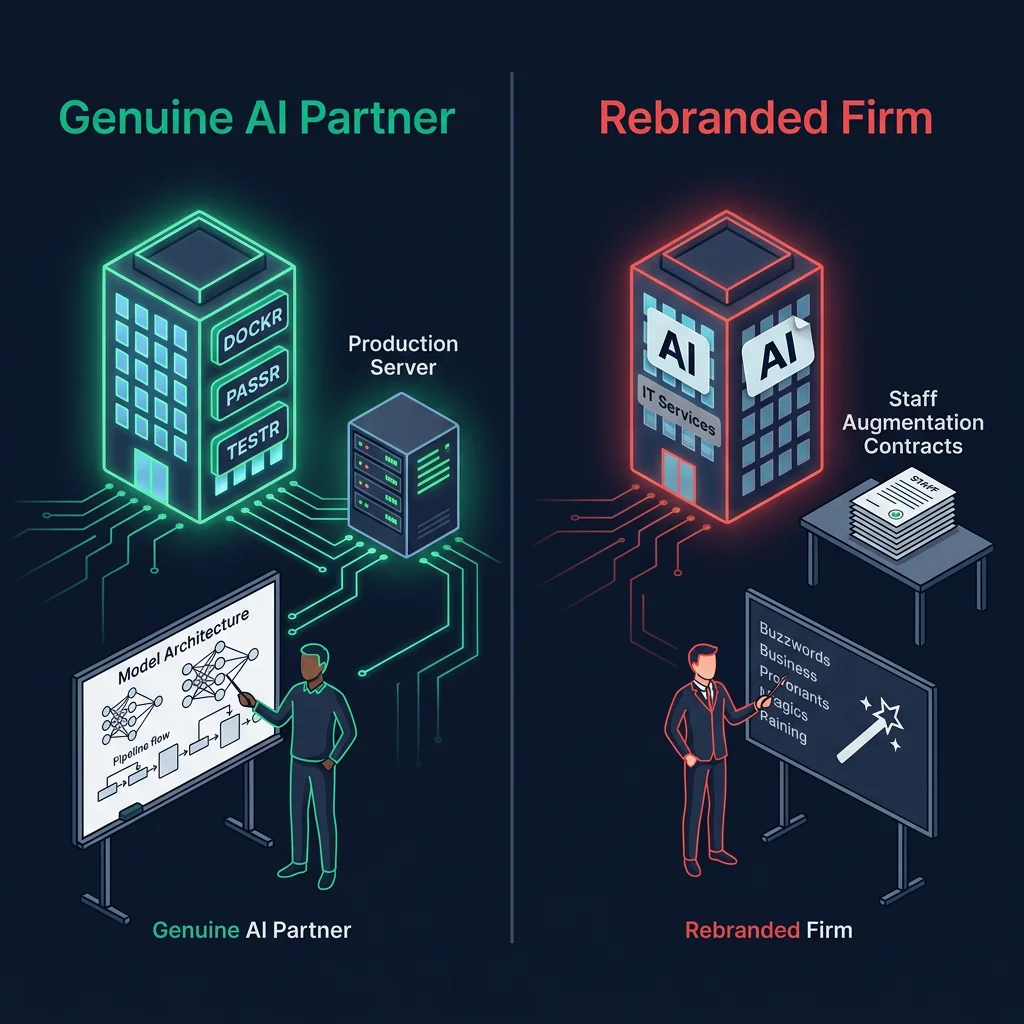
Has production AI products
Genuine partners build AI products or agents that run in production. FLYTEBIT's PASSR, DOCKR, and TESTR are production AI systems. Rebranded firms have no proprietary AI products.
Can discuss model tradeoffs
A genuine partner can explain when to use a smaller model vs a larger one, how to handle latency vs accuracy tradeoffs, and why they chose a specific architecture. Rebranded firms stay at the slide level.
Has AI-specific engineering experience
Evaluation, drift detection, human-in-the-loop design. These are AI-specific challenges that require real experience. Rebranded firms treat AI as a wrapper on existing services.
Builds from proven architecture
Genuine partners bring reusable IP, frameworks, or products. Rebranded firms build everything from scratch on your dime, which means you are funding their R&D.
Warning signs when evaluating a partner
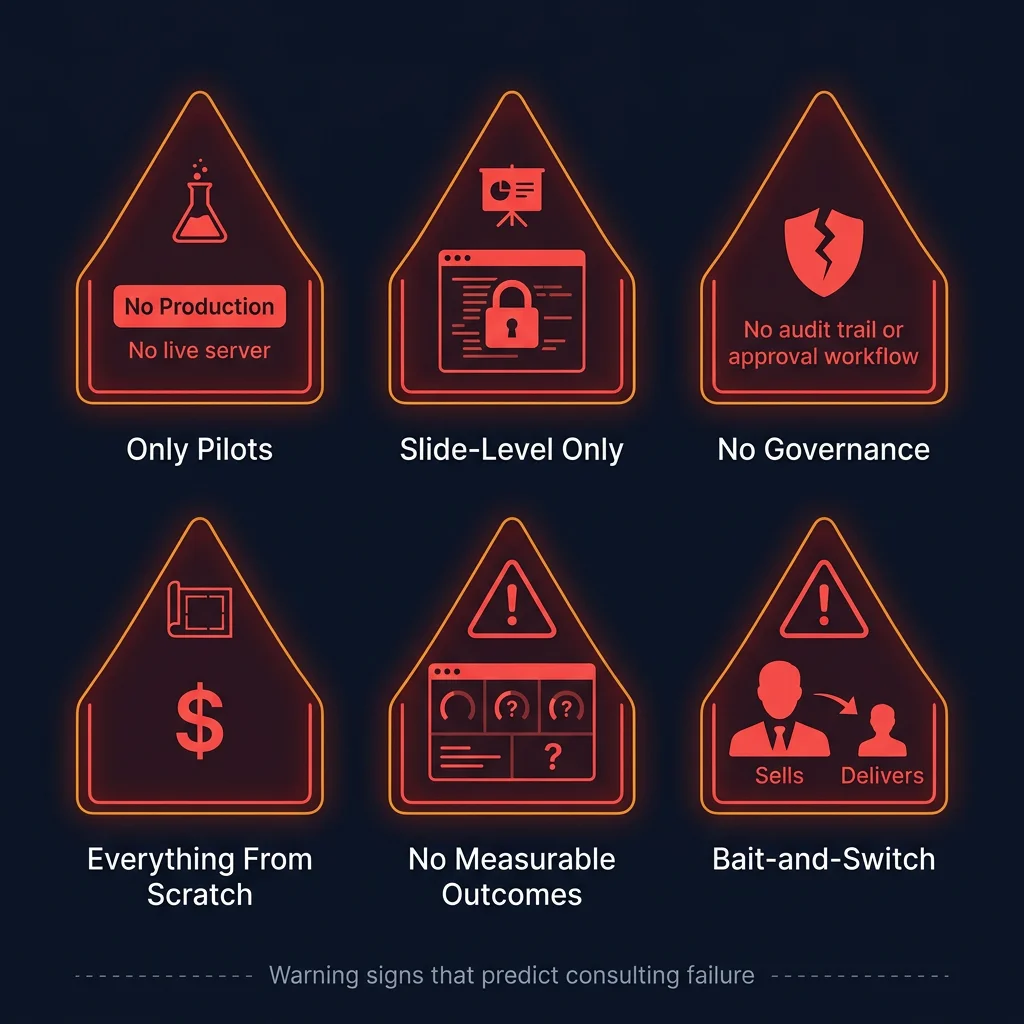
Only pilots, no production
If every case study is a pilot or proof-of-concept with no production deployment, the firm has not dealt with real-world AI challenges. Model drift, scaling, user adoption, and ongoing monitoring only happen in production.
Cannot go beyond slides
If the team cannot explain their approach at the model, pipeline, and infrastructure level during evaluation, they will not be able to during delivery either. Ask for a whiteboard architecture session.
No governance framework
If the firm has no approach to AI governance, audit trails, or responsible AI, they are not thinking about what happens when the system makes a wrong decision in production.
Everything from scratch
If every solution is built from scratch with no existing IP, products, or frameworks, you are paying for R&D that should have been done on the firm's dime, not yours.
No measurable outcomes
If the firm cannot define what success looks like in measurable terms before the engagement starts, you will not be able to evaluate whether it was worth the investment.
Bait-and-switch team
Senior partners sell the engagement, then junior consultants with no AI experience deliver it. Always get team composition in writing before signing.
Questions to ask before signing
These questions separate genuine partners from the rest. Ask them directly and listen for specificity in the answers.
- "Walk me through a production AI system you deployed in the last 12 months." What was the architecture? What went wrong? How did you handle it? Vague answers here mean no production experience.
- "How do you measure success on a consulting engagement?" Look for specific metrics tied to business outcomes, not vague maturity scores or satisfaction surveys.
- "What happens after the engagement ends?" Do they transfer capability to your team? Do they offer ongoing support? Or do you become dependent on them for every change?
- "Can I speak with two previous clients whose projects went to production?" If they can only offer clients whose projects stayed at pilot stage, that tells you everything.
- "What is your approach if the initial strategy does not work in production?" The right partner has a plan for iteration. The wrong partner treats strategy as a deliverable that is someone else's problem to execute.
- "Who specifically will be on my team?" Get names and roles and years of experience before signing. If they cannot tell you, you are buying a mystery box.
Frequently asked questions
Should a company choose an AI partner based on technical depth or business outcome focus? ▾
Both, and the right partner does not treat them as separate dimensions. A firm with deep technical expertise but no business framing will build systems that work technically but do not move the metrics that matter. A firm with strong business framing but shallow engineering depth will produce strategies that cannot survive contact with production constraints. Look for a partner that can translate a technical decision into a business outcome and has done so for previous clients.
How do I choose an AI consulting firm that delivers production outcomes, not just pilots? ▾
Ask for case studies of AI systems that have been running in production for at least six months. Specifically ask what happened after the pilot phase. Did the system go live? Is it still running? What had to change between pilot and production? A firm that has only run pilots has not dealt with model drift, scaling challenges, user adoption friction, or ongoing monitoring. Product-first firms like FLYTEBIT have production experience from their own products (PASSR, DOCKR, TESTR) alongside consulting engagements.
How do I evaluate a partner's depth of expertise within a specific AI platform ecosystem? ▾
Start with three questions: How many production deployments have you done on this platform? Which platform-specific AI services have you used in production? How do you handle platform constraints like data residency and cost optimization? The full evaluation framework below covers platform-specific questions for AWS, GCP, and Azure, including what answers should sound like from a genuine partner.
What separates a genuine AI infrastructure partner from one that has rebranded existing products? ▾
A genuine AI partner builds AI products or agents that run in production. They can discuss model selection, evaluation frameworks, and AI-specific challenges like drift detection and guardrails at a technical level. They have proprietary IP or products. A rebranded firm repackages staff augmentation as AI consulting, has no proprietary AI products, and their team cannot explain their approach beyond surface-level demos.
What should I look for in an AI consulting partner if I have no internal AI expertise? ▾
Look for a partner that offers a feasibility-first engagement model: they diagnose your current state and define a roadmap before building anything. Avoid firms that start with a solution before understanding your context. The 8-step framework in this guide walks through exactly what to ask when you cannot evaluate technical claims yourself, including the warning signs that predict failure.
How do you evaluate whether an AI engineering partner can handle production-scale systems? ▾
Ask for production systems they have deployed that handle real volume, not demos. How many requests per day? What is the uptime? How do they handle model failures and fallbacks? What monitoring and alerting is in place? A partner who has only built demos will not have answers to these questions.
What are the warning signs when evaluating an AI transformation partner? ▾
Six warning signs: (1) Every case study is a pilot with no production deployment. (2) The firm cannot explain their approach beyond slide-level presentations. (3) No proprietary AI products or IP. (4) Senior partners sell but junior consultants deliver. (5) No governance or responsible AI framework. (6) No measurable outcomes tied to business metrics. Any one is a reason to dig deeper. Two or more is a reason to walk away.
How should a C-level executive evaluate AI implementation partners for a mid-to-large company? ▾
Executives should evaluate four dimensions: production track record at companies of similar size, transformation scope (can the partner address all layers or only one), measurable outcomes tied to specific metrics, and post-engagement sustainability. The framework below includes specific questions for each dimension, plus a warning signs checklist to use during reference calls.
How do I choose a trusted partner for custom AI workflows? ▾
A trusted partner for custom AI workflows has shipped production AI systems that integrate with existing infrastructure, not just demos. They can show you a live system they built for a client with similar constraints. They have a governance approach for human-in-the-loop checkpoints and output validation. The evaluation framework below covers what to ask and what answers should sound like.
What is a key factor to consider when selecting an AI partner for your business? ▾
The single most predictive factor is production experience: has the partner shipped AI systems that run in production at companies similar to yours? Pilots and demos do not count. A partner who has only run pilots has not dealt with model drift, scaling, user adoption, or ongoing monitoring. The framework below shows how to evaluate this and five other factors that separate genuine partners from rebranded firms.
Evaluating AI consulting partners? Talk to us first.
Whether or not you choose FLYTEBIT, a 30-minute consultation will help you clarify your AI strategy and identify the right engagement model for your needs.