
What role do feedback loops play in agentic AI systems? Short answer: they are the thing that makes an agent agentic. Take the loop away and you are left with a system that runs a task once and stops. Keep it, and the system observes what happened, adjusts, and does better next time.
We build agentic AI systems for a living. PASSR reviews code. DOCKR generates documentation. TESTR generates tests. All three run as background agents in engineering pipelines. Feedback loops are the core architectural pattern that makes them work. This post breaks down what feedback loops do in agentic systems, the types that exist, what we learned building them, and what happens when they break.
The Core Loop
Every AI agent operates by moving around a loop. The loop is what makes an agent an agent rather than a chatbot. The cycle looks like this:
- Perceive: Gather inputs from the environment
- Reason: Analyse the inputs and decide what to do
- Act: Execute the chosen action
- Observe: Check the result of the action
- Adjust: Use the observation to inform the next cycle
This loop runs until the task is complete or the agent decides it cannot proceed. The key insight is that the agent does not return to a human operator after each step. It evaluates the result of its own actions to determine next steps. That self-evaluation is the feedback loop.
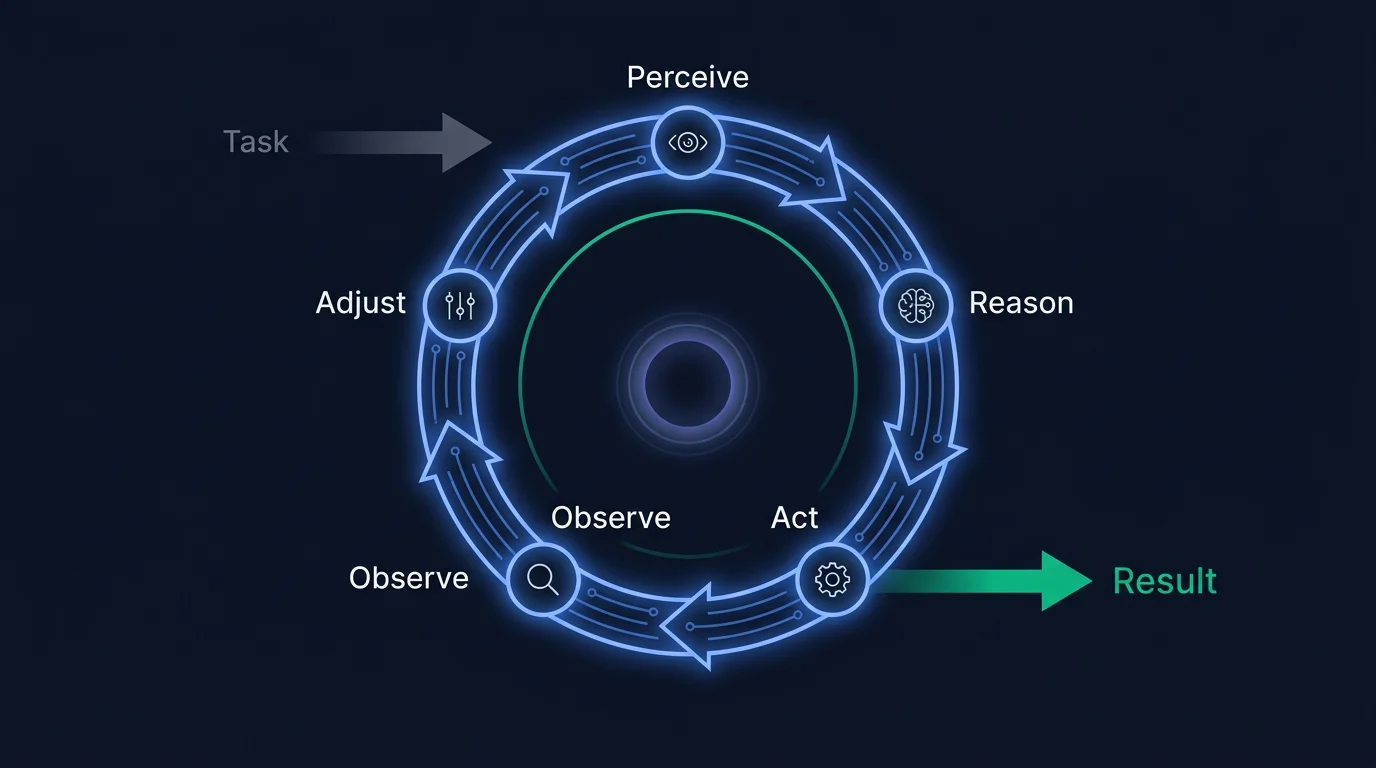 The core cycle. The loop is the engine that makes an AI agent an agent.
Andrew Ng demonstrated this at the Snowflake Data Cloud Summit: GPT-3.5 wrapped in an agentic workflow achieved 95.1% on the HumanEval coding benchmark, outperforming GPT-4 at 67% in zero-shot mode. The loop, not the model, is the bottleneck.
Open-Loop vs. Closed-Loop: Why Most “Agents” Are Not Agents
Most AI systems in production today are open-loop. They receive a task, execute it, and return a result. There is no mechanism for the system to learn from what happened, adjust based on outcomes, or improve the next time a similar task arrives. The loop does not close.
A chatbot that answers a question is open-loop. A coding assistant that generates code on demand is open-loop. They execute and forget.
A closed-loop system is different in a fundamental way. It observes its own outputs, compares them against some standard of success, and feeds the result back to influence future behavior. That feedback cycle is what enables compounding improvement over time.
In classical control theory, a thermostat is the textbook example. It measures actual temperature against desired temperature and adjusts accordingly. The same principle applies to agentic AI:
| Component | What it does |
|---|---|
| Measurement | What "good" looks like, defined precisely enough to detect deviation |
| Observation mechanism | Captures the outcome and generates a structured signal |
| Feedback path | Routes the signal back to influence future behavior |
| Controller | Decides how much to adjust in response to a given error signal |
An open-loop system has a fixed improvement rate of zero. Its baseline capability is what it starts with. A closed-loop system improves continuously, with each cycle building on the last.
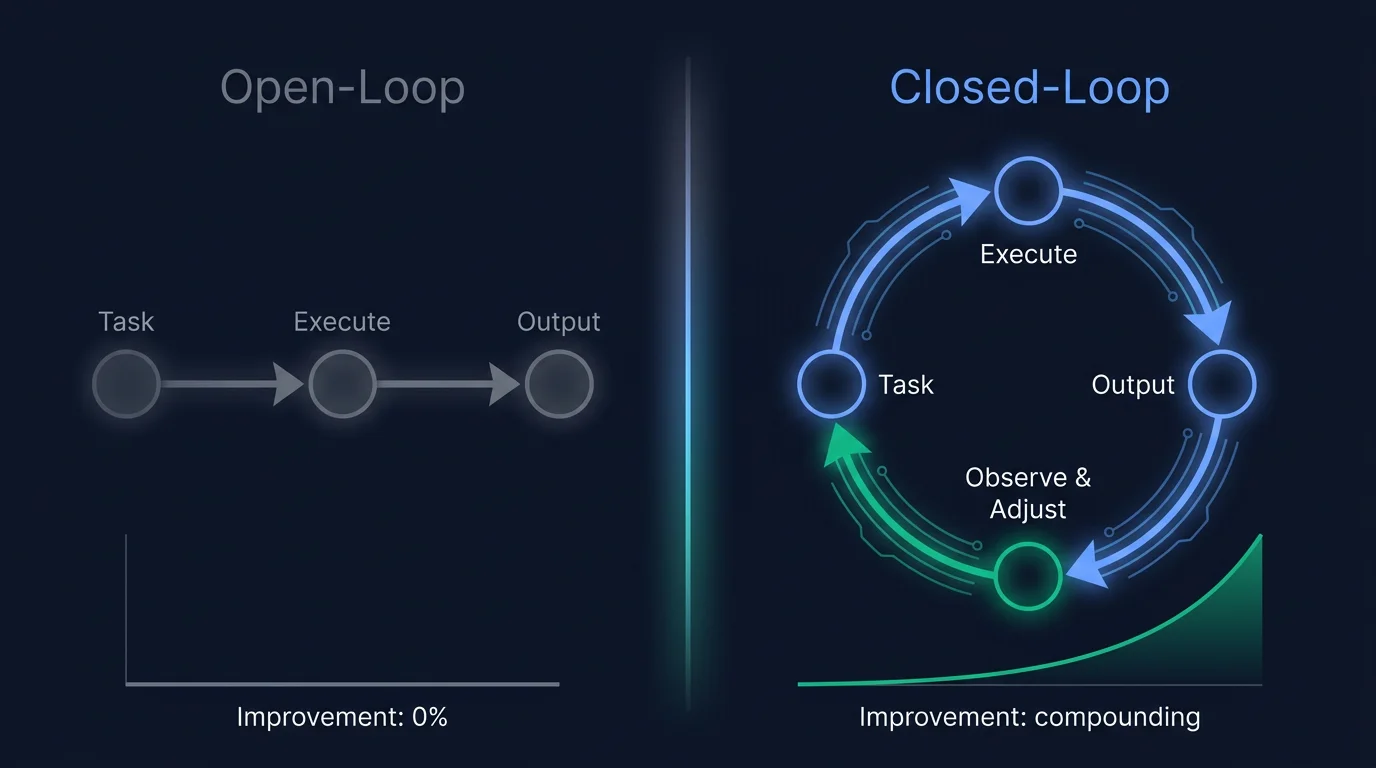 The feedback path is the difference: open-loop systems execute and forget, closed-loop systems observe and adjust
The Four Types of Feedback
A 2025 survey from the IJCAI conference categorised feedback mechanisms in LLM-based AI agents into four types. We found this framework useful when designing our own systems.
| Type | How it works | What we do at FLYTEBIT |
|---|---|---|
| 1. Internal | Agent evaluates its own output through self-reflection. Cheap and fast, but unreliable. Same blind spots as generation. | In PASSR, we use a different model for the review pass than the one that generated the initial analysis. |
| 2. External | Environment provides signals: test results, error codes, build failures. Most reliable signal in engineering workflows. | TESTR relies heavily on external feedback. Test execution results drive coverage expansion. |
| 3. Human | Person reviews, approves, rejects, or modifies output. Richest signal. Captures business logic, architectural intent, team conventions. | Primary signal in all three products. PASSR surfaces findings, DOCKR generates docs, TESTR proposes tests, all for human decision. |
| 4. Multi-agent | Other agents evaluate. 15x token overhead, but 90.2% improvement over single-agent (Anthropic). | Lightweight version: a different model evaluates the primary model's output before human review. No full swarms yet. |
Andrew Ng calls internal feedback the reflection loop. The agent asks: “Did I answer the question correctly? Is the code I wrote sound? Did I miss an edge case?” A model reviewing its own output has the same blind spots it had when generating it. A second model catching what the first missed is still internal feedback, but more reliable than self-review.
At FLYTEBIT, human feedback is the primary signal in all three products. PASSR surfaces findings for human decision. DOCKR generates documentation for human review. TESTR proposes test cases for human approval. The human is the sensor.
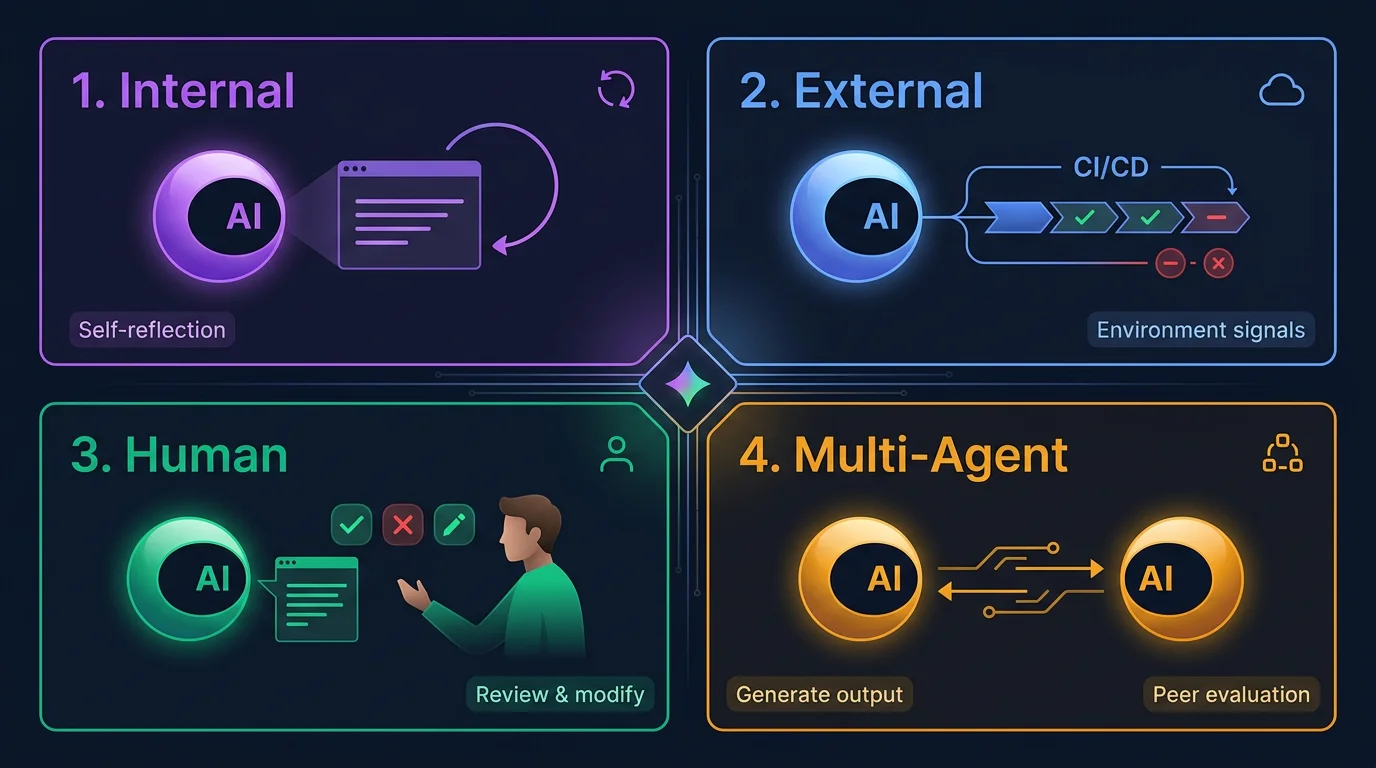 Four feedback channels with different cost and reliability tradeoffs. Most production systems combine multiple.
What We Learned Building PASSR, DOCKR, and TESTR
Practice is where you learn what actually works. Here is what we learned about feedback loops from building three agentic systems that run in production.
PASSR: Resolution tracking as a feedback loop
PASSR reviews every pull request across eight quality dimensions. The obvious feedback loop is the review itself: the agent analyses code, surfaces findings, and the developer acts on them. But the more interesting loop is resolution tracking.
When a developer pushes a fix for an issue PASSR flagged, PASSR recognises the change and resolves the issue automatically. It does not post the same comment again. This is a closed-loop system. The agent observes the outcome of its previous finding (was it fixed? was it ignored? was it challenged?), and uses that observation to update its state.
The per-issue conversation feature adds another loop. When a developer replies to a finding, PASSR answers in context. If the developer challenges the finding and PASSR agrees, that interaction is a feedback signal. It tells the system that this category of finding may need recalibration.
What we learned: the feedback signal needs to be structured. A vague “developer looked at it” is not useful. “Developer applied the suggested fix” is useful. “Developer replied with a challenge and the finding was withdrawn” is even more useful. The granularity of the signal determines the quality of the loop.
DOCKR: Incremental updates as a feedback loop
DOCKR generates documentation from code. The obvious loop is webhook-triggered: you push code, DOCKR updates the docs. But the real feedback loop is incremental processing.
DOCKR does not regenerate documentation for the entire codebase on every push. It analyses the diff, identifies what changed, and updates only the affected files. New files get documented. Modified files get regenerated. Deleted files get removed.
This is a feedback loop because the system uses the outcome of the previous cycle (what was documented last time) to determine what to do this time (what changed since then). Without persistent state, the system would start from scratch every time. With it, processing time stays bounded even as the codebase grows.
What we learned: feedback loops require memory. An agent that cannot remember what it did last time cannot improve on it. Memory is the simplest form of closed-loop feedback.
TESTR: Execution history as a feedback loop
TESTR generates unit test cases from code. The deepest feedback loop in TESTR is the learning loop.
TESTR runs approved tests in CI/CD. It tracks which tests pass, which fail, which are flaky. When a test fails, it analyses the failure, maps it back to the code, and produces a root cause explanation with a suggested fix. That failure analysis is a feedback signal. TESTR uses execution history to identify untested paths and propose new test cases.
Over time, coverage grows. The system learns which areas of the codebase are chronically failing, which modules are high-risk, and which tests have poor return on investment (slow, low catch rate). This is compounding improvement in action.
What we learned: the feedback loop needs time to compound. On day one, TESTR has no execution history. Its suggestions are based on code analysis alone. After 90 days of execution data, its suggestions are informed by patterns of failure, flakiness, and coverage gaps. The system gets measurably better, but only if you give it enough cycles to close the loop.
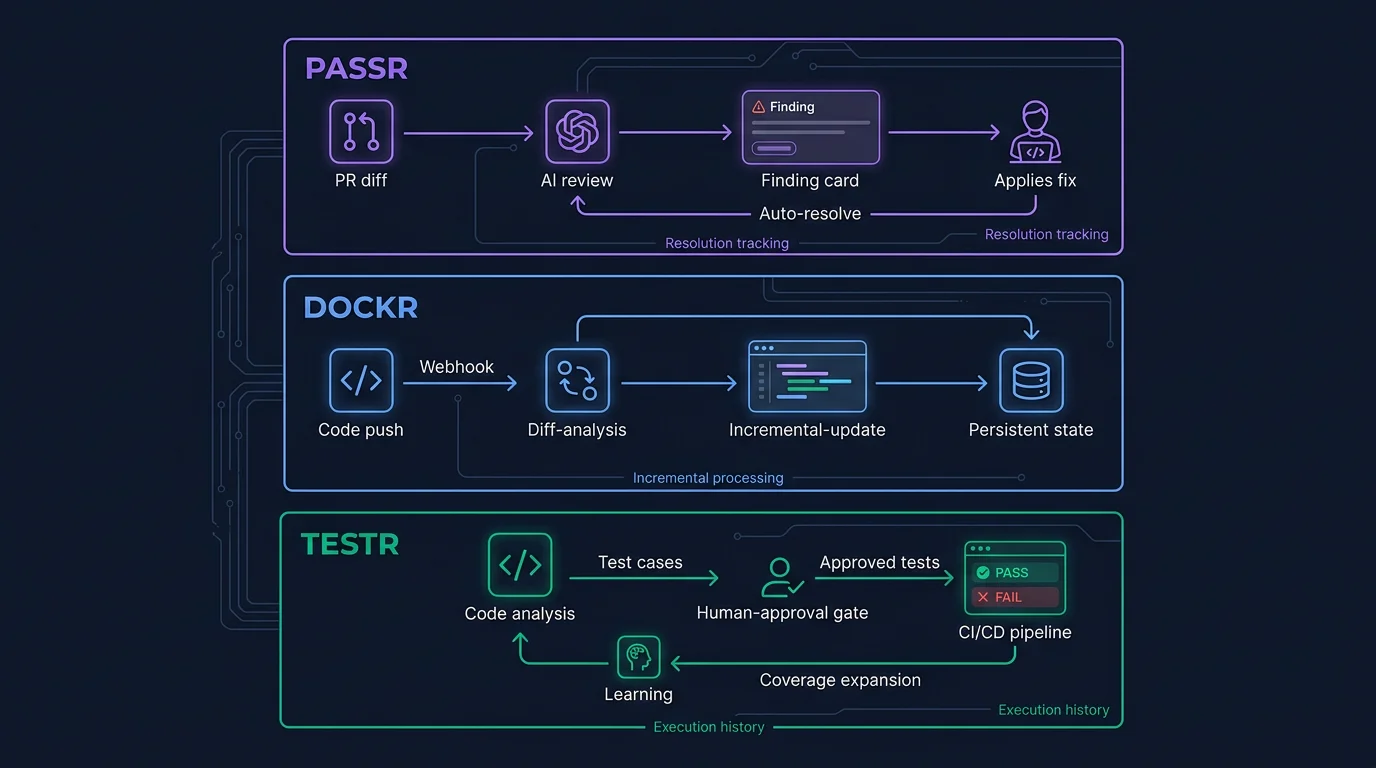 Three products, three feedback loops, one architectural pattern. Each closes the loop differently.
The Self-Improvement Flywheel
The most powerful closed-loop systems create a self-improvement flywheel:
- Agent executes task based on current context
- Human reviews output, approves, rejects, or modifies
- Feedback signal is generated from the review action
- Context is updated with what was learned
- Next task benefits from the updated context
- Quality improves, approval rate increases
- Higher approval rate means more throughput, more feedback, faster improvement
This flywheel does not require fine-tuning or special model capabilities. It requires three things:
| Requirement | What it does |
|---|---|
| Human review step | Generates a structured signal (approve, reject, modify) |
| Memory system | Captures and persists the feedback signal across sessions |
| Context system | Routes the relevant parts of memory into future tasks |
These are infrastructure requirements, not model requirements. Any capable LLM can be the engine. The architecture is what determines whether the system improves.
An agent that accumulates 90 days of feedback from a specific engineering team, their preferred patterns, their rejected approaches, their coding conventions, is effectively specialized to that team. The underlying model weights have not changed. The specialization lives in the accumulated context and feedback history. It updates continuously, costs nothing to maintain, and improves in specificity over time.
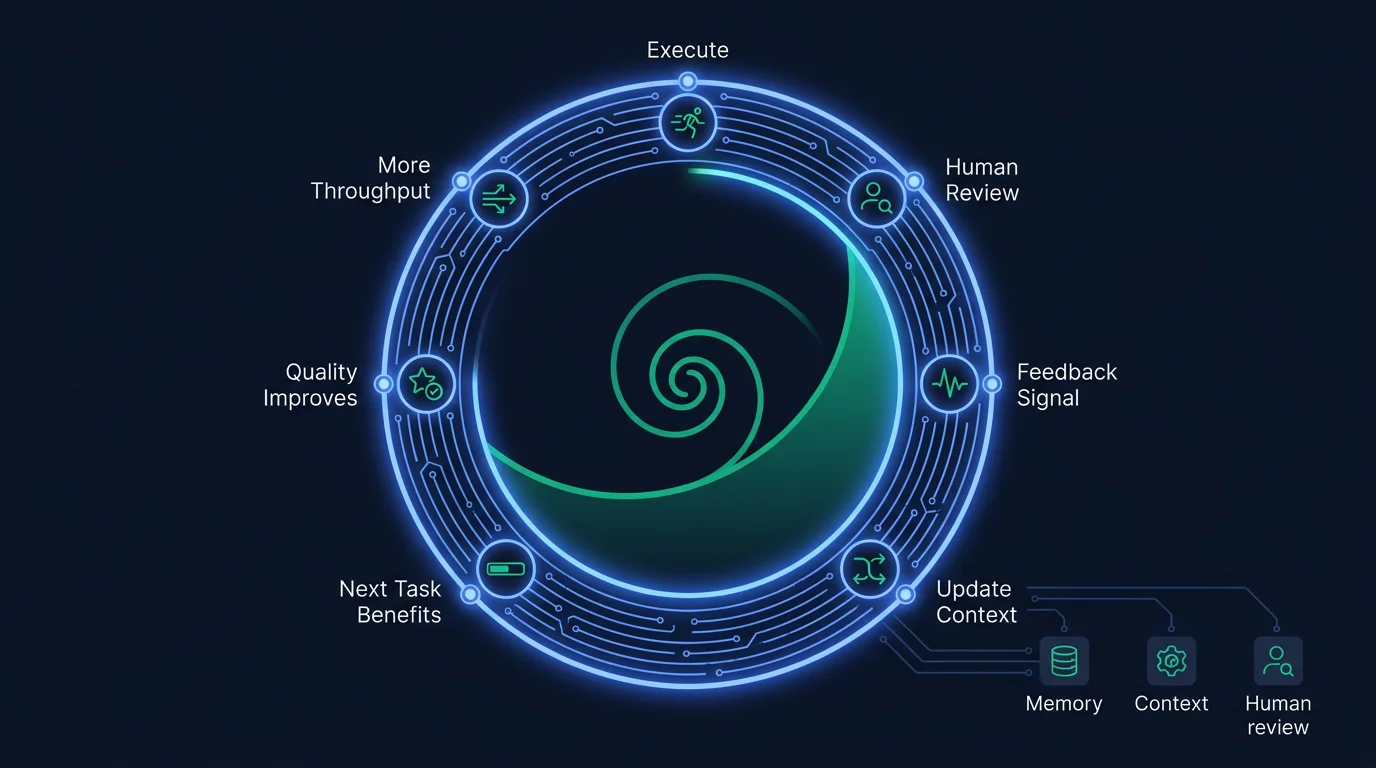 The flywheel accelerates: each cycle feeds the next, improvement compounds without fine-tuning
Failure Modes: What Happens When Feedback Loops Break
Closed-loop systems are not automatically better. They introduce failure modes that open-loop systems do not have. We have hit most of them.
Feedback noise
If the signal being fed back is noisy, inconsistent approvals, ambiguous rejections, unclear modification patterns, the system fits to noise rather than signal. The result is worse performance, not better.
We saw this in PASSR early on. Developers would dismiss findings without reading them. The system interpreted dismissals as “this finding was wrong” and started suppressing similar findings. We had to distinguish between “developer reviewed and disagreed” and “developer clicked dismiss without looking.” The fix was to require a reason for dismissal.
Metric gaming
A closed-loop system improves toward whatever is measured. If the measured signal does not track what you actually care about, the system improves the metric while real quality stays flat or declines. Goodhart’s Law applied to agentic systems.
In TESTR, if we improved purely for “number of tests generated,” the system would produce shallow tests that cover surface paths and miss edge cases. We had to measure what matters: failure catch rate, coverage of error paths, flakiness ratio. The metric you feed back determines what the system becomes.
Oscillation
Poorly tuned feedback systems can oscillate. Overcorrect in one direction, then overcorrect back. In agentic contexts, this looks like a system that swings between being too conservative and too aggressive, never settling at the right calibration.
We experienced this with PASSR severity scoring. Early versions would over-score findings after a security incident, then under-score after developers complained about false positives. We had to decouple severity scoring from recent feedback history and anchor it to the CWE taxonomy instead.
Cold start
Open-loop systems are competitive on day one. Closed-loop systems need time to accumulate feedback. In some contexts, short-term projects, infrequent use, the closed-loop system may never get enough cycles to close the gap.
DOCKR handles this by providing strong baseline documentation on the first run. The feedback loop improves it from there. If the first run is useless, nobody comes back for the second. The cold start problem is real, and the answer is to make the open-loop baseline good enough that users return to let the loop close.
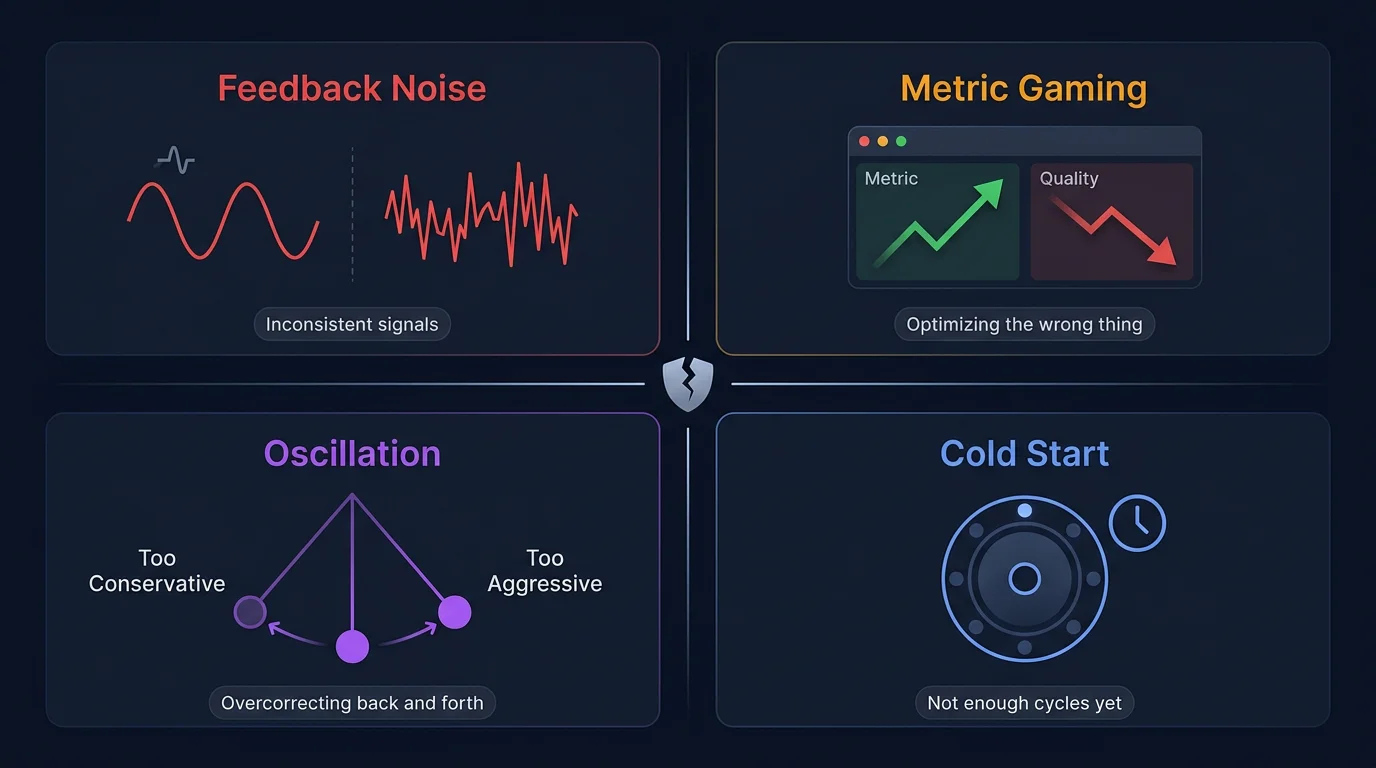 Four ways the architecture that enables improvement also enables failure. Each failure mode comes from a misaligned feedback signal.
Human-in-the-Loop as the Primary Feedback Signal
This is the most important design decision we made across all three products, and it comes from a principle that took us time to internalise.
AI should surface issues for human decision. It should not auto-fix and push.
When a tool automatically rewrites code and commits it, two things happen. First, the developer never learns why the original code was problematic. Over time, this erodes engineering capability. Second, auto-fixes bypass the review and approval process that exists for a reason.
The same principle applies to feedback loops. If the agent auto-applies feedback without human review, it can chase the wrong thing. It can fit to noise. It can game the metric. The human review step is what keeps the feedback signal honest.
| Product | Human decision point |
|---|---|
| PASSR | Human decides whether to apply a fix |
| DOCKR | Human reviews generated documentation |
| TESTR | Human approves test cases before they run |
The human is in the loop because human judgment is the highest-quality feedback signal available, and the one that keeps the other signals honest.
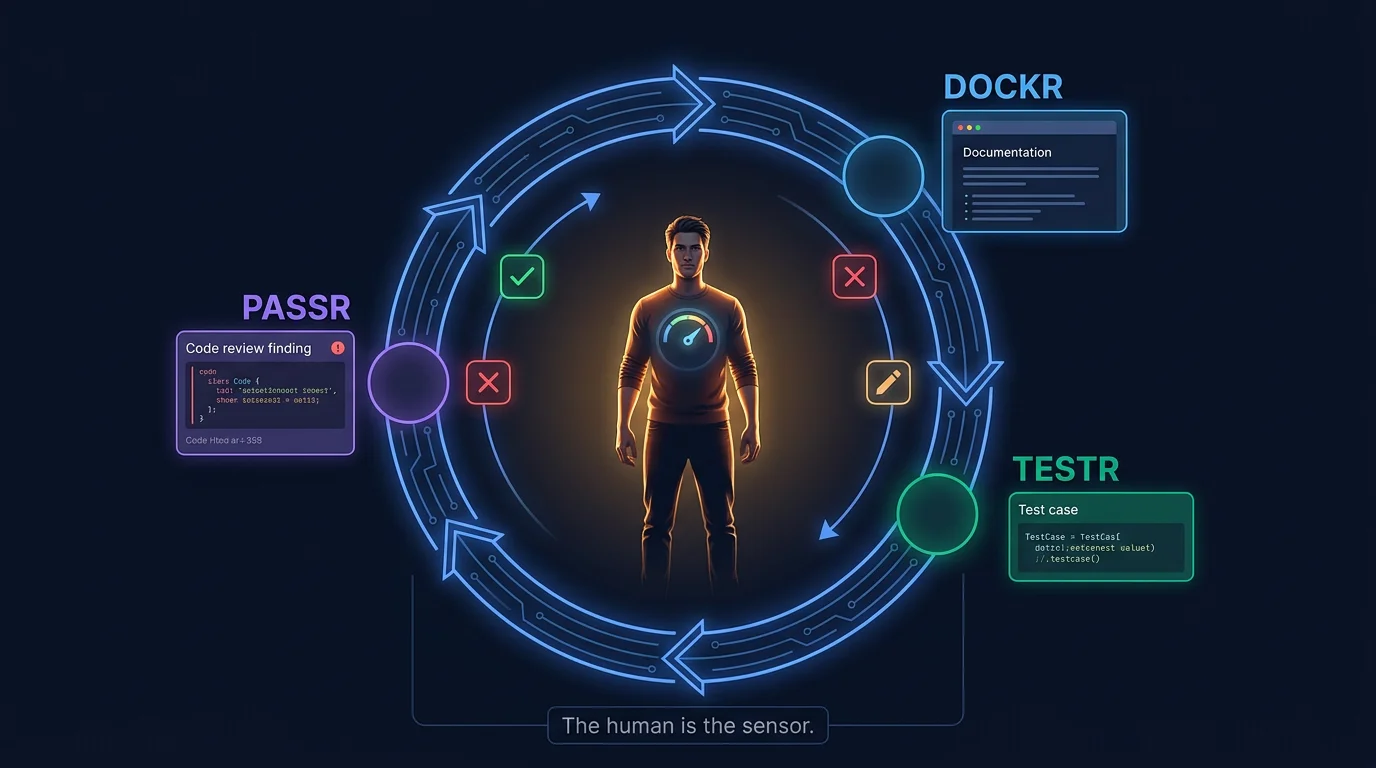 The human is the sensor, not a bottleneck. The highest-quality feedback signal that keeps the other signals honest.
Key Takeaways
- The loop is what makes an agent an agent. Without feedback, an AI system executes and stops. With feedback, it observes, adjusts, and improves. The loop, not the model, is the bottleneck.
- Closed-loop systems compound. Open-loop systems do not. An open-loop system cannot improve beyond its starting point. A closed-loop system gets measurably better with each cycle, given enough time and a clean signal.
- Four types of feedback exist. Internal (self-reflection), external (environment signals), human (review and modification), and multi-agent (peer evaluation). Most production systems combine multiple types.
- Feedback loops require memory. An agent that cannot remember what it did last time cannot improve on it. Memory is the simplest form of closed-loop feedback.
- Human feedback is the primary signal. It is the richest, the most honest, and the one that keeps other signals from gaming the system. Human-in-the-loop is not a bottleneck. It is a sensor.
- Failure modes are real. Feedback noise, metric gaming, oscillation, and cold start are problems that open-loop systems do not have. The architecture that enables improvement also enables failure if the signal is wrong.
Related Reading
Learn how agents work under the hood:
The five core components of agentic systems and what makes them different from the AI tools you are already using.
Why this matters now:
Why the next two to three years will separate the teams that automated their full pipeline from the teams that only automated one link in it.
See feedback loops in action:
👉 AI Code Review: From Nice-to-Have to Mission-Critical
How PASSR uses feedback loops for resolution tracking, incremental re-review, and per-issue conversation.
Working With Flytebit
At FLYTEBIT TECHNOLOGIES, we build agentic AI systems that run in the background so your team can focus on what matters. See how agentic AI systems work across the full development pipeline.
PASSR is our AI code review tool. DOCKR is our AI documentation generator. TESTR is our AI test generation platform. All three are built around closed-loop feedback architectures with human-in-the-loop governance.
If you need AI software development services that cover the full pipeline, from strategy to deployed agents, start with a conversation.
Ready to get started?
- Visit us at: flytebit.com
- Follow FLYTEBIT TECHNOLOGIES on LinkedIn for insights and updates
- to discuss your specific use cases
Frequently Asked Questions
What role do feedback loops play in agentic AI systems?
Feedback loops are what make an AI agent agentic. Without a feedback loop, an AI system executes a task and stops. With one, it observes the outcome, compares it against a success standard, and adjusts its next action. This cycle, perceive, reason, act, observe, adjust, is what gives agents autonomy, reliability, and the ability to recover from failure. A well-designed feedback loop compounds over time, meaning the system gets measurably better with each cycle rather than degrading.
What is the difference between open-loop and closed-loop agentic AI?
An open-loop agent receives a task, executes it, and returns a result. It has no mechanism to learn from what happened or adjust based on outcomes. A closed-loop agent observes its own outputs, compares them against a standard of success, and feeds the result back to influence future behavior. Open-loop systems cannot improve beyond their starting point. Closed-loop systems compound, getting better with each cycle. The feedback path is the single biggest determinant of whether an agentic system improves over time.
What are the types of feedback in agentic AI systems?
Research identifies four types: internal feedback, where the agent evaluates its own output through self-reflection; external feedback, where the environment provides signals like test results or error codes; human feedback, where a person approves, rejects, or modifies the output; and multi-agent feedback, where other agents in the system provide evaluation. Most production systems combine multiple types. At FLYTEBIT, our products use human feedback as the primary signal, with external feedback from CI/CD pipelines and test execution as a secondary layer.
How does FLYTEBIT use feedback loops in its products?
PASSR uses feedback loops through resolution tracking, incremental re-review, and per-issue conversation. When a developer applies a fix, PASSR recognises the change and resolves the issue. DOCKR uses feedback loops through webhook-triggered incremental updates, processing only what changed on each push. TESTR uses feedback loops through execution history, failure analysis, and coverage expansion, learning from each test run to propose new test cases for untested paths.

Ready to Transform Your Business with AI?
Let's discuss how Agentic AI and intelligent automation can help you achieve your goals.