
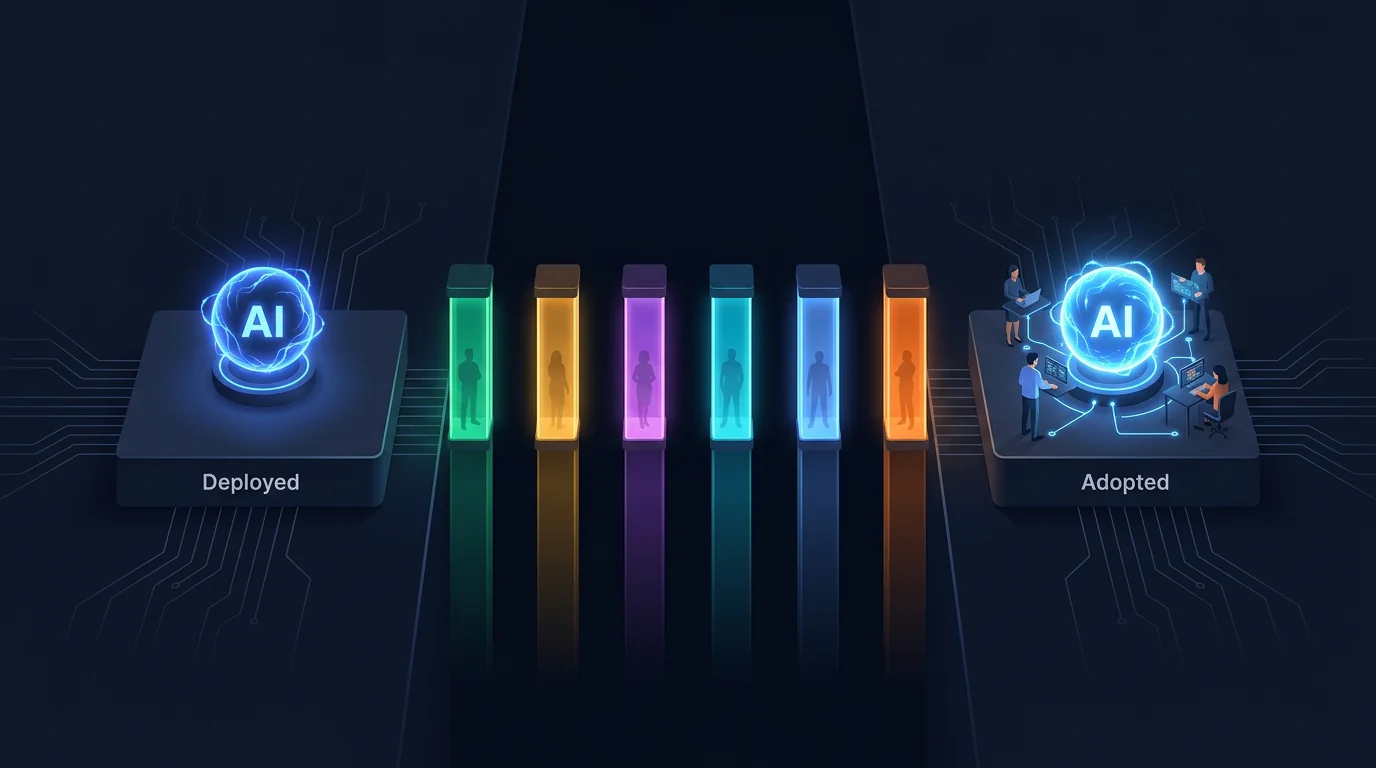
AI is deployed in 57% of enterprises today, up from 35% one year ago. That sounds like progress until you see the other number: only 11% of those organizations have achieved both of their top two AI objectives. (Kyndryl 2026 People Readiness Report)
HCLTech’s 2026 Enterprise AI Market Report found that 43% of major AI initiatives are expected to fail. (HCLTech, May 2026) MIT’s Project NANDA reviewed more than 300 publicly disclosed enterprise AI initiatives and found that 95% of pilots delivered no measurable profit and loss impact. (MIT Project NANDA, 2025)
The technology is not the bottleneck. BCG’s research found that in successful AI-driven transformations, 70% of the value comes from people-related action, not technology-related action. (BCG, 2026) Gartner identified poor change management as a standalone failure point: technically excellent tools that see minimal adoption because the deployment treated the technology as the deliverable instead of treating user behavior change as the deliverable. (Gartner, 2025)
Here is the number that should worry every CFO. BCG’s 10/20/70 principle says organizations should devote 10% of their AI efforts to algorithms, 20% to technology and data, and 70% to people and processes. Most organizations invert that ratio — they spend the majority on technology and treat change management as an afterthought. (BCG, 2024)
This post is about what that 70% actually looks like in practice. Six strategies, grounded in 2025-2026 enterprise research, that determine whether AI adoption sticks or stalls.
Why AI Change Management Hits Different
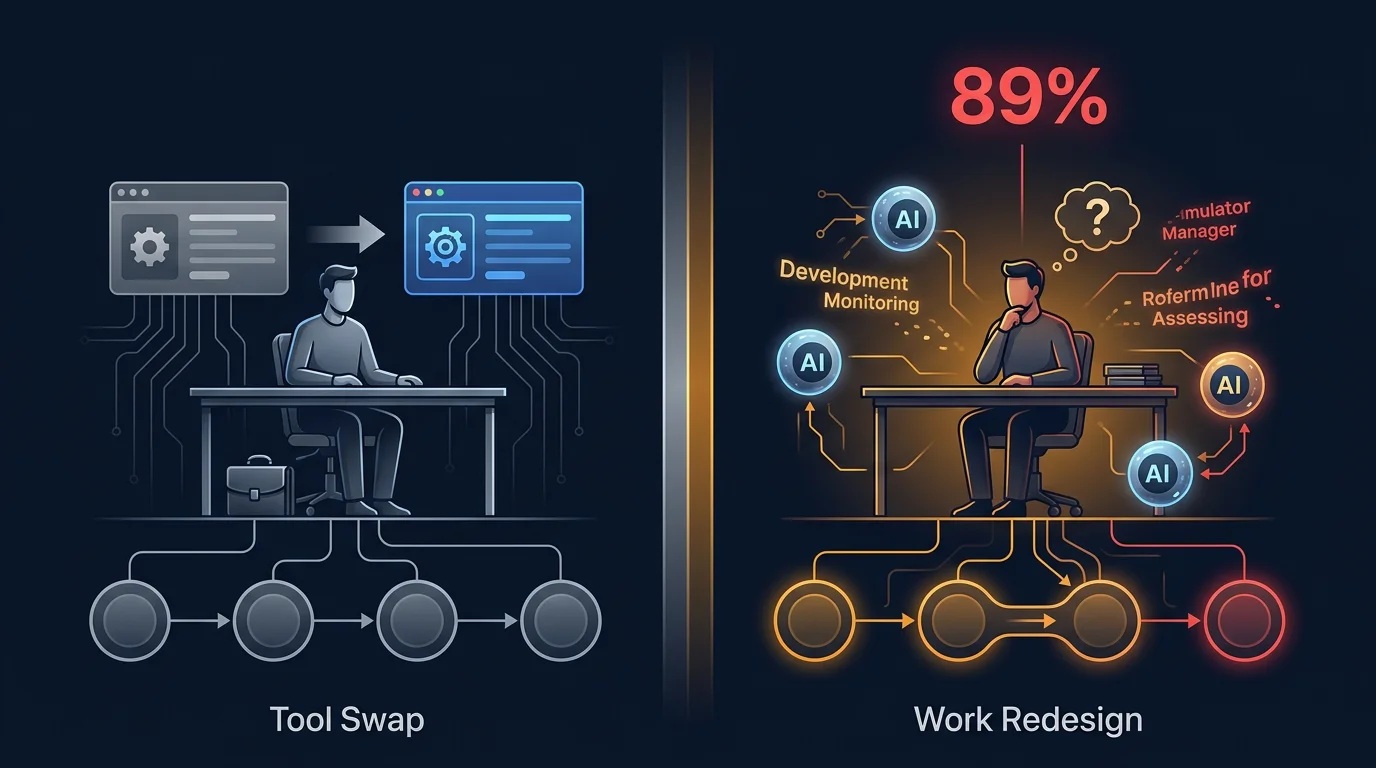 Workers fear AI as a threat to their roles. No ERP rollout ever generated that kind of existential anxiety.
ERP and cloud migrations were about tool replacement. The tool changed, the workflow stayed mostly the same, and people adapted to a new interface. AI is different. It changes who does the work, how decisions get made, what roles exist at all, and how success gets measured.
Workers perceive AI as a direct threat to their roles and careers. The fear is not about learning a new interface. It is about whether the job still exists. No ERP rollout in history generated that kind of existential anxiety. You cannot apply a training-and-communications playbook built for a systems migration to a threat perceived at this level.
The middle layer of the organization has the most to lose and the most power to quietly kill the initiative. McKinsey’s research on generative AI adoption found that middle managers are often the most resistant to change because of rational self-interest: they are busy and their current methods work reasonably well. The learning curve feels daunting on top of that. (McKinsey, 2025) This resistance is rational. It is a response to a system that rewards current output over adoption of a tool that, in the short term, slows them down. You cannot train it away with a lunch-and-learn.
BCG also identified the “false alignment” problem. Leaders agree on “we should do AI” but have not resolved the underlying trade-offs. The CEO wants innovation. The CFO wants cost reduction. The COO wants operational efficiency. They all nod in the same meeting and pursue different agendas afterward. (BCG, 2026)
Strategy 1: Align Executives Before You Pick a Tool
 Successful organizations pick 3-4 use cases. Unsuccessful ones pick 6-7.
BCG’s research shows that successful companies prioritize 3-4 AI use cases on average, compared to 6-7 for unsuccessful organizations. (BCG, 2026) The pattern is consistent. Organizations that try to do everything get nothing done. Organizations that pick a few critical workflows and go deep are the ones that produce measurable value.
Breaking false alignment requires more than a vision statement. It requires leaders to resolve trade-offs explicitly. If the goal is cost reduction, say that. If the goal is innovation and new capabilities, say that. If the goal is both, acknowledge the tension and decide which one gets priority when they conflict.
The real test of commitment is resource reallocation. Top talent and budget must move toward the prioritized use cases. BCG found that tough reallocations of funding and resources, including top talent, are commonly required when leaders have announced AI as a top priority. (BCG, 2026) If your best engineers are still working on legacy maintenance, the AI initiative is not actually the priority regardless of what the press release says.
HCLTech’s report found that nearly half of enterprise leaders expect measurable value from AI investments within 9 months. (HCLTech, May 2026) That timeline leaves little margin for error. Executive alignment needs to include specific targets: which workflows, what outcomes, what timeline, who owns each one by name.
Strategy 2: Redesign Workflows, Do Not Bolt AI Onto Existing Ones
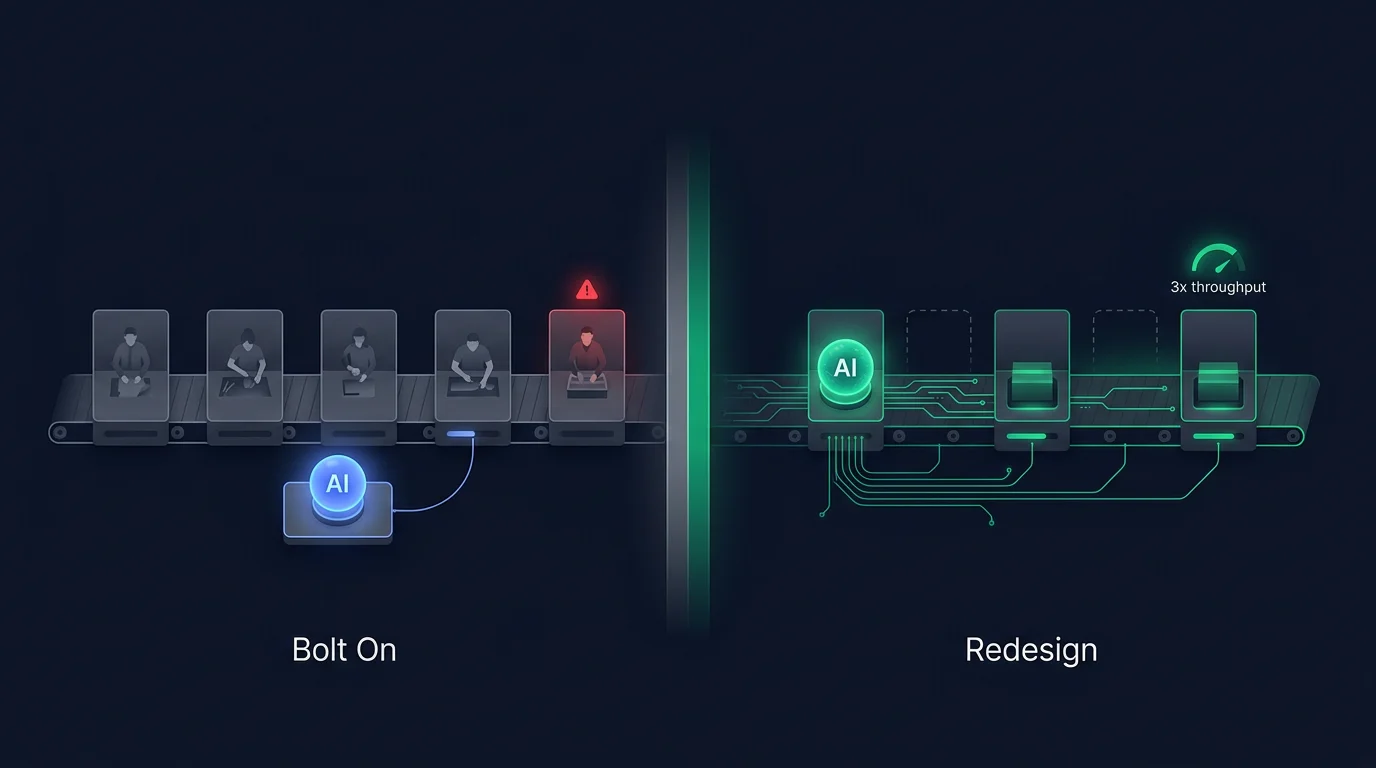 High performers are 3x more likely to have redesigned workflows before deployment.
McKinsey’s 2025 State of AI survey found that high performers are nearly three times more likely than peers to have fundamentally redesigned workflows before deployment, not after. (McKinsey State of AI, 2025) Deloitte’s 2026 AI Pulse Check found that 37% of organizations begin by fully owning one workflow end-to-end, testing it, then scaling up. Nearly half are adding AI without redesign. (Deloitte, 2026)
The gap between these two approaches is the gap between transformation and expensive sidecar. The issue goes beyond slower execution. Organizations still running AI on pre-AI process maps face structurally higher costs and less flexibility as competitors redesign around AI-native workflows. (Deloitte, 2026)
McKinsey recommends a “two-in-the-box” approach where business and technology teams co-own the redesigned workflow. Business teams ensure the new working mode delivers expected business results. Technology teams ensure the technical architecture is feasible. (McKinsey, 2025)
What workflow redesign actually looks like: map every decision point in the current process, then ask the following for each step:
- Does this step exist only because humans were slow? If AI can do it faster without quality loss, eliminate or automate it.
- Does this handoff exist only because context got lost between people? If AI preserves context across stages, collapse the handoff into a single flow.
- Does this review layer exist only because volume was unmanageable? If AI handles first-pass triage, narrow the human review to judgment calls only.
- Does this approval gate exist only because no one trusted the upstream quality? If AI improves upstream quality, remove the gate or convert it to an exception-only check.
Eliminate the steps that no longer serve a purpose. Redesign the remaining steps around what AI does well and what humans do well.
A concrete example. In a traditional PR review workflow, a human reviewer reads every line of every PR: syntax, style, security, architecture, correctness. When AI tools triple output volume, that review model breaks. Rubber-stamping becomes the coping mechanism. Rubber-stamped code is the risk vector. The redesigned workflow splits the review: automated tooling handles first-pass triage (syntax, security vulnerabilities, style violations), and human reviewers focus on architecture, outcome judgment, correctness reasoning, and edge-case handling. The human review becomes higher-value because the noise has been filtered out.
Strategy 3: Activate Middle Managers, Do Not Just Train Them
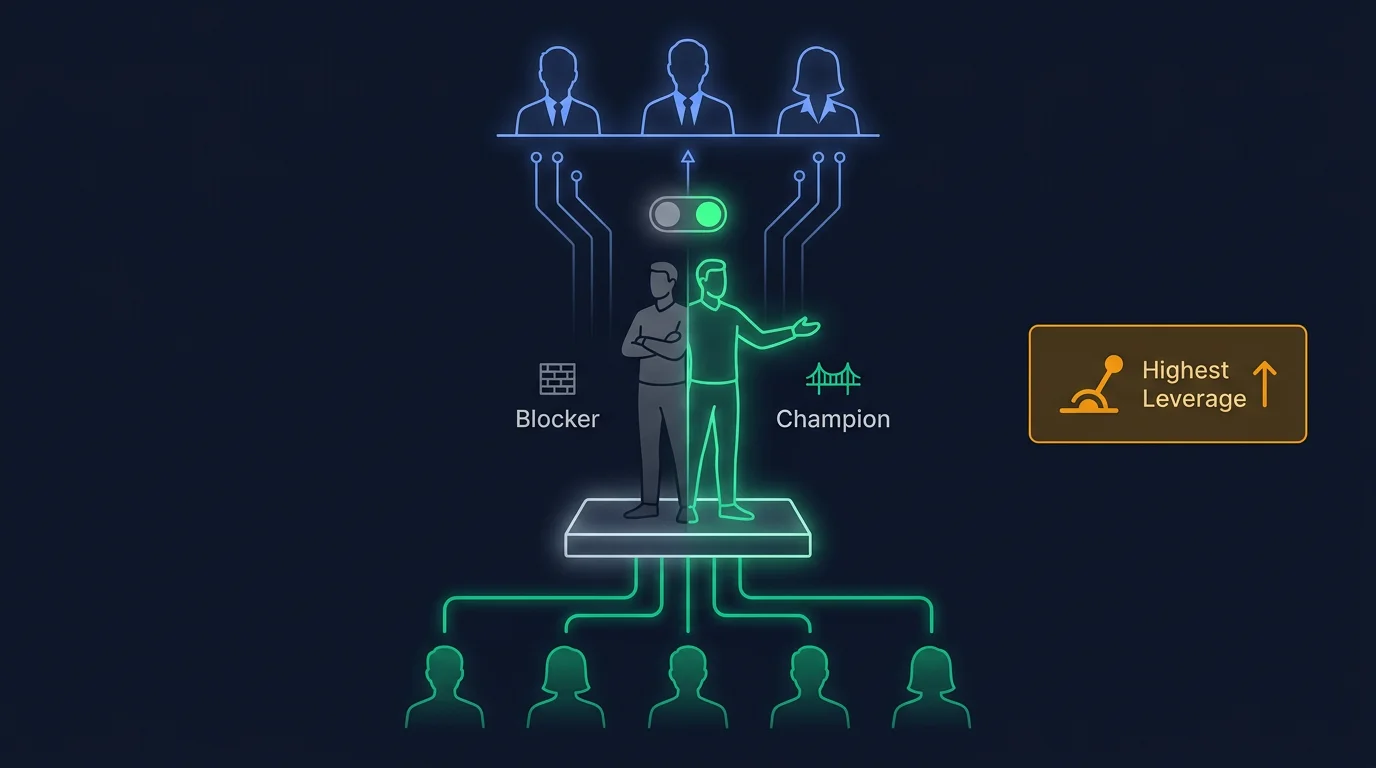 Middle managers are both the primary blockers and the highest-leverage intervention point.
McKinsey identifies manager role-modelling as the highest-leverage leadership intervention in AI adoption. (McKinsey, 2025) Yet this layer receives the least structured support in most AI change programs.
The resistance is rational. Middle managers are busy. Their current methods work. The learning curve slows them down in the short term. And their role may shrink as AI takes over coordination and administrative work. BCG notes that AI fundamentally changes the manager’s equation: it streamlines coordination and reduces administrative workloads, shifting managers from managing process toward making higher-value decisions about substance. (BCG, 2026)
The activation approach is to give managers agency in designing the new workflows for their teams. BCG found that managers need meaningful agency in designing AI-enabled workflows precisely because their own roles are the most significantly disrupted. (BCG, 2026) When managers design the new workflow, they own the outcome. When it is designed for them, they route around it.
Specific practices that work:
- Managers use AI tools visibly in team meetings. Demonstrate, do not just advocate.
- Frame AI as capability expansion, not headcount reduction. Language shapes culture at the team level.
- Create psychologically safe spaces for experimentation. Explicitly permit mistakes during the learning period.
- Report upward on what is and is not working. Middle managers are the most valuable feedback channel in any AI rollout.
Strategy 4: Design Graduated Autonomy With Intentional Boundaries
 81% expect AI agents to make impactful decisions within a year. Only 33% have policies defining what AI can decide.
Kyndryl’s 2026 report found that only 33% of organizations have established clear policies defining which decisions AI can and cannot make. 81% expect AI agents to make impactful business decisions within the next year, but only 25% completely trust AI systems operating without human oversight. (Kyndryl 2026)
That trust gap sits directly in the path of any agentic AI rollout. BCG describes a graduated autonomy model with four tiers: shadow mode, supervised mode, guided autonomy, and full autonomy. Each tier is earned through demonstrated performance, and each requires clear measurement. (BCG, 2026)
The governance challenge goes beyond how much autonomy to allow. The real question is whether the boundaries were intentionally designed or whether they are emerging by default as teams experiment. Deloitte found that a combined 69% of respondents sit at the most conservative end of AI autonomy: either no AI autonomy at all, or limited to low-risk, reversible actions. Only 12% report the most mature state, where AI can run end-to-end and humans audit outcomes rather than approve each step. (Deloitte, 2026)
Governance that enables speed rather than blocking it requires:
- Pre-approved patterns that teams can use without individual review. If a use case fits an approved pattern, it proceeds without a governance committee meeting.
- Clear risk tiers that match oversight intensity to actual risk. A low-risk internal summarization tool should not require the same review as a customer-facing autonomous agent.
- Automated compliance checks built into the platform rather than manual review processes.
The accountability gap is where enterprise risk quietly builds. Autonomy expands one use case at a time, but controls and escalation paths lag behind. Most leaders only see the gap clearly when an exception, failure, or audit forces the issue. (Deloitte, 2026)
Strategy 5: Build Capability Through Practice, Not Slides
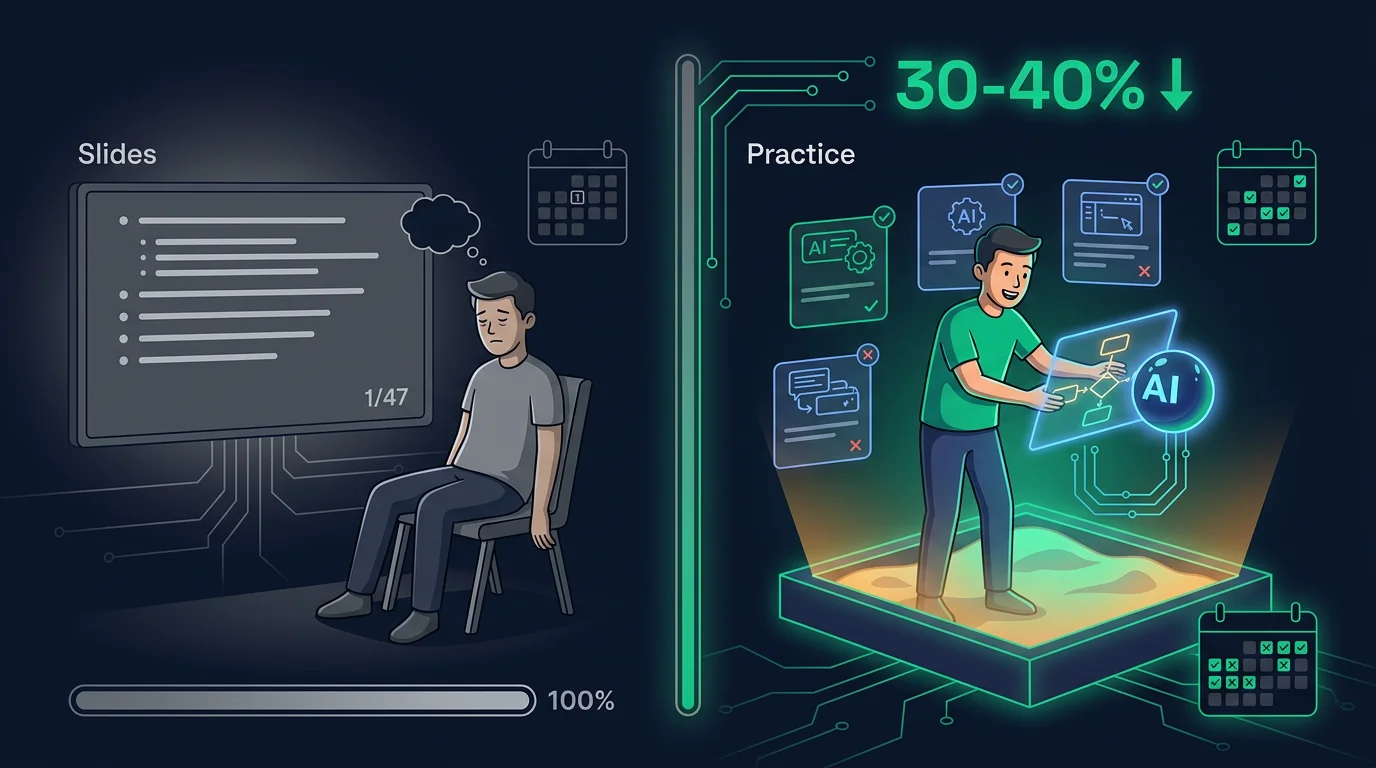 Role-specific training with safe experimentation reduces implementation time by 30-40%.
Kyndryl’s data shows that 61% of organizations have already redesigned roles to support AI adoption, and 24% are creating new AI-focused management positions. Yet only one-third have fully implemented employee training programs focused on working alongside AI tools. (Kyndryl 2026) Role redesign is outpacing the skills development needed to make it stick.
One-time upskilling sessions are not enough. AI capability building must be continuous because AI capability requirements shift faster than any other technology category in enterprise history. Research on AI organizational change consistently identifies continuous learning, strategic communication, and leadership involvement as the top three predictors of success.
Role-specific training that includes safe experimentation environments reduces implementation time by 30-40% compared to generic training approaches. The difference is significant in terms of retention and applied value. Generic training teaches people what buttons to press. Role-specific training teaches people how to solve problems with AI as a component.
Three resistance archetypes require different interventions. Treating all resistance as the same is the most common change management mistake:
- Job displacement fear requires transparency about role evolution, not vague reassurance. People need to know what their role becomes, not that "AI will not replace you."
- Algorithmic distrust requires governance visibility. People need to see the guardrails, not just be told they exist.
- Skill anxiety requires structured practice environments where people can fail safely before stakes are real.
The AI capability index is a practical tool: a recurring measurement of AI proficiency by role, updated quarterly, tied to development planning. It tracks whether capability is building or decaying, and it catches skill atrophy before it becomes a production incident.
Strategy 6: Measure Behavior, Not Logins
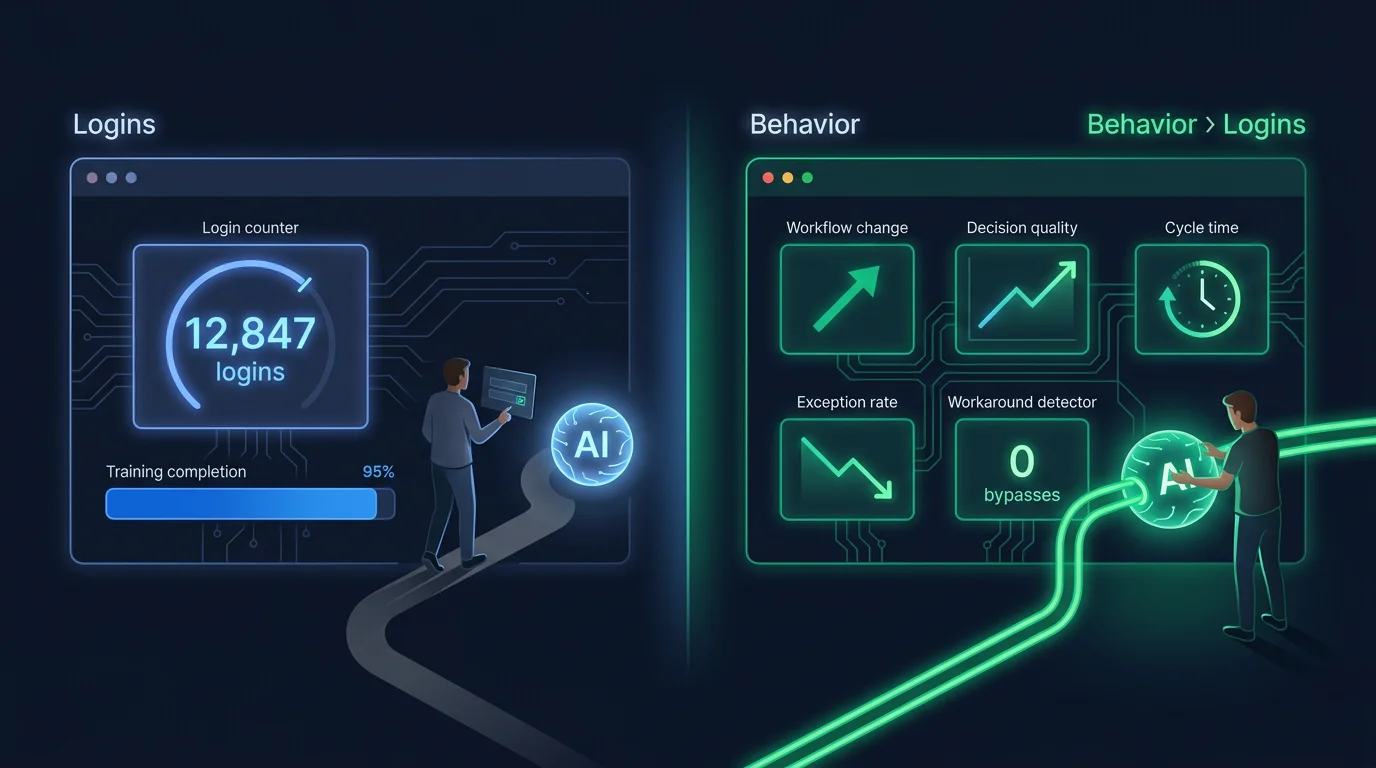 The gap between AI access and AI adoption is where ROI lives or dies.
Login metrics and training completion rates are misleading adoption proxies. The difference between organizations that capture value from AI and those that do not comes down to who has changed how they work, not who has access.
Compliant use is not genuine adoption. An employee who logs into the AI tool once a week to satisfy a mandate but routes around it for real work is not adopting anything. They are performing adoption. The behavioral difference between compliant use and genuine adoption is what determines whether AI investment delivers its projected ROI.
What to measure instead:
- Workflow behavior change: Are decisions being made differently? Are handoffs happening through the AI system or around it?
- Decision quality with AI assistance: Are outcomes improving where AI is involved, or staying the same?
- Cycle time changes: Is work moving faster, or is the AI layer adding overhead?
- Exception rates: How often do people override the AI? Is that rate going down over time as trust builds?
- Workarounds: Are people finding ways to bypass the AI system? That is the clearest signal that adoption is surface-level.
Deloitte’s framework distinguishes between adoption metrics and transformation metrics. Adoption metrics track whether people are using the tool. Transformation metrics track whether AI is changing what is possible in the workflow: decisions, handoffs, cycle time, and quality. (Deloitte, 2026) The first tells you the tool is live. The second tells you it is working.
The Pacesetter Pattern: What the 9% Do Differently
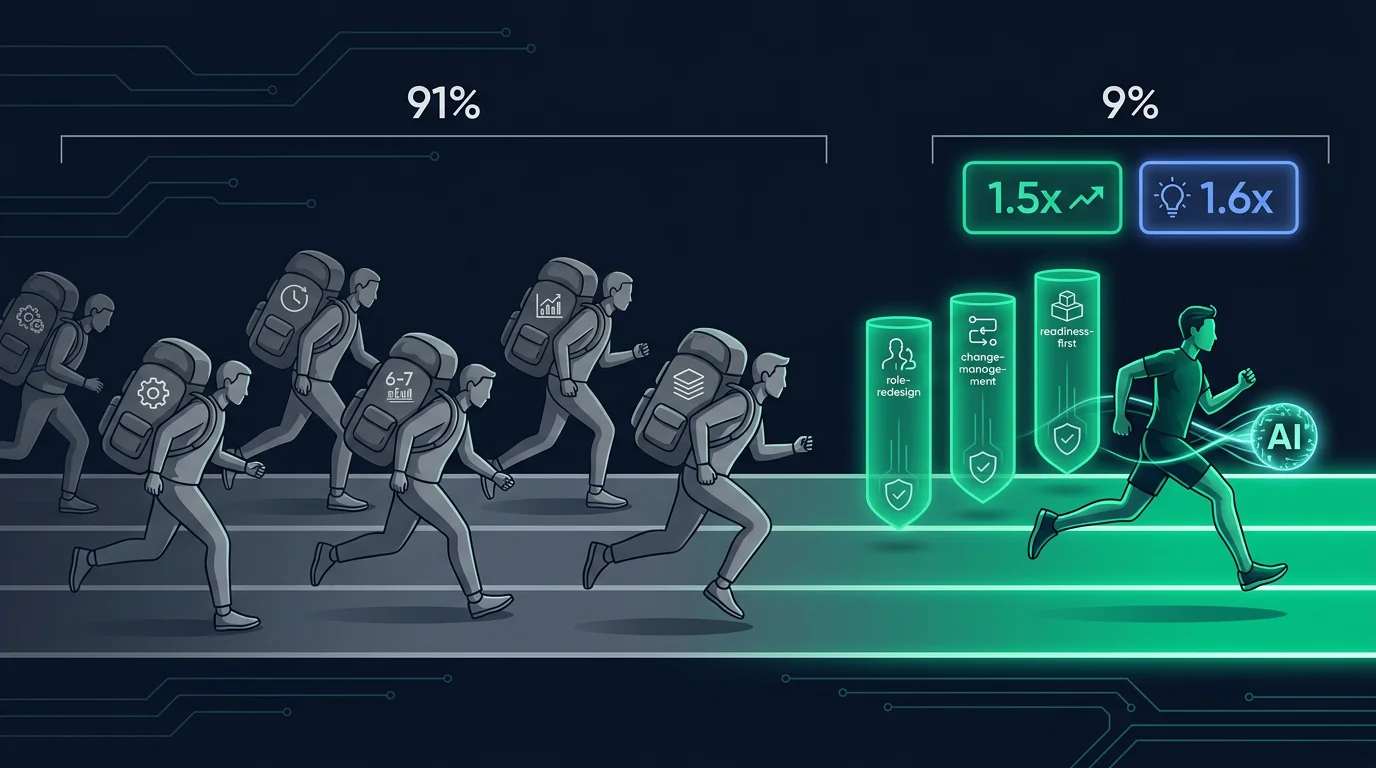 Pacesetters are 1.5x more likely to see AI revenue growth and 1.6x more likely to report improved innovation.
Kyndryl’s report identifies a cohort it calls Pacesetters, roughly 9% of survey respondents, who are converting AI investment into measurable business results. These organizations share three operational behaviors: they redesign roles around AI rather than adding AI capabilities to unchanged job structures, they implement structured change management so employees understand the new operating model, and they invest deliberately in workforce readiness before scaling deployment. At each stage, they also build governance frameworks that help employees trust and adopt AI. (Kyndryl 2026)
The performance differential is concrete. Pacesetters are 1.5 times more likely to achieve AI-related revenue growth and 1.6 times more likely to report improved innovation in products and services. They are also approximately twice as likely to have fully implemented every governance dimension the study measured compared to peers. (Kyndryl 2026)
The sequencing that works: readiness first, then targeted deployment, then scale. Not the reverse. Organizations that deploy first and try to build readiness after are the ones in the 89% who have AI deployed but no outcomes to show for it.
Accenture’s 2026 research converges on the same conclusion. The winners will not be the organizations that deploy AI the fastest. They will be the ones that combine technology, work redesign, workforce transformation, and governance to realize enterprise-wide value. (Accenture, 2026)
Working With Flytebit
At FLYTEBIT TECHNOLOGIES, our Vibe Coding Transformation engagement is structured around the Pacesetter pattern. A two-stage process: feasibility study first (readiness assessment, role mapping, process health, codebase health, developer readiness, infrastructure blockers), then transformation engagement (role redesign, requirement precision, QA evolution, governance model design, metrics transition from activity to outcomes).
Two of our products directly support the strategies in this post. PASSR automates the first-pass review layer so human reviewers focus on architecture and correctness, which is the workflow redesign in Strategy 2 made operational. DOCKR eliminates documentation debt by auto-generating and auto-updating docs with every PR merge, which addresses the capability gap in Strategy 5 by removing a task that nobody wants to do and AI does well.
Not sure where your organization stands today? The Vibe Coding Transformation Readiness Quick Check takes five minutes and gives you a per-function view of where your pipeline is most exposed.
Ready to get started?
- Visit us at: flytebit.com
- Follow FLYTEBIT TECHNOLOGIES on LinkedIn for insights and updates
- to discuss your specific use cases
Related Reading
On AI implementation failure patterns:
👉 The 6 Biggest AI Implementation Mistakes (And How to Avoid Them)
The patterns that cause AI rollouts to underdeliver, including the change management mistakes that are easiest to make.
On workflow redesign for developers:
👉 Vibe Thinking - The Developer Who Codes at the Speed of Thought
What actually changes in a developer’s day when AI tools are introduced, and the discipline layer that makes the pace sustainable.
On enterprise AI integration:
👉 Best Practices for Integrating Generative AI with Existing Enterprise Automation Platforms
Three integration patterns, RAG failure points, governance as architecture, and what breaks at scale. Real lessons from building DOCKR, PASSR, and TESTR.
Key Takeaways
- ✅ Deployment is not adoption: 57% of enterprises have AI deployed, only 11% are achieving their top objectives. The gap is organizational, not technical.
- ✅ Budget for people, not just tools: BCG's 10/20/70 principle says 70% of AI effort should go to people and processes. Organizations that spend the majority on technology and treat change management as an afterthought are underfunding the exact function that determines whether the other 30% produces a return.
- ✅ Redesign workflows before deployment: High performers are 3x more likely to have redesigned workflows before deployment. Bolting AI onto pre-AI process maps captures a fraction of the value.
- ✅ Activate middle managers, do not just train them: Managers are both the primary blockers and the highest-leverage intervention point. Give them agency in designing new workflows, not just training on new tools.
- ✅ Design graduated autonomy: 81% of organizations expect AI agents to make impactful decisions within a year, but only 33% have policies defining what AI can and cannot decide. Design the boundaries intentionally before they emerge by default.
- ✅ Measure behavior, not logins: Track workflow behavior change, decision quality, and workarounds, not login rates. The gap between access and adoption is where AI ROI lives or dies.
Frequently Asked Questions
What are the organizational change management strategies for AI automation adoption?
Six strategies drive successful AI adoption. First, align executives on 3-4 prioritized use cases before selecting tools. Second, redesign workflows around AI capabilities rather than bolting AI onto existing processes. Third, activate middle managers by giving them agency in designing new workflows. Fourth, design graduated autonomy tiers with clear governance boundaries. Fifth, build role-specific capability through continuous practice, not one-time training. Sixth, measure adoption behavior like workflow changes and decision quality, not login metrics. Only 11% of organizations achieve both of their top two AI objectives today. The gap between deployment and outcomes is organizational, not technical.

Ready to Transform Your Business with AI?
Let's discuss how Agentic AI and intelligent automation can help you achieve your goals.